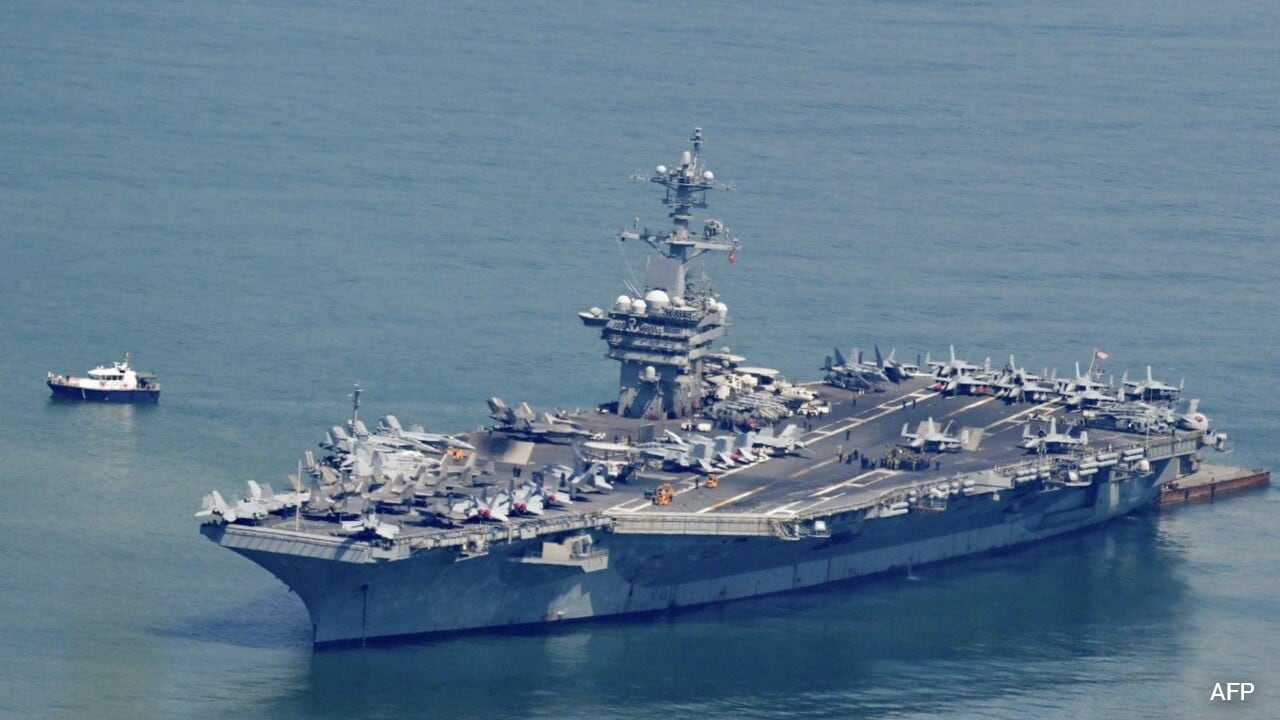
Every time a supercarrier shifts berths in the Western Pacific, defense journalists and armchair admirals panic. The current headlines screech that the departure of the USS George Washington leaves a gaping void in Asia, stripping the region of American deterrence and handing the strategic initiative to adversaries. It is a lazy, predictable narrative built on outdated 20th-century assumptions. The entire premise that a floating city of 100,000 tons represents permanent stability is fundamentally broken.
Strip away the institutional dogma and look at the actual physics of modern anti-access area denial networks. We are clinging to a multi-billion-dollar maritime relic while pretending hypersonic glide vehicles and saturation missile salvos do not exist. The carrier is not a symbol of strength in a contested littoral zone; it is a high-value, highly visible target sitting in a shooting gallery.
The Fallacy of Forward Presence
For decades, the standard playbook dictated that naval power meant hulls in the water near flashpoints. If a carrier is not parked within striking distance of the Taiwan Strait or the South China Sea, Washington insiders act as though deterrence has vanished. This line of thinking ignores how modern precision strike regimes operate.
Distance is no longer sanctuary, but proximity is no longer supremacy.
A nuclear-powered aircraft carrier carries roughly eighty aircraft. Its air wing is formidable against insurgencies or regional states lacking sophisticated air defense architectures. Against a peer adversary equipped with tiered surface-to-air missile grids and over-the-horizon targeting, that same carrier becomes a liability. Packing thousands of service members and billions of dollars in hardware into a predictable geographic box does not deter aggression; it provides a concentrated target set for modern reconnaissance-strike complexes.
When the USS George Washington moves, defense analysts mourn the loss of deck space. They measure capability by counting flight decks instead of assessing network resilience, undersea dominance, and distributed lethality.
The Myth of the Indispensable Deck
Let us address the core mechanical misunderstanding plaguing naval strategy. The worship of the carrier stems from a historical fetishization of power projection pioneered in World War II. In that era, naval aviation was the ultimate arbiter because command of the sea depended on controlling the skies above the fleet.
That calculus shifted the moment land-based anti-ship ballistic missiles gained terminal guidance.
Imagine a scenario where a conflict erupts in the Western Pacific and a supercarrier group attempts to operate within five hundred miles of hostile shores. Within hours, the carrier faces a coordinated barrage of ballistic and cruise missiles designed specifically to overwhelm Aegis defense systems. Even if ninety percent of incoming threats are intercepted, the remaining impact or near-miss renders the flight deck inoperable. A cracked catapult or a ruined arresting gear cable turns a ninety-thousand-ton airfield into a very expensive, immobile barge.
Fixating on carrier deployments blinds planners to the real deterrents: long-range strike submarines, autonomous maritime systems, and distributed land-based anti-ship missile batteries hidden across allied island chains.
The Bureaucratic Inertia of Megaprojects
Why do defense budgets continue to feed the carrier monster? The answer lies in procurement politics, industrial base preservation, and institutional inertia. Shipyards build careers, congressional districts rely on shipbuilding contracts, and admirals grew up flying off these exact flight decks. Admitting that the supercarrier era is drawing to a close requires dismantling decades of operational doctrine and budgetary priorities.
I have watched defense contractors and program managers defend bloated platforms with circular logic, claiming that because we spent a fortune building these ships, we must continue risking them in high-threat zones to justify their existence.
This is the sunk cost fallacy on a national security scale.
The defense establishment fears the political fallout of a carrier-less regional posture more than it fears the tactical consequences of losing one in combat. That is cowardice disguised as strategy.
Distributed Lethality As The Only Viable Alternative
The solution is not to find a replacement carrier to fill every berth vacated during a rotation cycle. The solution is to abandon the obsession with concentrated mass altogether.
Modern warfare belongs to the resilient, the dispersed, and the invisible. Instead of relying on floating islands that require an entire strike group just to keep them alive, power projection must pivot toward networked, unmanned, and stealthy platforms. Think of modular surface combatants equipped with containerized missile launchers, uncrewed underwater vehicles patrolling choke points, and tactical aviation operating from austere, dispersed airstrips across the First Island Chain.
A adversary cannot decapitate a naval strategy if there is no central hub to strike.
When the USS George Washington relocates, stop reading it as a retreat. Read it as a long-overdue eviction notice for an obsolete way of war. The sooner Washington stops measuring power by the square footage of its flight decks, the sooner it can build a military capable of surviving the next conflict.


