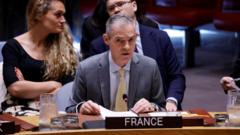
The United States delegation physically walked out of a United Nations Security Council meeting while French representatives delivered official remarks, exposing a severe rift in Western foreign policy. This abrupt departure occurred during a high-stakes diplomatic session regarding ongoing international conflicts and peacekeeping mandates, signaling a profound breakdown in consensus among permanent council members. When Washington turns its back on Paris inside the world's premier diplomatic chamber, the event transcends a mere protocol breach. It marks a systemic fracture in transatlantic alliances that have held since the end of the Second World War.
Diplomatic walkouts are rarely impulsive outbursts. They are calculated theater, meticulously choreographed to broadcast deep institutional fury without officially severing diplomatic ties. To understand why American diplomats stood up from their mahogany seats and strode out of the chamber, one must look past the immediate friction points on the agenda and examine the structural decay of multilateral institutions.
The Anatomy of a Boycott
For decades, the United Nations Security Council functioned as a clumsy yet functional valve for global pressure. When superpowers disagreed, they shouted across the horseshoe table. They vetoed resolutions. They drafted competing texts until exhaustion set in. They almost never walked out of an active presentation by an allied nation.
When the American delegation abandoned the room during the French intervention, they shattered an unwritten code of allied decorum. The underlying trigger involved a bitter dispute over sovereign mandates, humanitarian corridors, and the legal phrasing of multi-national intervention forces. Paris pushed for language that Washington viewed as a direct encroachment on bilateral security agreements negotiated outside the United Nations framework.
France has historically styled itself as an independent voice within the Western bloc, occasionally frustrating Washington by charting a distinct diplomatic course. This independent streak has periodically strained relations, but the current friction stems from a deeper operational divergence. European capitals increasingly view the United States as unilateralist and transactional. Conversely, Washington perceives European diplomacy as increasingly performative, heavy on rhetorical declarations of international law and light on the logistical and financial burdens required to enforce peace.
The walkout exposed these competing frustrations in real time. Cameras caught the swift, silent departure of senior American officials, leaving empty chairs staring directly at the French delegation. The message was unmistakable. Washington no longer felt obligated to dignify positions it deemed actively obstructive to its strategic goals.
Behind the Closed Doors of the Horseshoe Table
To grasp the weight of this standoff, one must understand the claustrophobic nature of Security Council negotiations. Draft resolutions pass through dozens of iterations, known in diplomatic jargon as blueings. Every comma is contested. Every adjective carries geopolitical weight.
In the weeks leading up to the walkout, negotiations over the deployment framework had reached a complete stalemate. France, wielding its permanent veto power, refused to back down on human rights monitoring mechanisms that the United States argued would compromise operational security on the ground. Washington wanted streamlined, unhindered authority granted to local coalition partners. Paris insisted on strict multilateral oversight anchored strictly in UN resolutions.
This is where the theoretical ideals of international law collide with the messy reality of power politics. From the American perspective, French insistence on procedural purity amounts to diplomatic obstructionism that paralyzes timely interventions. From the French perspective, American bypassing of multilateral consensus threatens to dismantle the rules-based international order altogether.
When compromise proved impossible behind closed doors, the theater shifted to the public chamber. The French representative took the floor, prepared to deliver pointed remarks criticizing unilateral force projection. Rather than sit and absorb the critique on the public record, the American team executed their exit.
The Transatlantic Trust Deficit
The ramifications of this walkout extend far beyond a single afternoon in New York. The incident accelerates a long-term erosion of trust among traditional allies. For years, analysts have pointed to the rise of multipolarity and the assertiveness of non-Western powers as the primary threats to the United Nations system. Yet, the most damaging blows are frequently self-inflicted by the traditional Western vanguard.
When permanent members of the Security Council display open contempt for one another in public sessions, smaller member states take note. The moral authority of the council depends entirely on the perception of a united front on fundamental norms. If the United States and France cannot occupy the same room during a routine debate, the institution loses its utility as a reliable arbiter of global crises.
This breakdown also reflects shifting domestic political pressures within Western democracies. Leaders in both Washington and Paris face fragmented legislatures and populist movements that reward nationalist posturing over international compromise. Accommodating an ally's security concerns domestically looks like weakness. Playing to the home crowd by standing firm against international partners yields immediate political dividends, even if it degrades long-term diplomatic capital.
The Mechanics of Multilateral Paralysis
The Security Council was designed in 1945 for a bipolar world dominated by Washington and Moscow. It was never optimized for a multipolar reality where middle powers like France assert independent global agendas while superpowers like the United States increasingly prioritize bilateral alliances and minilateral security pacts like AUKUS or regional frameworks.
When the machinery of the UN jams, states look for alternative venues. We are witnessing a systemic shift away from universal bodies toward task-specific coalitions of the willing. These ad-hoc arrangements bypass the cumbersome veto dynamics of the Security Council, but they do so at the cost of international legitimacy and transparency.
The French-American clash in New York highlights the growing obsolescence of the current council architecture. If permanent members treat the chamber as a television studio for political point-scoring rather than a workshop for genuine negotiation, the institution transitions from a peacekeeper to a spectator.
Empty seats at the horseshoe table are not just a diplomatic embarrassment. They are warning signs of a disintegrating global order where the rules of engagement are no longer written in treaty rooms, but decided by unilateral friction and strategic abandonment.