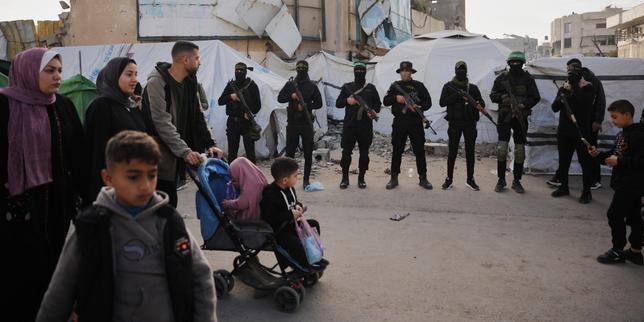
The international community loves a good fairy tale. The current favorite involves a world where a militant group like Hamas simply hands over its rifles, signs a piece of paper, and dissolves into the ether because of "pressure." It is a comforting narrative for diplomats in air-conditioned rooms in Doha or Washington, but it ignores the brutal physics of asymmetric warfare. Demanding disarmament as a prerequisite for stability isn’t just optimistic; it is a fundamental misunderstanding of how non-state actors survive.
Conventional wisdom suggests that if you squeeze an organization hard enough—blockade their borders, degrade their infrastructure, and isolate their leadership—they will eventually trade their bullets for a seat at the table. This "lazy consensus" assumes that Hamas views its military wing as a bargaining chip. It doesn’t. It views its hardware as its only life insurance policy.
The Sovereignty Trap
Mainstream analysis treats disarmament as a logistical hurdle. In reality, it is an existential impossibility for any group that defines itself through "resistance." When a state disarms a militia, it assumes a monopoly on the use of force. But in the Gaza Strip, there is no credible state actor capable of guaranteeing security for the factions that would be laying down their arms.
History is littered with the corpses of groups that disarmed too early. Look at the 1994 1994 Budapest Memorandum—though a state-level example—where Ukraine gave up nuclear leverage for "assurances" that evaporated the moment they were needed. On a sub-state level, the IRA only moved toward decommissioning after decades of stalemate and, crucially, after a political framework was built that ensured they wouldn’t be slaughtered the moment the last bunker was emptied. In Gaza, that framework is non-existent. Asking Hamas to disarm now is asking them to volunteer for an execution.
Leverage is Not a Luxury
The competitor's piece argues that Hamas is "refusing" to disarm despite pressure. This framing suggests a petulant child holding onto a toy. The reality is far colder. Weapons are the only reason Hamas is even part of the conversation. Without the Al-Qassam Brigades, Hamas is a redundant political entity with a failed governance record.
In any negotiation, you do not throw away your only source of power before you reach the goal. If Hamas disarms, they lose their seat at the table, their relevance to regional players like Iran, and their internal grip on power. The "pressure" being applied—military strikes and economic strangulation—actually increases the perceived value of every rocket and tunnel. When the world tells you that your destruction is the goal, you don't throw away your shield. You sharpen your sword.
The Counter-Intuitive Reality of Persistence
Think about the math of urban insurgency. You do not need a 1:1 ratio to remain relevant. You only need to survive. The mistake most analysts make is counting tanks and boots. They should be counting the "will to persist."
Total victory—the kind that ends in a formal surrender ceremony and a pile of confiscated rifles—is a relic of 20th-century conventional war. Modern conflict with ideological non-state actors doesn't end; it just changes state. By focusing on disarmament as the primary metric of success, Western powers are setting themselves up for a perpetual "Mission Accomplished" loop where the enemy is "defeated" every six months only to resurface in the next rubble-strewn alleyway.
Why the Current Strategy is Backfiring
The current approach assumes that suffering leads to moderation. It doesn't. It leads to radicalization and a doubling down on the military apparatus. When you destroy the civilian economy, the only employer left is the militia. When you kill the mid-level commanders, you get younger, more radicalized replacements who haven't yet learned the value of pragmatism.
The demand for disarmament is actually the greatest gift you can give to hardliners. It provides them with a permanent "No" that they can use to rally the base. It simplifies the narrative into a binary of survival versus surrender.
The Cost of Being Right
I have watched policy "experts" waste decades trying to force Western democratic norms onto groups that operate on a thousand-year-old timeline. They use words like "legitimacy" as if it’s a currency Hamas wants to spend in the halls of the UN. Hamas doesn't want Western legitimacy; they want regional dominance and survival.
The downside to this contrarian view is grim: if disarmament is off the table, the only remaining options are total annihilation—which is practically impossible and morally catastrophic—or a managed stalemate that recognizes the militia isn't going anywhere. Neither option looks good on a campaign poster.
The False Premise of "The Day After"
Everyone is obsessed with "The Day After" the war. They envision a technocratic government sweeping in to fix the plumbing while the fighters go back to being shopkeepers. This is a hallucination.
Any post-war entity that isn't Hamas will be viewed as a puppet of the occupying force if it doesn't have its own means of defense. If it does have its own means of defense, you've just traded one armed group for another. You cannot "fix" the security dilemma in Gaza through a hardware audit. You have to address the software—the underlying political reality that makes the hardware necessary in the eyes of the population.
Stop Asking for the Impossible
If you want to actually move the needle, stop asking when the guns will be handed over. Start asking what conditions would make the guns irrelevant.
Disarmament isn't the first step to peace; it's the last. It’s the final 1% of a process that starts with security guarantees, economic integration, and a political horizon that doesn't look like a dead end. Demanding it at the start is a tactical error that ensures the fighting never stops.
The world is obsessed with the "refusal" to disarm because it’s an easy headline. The harder truth is that in the current environment, disarmament is a synonym for suicide. Until that calculation changes, the rifles stay in the tunnels. Anyone telling you otherwise is selling a fantasy or doesn't understand the first thing about how power works in the Middle East.
Drop the obsession with the arsenal. Focus on the architecture of the stalemate.