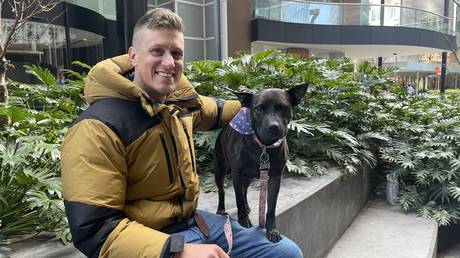
The floor of a veterinary oncology ward has a specific, clinical silence. It is a quiet punctuated only by the rhythmic clicking of claws on linoleum and the low, heavy sighs of creatures who don't understand why their bodies are betraying them. For Murphy, a golden retriever whose coat had begun to lose its luster to the dullness of disease, that silence was supposed to be final.
He had osteosarcoma. In the world of canine health, those six syllables are often a death warrant. It is an aggressive, predatory bone cancer that doesn't just take a limb; it hunts the lungs and the blood. Murphy’s family was facing the hollow reality that every pet owner eventually meets: the transition from "how do we fix this?" to "how do we say goodbye?"
But Murphy became the first subject of a radical experiment that bridges the gap between biological tragedy and computational triumph. He didn't just get a shot. He received a custom-built piece of software, translated into medicine, designed specifically for him by an intelligence that never sleeps.
The Architecture of a Mutation
Cancer is not a single entity. It is a chaotic, shifting shapeshifter. When we talk about a "cure for cancer," we are often using a linguistic shorthand that masks a terrifying complexity. Every tumor is a unique snowflake of genetic errors. Murphy’s cancer was not exactly like the cancer of the dog in the next kennel.
To fight it, doctors have traditionally used sledgehammers: radiation and chemotherapy. These treatments are effective because they kill fast-growing cells, but they are indiscriminate. They hit the villain and the innocent bystander with the same force.
The alternative is immunotherapy—training the body’s own immune system to recognize the cancer as an invader. The problem is that cancer is a master of disguise. It wears the body's own protein markers like a stolen uniform, slipping past the sentries of the immune system.
This is where the artificial intelligence stepped in.
Researchers took a biopsy of Murphy’s tumor and sequenced its entire genetic code. They also sequenced his healthy DNA. By comparing the two, they could see exactly where the "typos" in his genetic instructions were. These typos are neoantigens—tiny, specific proteins that exist only on the surface of the cancer cells.
Identifying them is a needle-in-a-haystack problem. A single tumor might have thousands of mutations, but only a handful are "visible" enough to trigger an immune response. A human researcher might spend months trying to predict which ones to target. Murphy didn't have months. He had weeks.
The Algorithmic Apothecary
The AI didn't just look at the list of mutations. It simulated them. It ran millions of permutations, calculating how Murphy’s specific immune cells would dock with these mutated proteins. It was looking for the perfect "lock and key" fit.
Think of it like a high-speed forensic artist. Based on the wreckage at a crime scene, the AI draws a perfect portrait of the suspect. It then hands that portrait to the immune system and says, "This is the one. Ignore everyone else. Find this face."
Within days, the AI had selected a tiny handful of targets. These weren't generic markers. They were Murphy’s markers. This was a "vaccine" in the same way a fingerprint is a "description." It was an instruction manual written in the language of $mRNA$ or peptide chains, telling Murphy’s white blood cells to wake up.
The stakes here extend far beyond a single golden retriever. Murphy was the scout. If an AI can map the chaotic terrain of a canine tumor and design a precision strike, the implications for human oncology are staggering. We are moving away from "off-the-shelf" medicine toward "bespoke" biology.
The Weight of the Needle
There is a profound vulnerability in being the first. When the veterinarians administered the vaccine, there were no guarantees. There was only the data, the code, and the desperate hope of a family who wasn't ready to let go.
We often fear AI as something cold and distancing. We worry it will replace the human touch. But in that exam room, the technology did something deeply human: it provided an option where there was none. It gave a name to an invisible enemy.
Consider the mechanical precision required for this to work. The AI uses deep learning architectures—specifically neural networks trained on vast datasets of protein folding and molecular binding.
$$\Delta G = \Delta H - T\Delta S$$
The software calculates the Gibbs free energy $(\Delta G)$ of the binding process, ensuring the vaccine "sticks" to the target with enough stability to be effective. It is a world of cold math serving a very warm, breathing heart.
Beyond the Clinical Trial
As the weeks passed, something happened that the statistics hadn't promised. Murphy didn't just survive; he surged. The lethargy lifted. The sparkle returned to his eyes. The "dying dog" was once again a dog who wanted to chase a tennis ball.
The success of this pilot program at institutions like the University of Oxford and various biotech partners represents a shift in how we perceive the "end." In the past, a terminal diagnosis was a closed door. Now, it is a data problem.
But we must be honest about the hurdles. This isn't a miracle cure that will be in every clinic tomorrow. It is expensive. It is computationally intensive. It requires a level of infrastructure—sequencing labs, AI clusters, and rapid-response manufacturing—that most of the world doesn't yet possess.
There is also the question of the "escape." Cancer evolves. Sometimes, the tumor realizes it's being hunted and changes its uniform again. The fight is a constant, high-speed chess match between the AI and the mutation.
The Silence Replaced
The silence in Murphy’s home is gone. It has been replaced by the sound of a tail thumping against a sofa and the jingle of a collar.
We are entering an era where the line between computer science and biology is blurring into irrelevance. We are learning that the body is a series of instructions, and that when those instructions break, we can write a patch.
Murphy doesn't know about the millions of lines of code that saved him. He doesn't know about the GPUs humming in a cooling room miles away, or the researchers who stared at screens until their eyes blurred to find his specific "typos."
He only knows that the sun is out, the grass is cold under his paws, and for some reason, he has more time.
The most powerful thing a machine ever did wasn't winning a game of chess or writing a poem. It was looking at a dying creature and finding the one specific sequence of numbers that meant he could stay a little longer.
The needle went in, the code executed, and the dog lived.