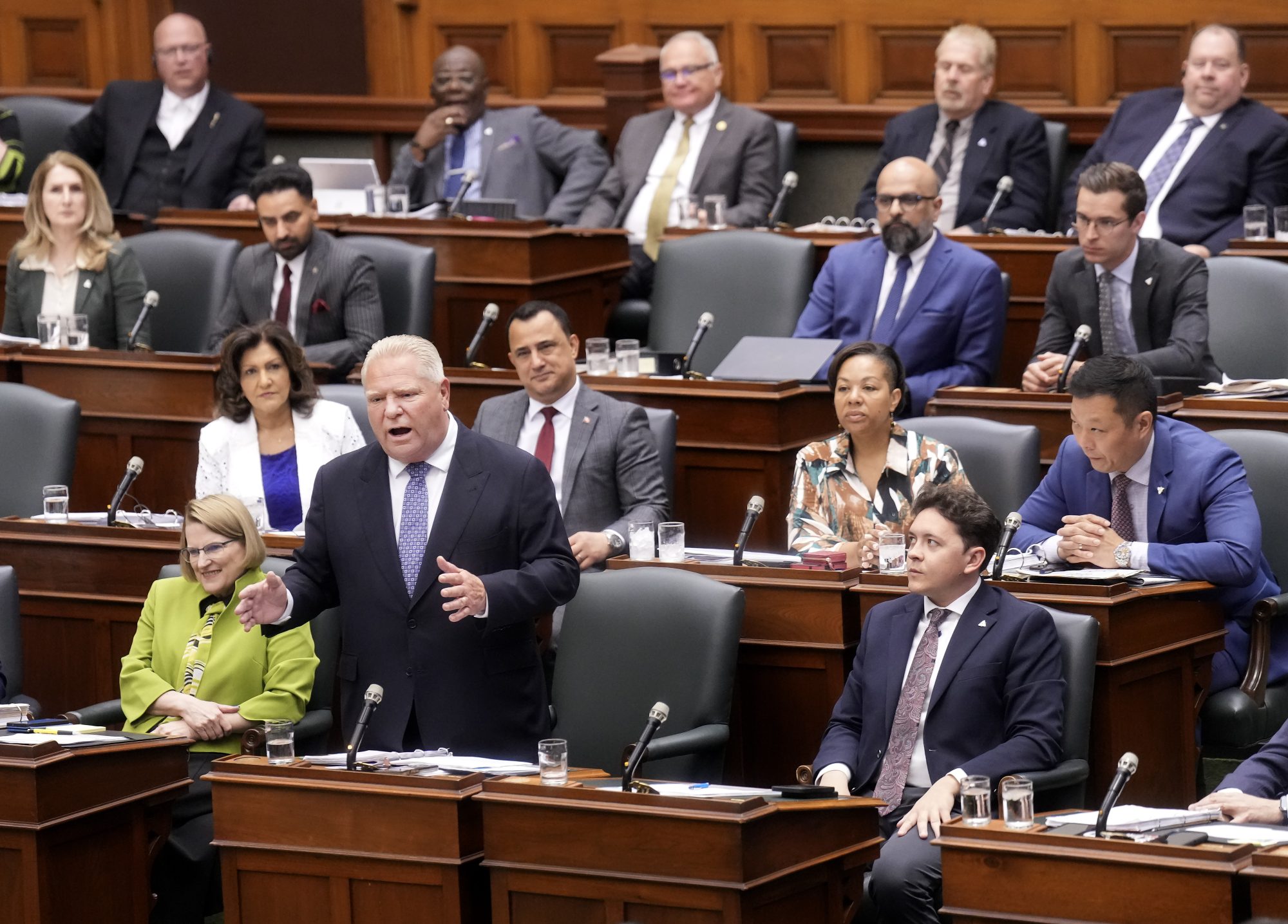
Ontario Premier Doug Ford recently promised that fraudsters exploiting the Ontario Student Assistance Program (OSAP) inside private career colleges are "going to jail." The soundbite makes for clean evening television, framing a systemic public-finance failure as a simple street-level crime wave. Yet beneath the tough-on-crime rhetoric lies an uncomfortable regulatory reality. The province spent years loosening oversight, starving compliance divisions of staff, and expanding student aid eligibility to for-profit operators before feigning shock when bad actors drained the public purse.
Public outrage sells. Systemic auditing does not.
When a premier threatens prison time over student aid abuse, the target is rarely the corporate architecture that made the abuse profitable in the first place. Instead, the political spotlight swings toward individual recruiters, small-time operators, or desperate applicants caught in the gears of a poorly policed subsidy pipeline. Understanding how Ontario arrived at this point requires looking past the podium and examining the mechanics of how public student aid flows into private, for-profit classrooms.
The Anatomy of the OSAP Subsidy Pipeline
To grasp why private career colleges attract fraud, you first have to follow the money. Unlike public universities and community colleges, which receive direct operating grants from Queen's Park alongside tuition revenue, private career colleges operate almost entirely on student tuition. For many of these institutions, OSAP is the lifeblood of their business model.
When an institution qualifies for OSAP designation, the provincial and federal governments effectively underwrite its revenue stream. Students apply for grants and loans, and the funds flow directly to the school to cover tuition and mandatory fees, with remaining living allowances sent to the student. Because non-repayable grants make up a substantial portion of low-income aid packages, the financial friction for a prospective student is remarkably low. A recruiter can truthfully tell an applicant that they will pay nothing out of pocket today, and may even walk away with extra cash for living expenses.
That structure creates a powerful financial incentive. Every warm body enrolled in an eligible program triggers a predictable transfer of taxpayer funds. In a legitimate institution, that incentive is balanced by rigorous admissions standards, real instruction, and measurable job placement outcomes. In a predatory operation, the classroom becomes an afterthought.
Consider a hypothetical example of how this plays out on the ground. Imagine a storefront career college offering a short-term diploma in business administration or personal support work. A third-party recruiter—paid a commission per head—targets newcomers, low-income residents, or individuals navigating language barriers. The recruiter handles the OSAP paperwork from start to finish, inflating living expense claims or falsifying prior academic credentials to ensure approval. Once the first tranche of tuition clears the bank, attendance tracking vanishes. The student might receive a fraction of their living allowance, the recruiter pockets a finder's fee, and the college retains thousands of dollars in public tuition grants for instruction that barely exists.
Nobody inside the transaction has an immediate incentive to blow the whistle. The college gets paid. The recruiter gets a commission. The student, often unaware that loans are accruing in their name or that their grant eligibility is being burned through, believes they are receiving legitimate financial support. By the time the Ministry of Colleges and Universities notices an anomaly, the corporate entity behind the school can be dissolved, rebranded, or shifted to a new numbered company.
Political Tough Talk Versus Regulatory Reality
Doug Ford's declaration that fraudsters are headed to prison relies on a convenient sleight of hand. Premiers do not sentence people to jail. Police investigate, Crown prosecutors lay charges, and judges hand down sentences based on strict evidentiary thresholds under the Criminal Code.
Proving criminal fraud beyond a reasonable doubt in the context of higher education is notoriously difficult. In a courtroom, defense lawyers do not argue that their clients stole money; they argue that their clients ran a disorganized business. Missed classes become "flexible asynchronous learning." High dropout rates become "academic challenges faced by an at-risk demographic." Unqualified instructors become "industry practitioners bridging a labor shortage."
When regulatory standards are vague, criminal prosecution hits a brick wall. You cannot easily convict an operator of fraud for delivering a terrible education if the provincial statute barely defines what a good one looks like.
Furthermore, the political timeline complicates the premier's outrage. Over the past decade, successive governments—and particularly the current administration—pushed aggressive deregulation agendas across multiple sectors to cut "red tape." In the post-secondary sphere, the drive to rapidly train workers for healthcare, trades, and technology led policymakers to treat private career colleges as nimble partners capable of scaling up faster than public institutions.
That partnership came with a blind spot. While public colleges faced strict tuition freezes and multi-year funding caps that squeezed their operating budgets, private career colleges retained far greater flexibility in how they priced programs and marketed themselves. For public colleges, the pressure to find alternative revenue drove a massive expansion in international student recruitment, which eventually triggered its own federal crackdown. For private career colleges, domestic OSAP funding remained a steady, lucrative target.
Where Provincial Oversight Quietly Eroded
For years, veteran observers of Ontario's post-secondary sector have warned that the oversight body responsible for policing private career colleges—now operating under the Ontario Career Colleges Act—was chronically outgunned by the industry it regulated.
Hundreds of registered private career colleges operate across the province, offering thousands of individual vocational programs. Monitoring them requires unannounced site inspections, forensic audits of attendance logs, verification of instructor credentials, and cross-referencing of OSAP disbursement data against actual graduation and employment rates.
Historically, the ministry's compliance apparatus relied heavily on reactive enforcement. Rather than proactively auditing institutions before millions of dollars left the treasury, inspectors largely responded to formal student complaints. Yet the very populations most vulnerable to predatory recruitment are the least likely to file formal regulatory grievances. Students who fear immigration repercussions, lack fluency in English, or do not understand the fine print of their Master Student Financial Assistance Agreement rarely navigate bureaucratic complaint portals.
Even when inspectors uncovered violations, the penalties functioned more like a cost of doing business than an existential deterrent. Administrative monetary penalties—fines levied by the Superintendent of Career Colleges—frequently amounted to a few thousand dollars a day for ongoing infractions. If a school is pulling in hundreds of thousands of dollars per intake cycle through questionable OSAP enrollments, a modest administrative fine does not stop the operation; it simply gets factored into the overhead.
Revoking a college's registration is the nuclear option, yet regulators have historically hesitated to pull the trigger quickly because doing so strands current students mid-program. When a private college collapses or loses its license, the province is forced to tap into the Training Completion Assurance Fund to place students elsewhere or refund tuition. That reality creates a perverse hesitation among bureaucrats: shutting down a bad actor creates an immediate administrative headache, whereas letting them limp along delays the reckoning.
The Structural Flaws Inside OSAP Disbursement
Blaming shady operators alone ignores the design flaws baked directly into the financial aid system. OSAP was built on an honor system designed primarily for traditional public universities and colleges, where institutional governance, faculty unions, and public boards act as natural checks against outright fabrication.
Applying that same trust-based disbursement model to lightly regulated, profit-driven entities is an invitation for arbitrage.
Verification Gaps at Enrollment
When a student applies for OSAP, the system relies heavily on the institution to confirm enrollment and ongoing academic progress. In theory, a school must verify that a student is actively attending classes before subsequent installments of funding are released. In practice, the ministry lacks real-time visibility into classroom attendance. If an institution submits a digital confirmation stating a student is in good standing, the automated payment system releases the funds. Without independent verification—such as third-party exam proctoring, digital attendance logs tied to verifiable student logins, or random in-person headcounts—the fox is effectively guarding the henhouse.
The Grant-to-Loan Ratio Trap
Changes to OSAP formulas over the years have repeatedly altered the balance between non-repayable grants and repayable loans. Whenever grant generosity expands for low-income brackets, fraud risk spikes immediately. Unlike a loan, which carries the eventual threat of collection agencies and credit damage, a grant looks like free money to an unscrupulous recruiter pitching a marksman's scheme. Even when students are saddled with the loan portion, the immediate cash payout from living allowances blinds applicants to the long-term debt accumulating on their National Student Loans Service Centre account.
Third-Party Recruiters in the Shadows
One of the most glaring loopholes in the sector involves independent agents and lead-generation firms. Many private career colleges outsource their marketing and admissions funnels to third-party recruiters who are not direct employees of the school. When abuses come to light, college executives routinely claim ignorance, pinning the blame on rogue agents who operated outside company guidelines. Until legislation makes institutions strictly and financially liable for every representation made by any third party recruiting on their behalf, schools will continue to hide behind plausible deniability.
What Meaningful Reform Actually Looks Like
If Queen's Park genuinely wants to stop taxpayers from subsidizing ghost classrooms and predatory diplomas, prison threats from a press conference podium will accomplish nothing. Stopping the bleed requires boring, structural, uncompromising regulatory surgery.
First, OSAP eligibility must be decoupled from basic business registration. Merely holding a license to operate a private career college should not automatically grant access to public student loans and grants. Eligibility for OSAP should require a multi-year probationary period funded entirely through private tuition, followed by strict performance benchmarks. If an institution cannot demonstrate verifiable graduation rates, third-party licensing exam pass rates, and legitimate employment outcomes in the field of study, it should be barred from touching a single dollar of public financial aid.
Second, performance-based clawbacks must replace administrative fines. If a college receives OSAP tuition for a cohort of students and more than a specified percentage drop out within the first half of the program—or fail to sit for mandatory provincial certification exams—the institution should be legally required to refund the tuition portion directly to the ministry, not keep it as forfeited fees. Furthermore, corporate directors and owners must be held personally and jointly liable for clawbacks, preventing operators from folding a bankrupt college on Friday and opening a new one under a spouse's name on Monday.
Third, auditing must shift from complaint-driven to data-driven. The ministry already sits on mountains of data. Cross-referencing OSAP disbursement spikes against sudden enrollment surges, identical IP addresses used on multiple student applications, or programs where 90 percent of students claim maximum living allowances takes basic data analytics, not a years-long police investigation. Flagged institutions should have their OSAP disbursements frozen immediately pending an unannounced, on-site forensic audit.
The Human Collateral Left Behind
Lost in the political theater of tough talk and fiscal outrage are the actual victims sitting in the middle of the wreckage. When an OSAP fraud ring is finally exposed, the headlines focus on the millions of dollars lost by the province. Rarely do they follow what happens to the student whose name is attached to the paperwork.
For a low-income worker or newcomer who was misled into signing OSAP forms for a worthless credential, the fallout is devastating. They are left with thousands of dollars in student loan debt that cannot be easily discharged, damaged credit scores, and exhausted lifetime limits on OSAP funding. When they eventually try to enroll in a legitimate public college to actually learn a trade or earn a nursing credential, they discover their financial aid eligibility has been burned up by a ghost program they barely attended.
True accountability means wiping the slate clean for defrauded students while seizing the assets of the operators who profited from their signatures. Until the government backs up its tough rhetoric with forensic audits, personal liability for corporate owners, and strict barriers to public funds, the warning that fraudsters are going to jail will remain little more than political noise over a system still wide open for business.