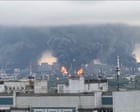
The headlines write themselves. Smoke billows over the Kapotnya district. A Ukrainian drone slices through the early morning sky, evading Moscow’s multi-layered air defense grid, and hits a primary distillation unit. The media explodes into a frenzy of tactical analysis. "A massive blow to the Kremlin's war chest," they declare. "Russia's energy infrastructure is crumbling."
It is a comforting narrative. It is also fundamentally wrong.
Western media coverage of the ongoing drone campaign against Russian refining infrastructure suffers from a chronic misunderstanding of industrial downstream operations. Analysts stare at dramatic video footage of burning crude towers and mistake tactical success for strategic victory. They assume that because a refinery is on fire, Vladimir Putin’s war machine is running out of money and fuel.
The reality is far more frustrating, economically complex, and hazardous to Western interests. Drones are poking a bear in the eye, but they are not cutting off its paws. In fact, if you look closely at the mechanics of global energy markets and industrial repair cycles, these strikes might actually be achieving the exact opposite of their intended goals.
The Flawed Premise of the "Crushed Refinery"
The lazy consensus relies on a simple equation: Strike Refinery = Destroy Fuel Production = Bankrupt the Russian State.
To understand why this equation fails, you have to look at how a refinery actually works. A facility like the Moscow Oil Refinery, which processes roughly 10.5 million tons of crude per year, is not a fragile, single-entity machine. It is a vast, modular industrial campus spread over hundreds of acres.
When a drone strikes, it typically targets the Atmospheric Distillation Unit (often called the AVT unit). This is the tall tower where crude oil is heated and separated into basic fractions like naphtha, kerosene, and diesel. Yes, hitting an AVT unit halts the production of finished gasoline and diesel at that specific site.
But it does not destroy the oil.
When a refinery’s distillation capacity goes offline, Russia does not stop pumping crude out of the ground in Western Siberia. The oil simply shifts lanes. Instead of being refined domestically into gasoline for Russian drivers, the raw crude is redirected into the export pipeline network. It flows directly to ports like Primorsk or Novorossiysk, where it is loaded onto the "shadow fleet" of aging tankers and shipped to buyers in India, China, and Turkey.
Here is the kicker: global crude markets care about the total volume of oil available, not where it gets cooked. By forcing Russia to export more raw crude rather than refined products, drone strikes can accidentally stabilize global crude supplies, keeping prices lower for Western consumers while ensuring Moscow continues to collect massive sovereign revenues through its mineral extraction taxes. The Kremlin still gets paid; the money just changes pockets from downstream refining margins to upstream production taxes.
The Myth of the Unreplaceable Western Parts
The second pillar of the media's flawed narrative is the sanctimonious belief in Western sanctions. "Russian refineries depend on automated control systems from Honeywell or Siemens and catalytic cracking technology from UOP," the experts chime. "Without Western parts, they can never fix these units."
I have spent twenty years watching how heavy industrial companies operate under extreme duress. Believing that a nation with Russia's engineering legacy cannot bypass software locks or reverse-engineer a distillation tray is pure hubris.
Step inside any major refinery outside the G7. You will find a thriving global black market for industrial automation components. Programmable Logic Controllers (PLCs) and industrial valves are smuggled through logistics hubs in Dubai, Tashkent, and Yerevan every single day.
Furthermore, a distillation column is essentially a giant steel cylinder filled with perforated metal trays. It is nineteenth-century physics dressed up in twenty-first-century sensors. It does not require microchips from TSMC to build a functional fractionation tower. Russian metallurgical plants and Chinese engineering firms are perfectly capable of fabricating replacement vessels.
The data backs this up. Following the intense drone campaigns of early 2024, which briefly knocked out nearly 14% of Russia's refining capacity, international analysts predicted a total collapse of the Russian domestic fuel market by autumn. Instead, by June, Russian engineers had brought the targeted units at Ryazan, Syzran, and Kuibyshev back online. Repair times that Western compliance departments insisted would take years were completed in eight to twelve weeks.
The Diesel Paradox: Who Actually Suffers?
Let us address the "People Also Ask" question that dominates every energy forum: Do drone strikes on Russian refineries cause a domestic fuel shortage inside Russia?
The short answer is yes, but not the kind that stops tanks.
Russia produces roughly twice as much diesel as it consumes domestically. It is a massive structural exporter of middle distillates. When a drone knocks out a refinery near Moscow or St. Petersburg, the immediate victim is not the Russian military machine. The Russian Ministry of Defense gets first priority on every single drop of fuel produced in the country. The military supply lines are insulated by federal mandate.
The actual casualties of these disruptions are global consumers and Russian civilians. To prevent domestic price spikes, the Kremlin periodically bans gasoline exports. This forces European and American markets to source their diesel from alternative, more expensive suppliers in the Middle East or India.
Meanwhile, the true bottleneck inside Russia is not production capacity—it is logistics. Russia’s rail network, managed by RZD, is choked by military transport moving East to West. Hitting a refinery near Moscow means the Kremlin must rail fuel in from deep within the Urals or Siberia. This strains their locomotive fleet and delays commercial freight. It creates a logistical headache, absolutely. But a logistical headache is a far cry from an industrial collapse.
The Strategy We Should Be Using Instead
If blowing up distillation towers is a high-visibility, low-yield strategy, how do you actually disrupt Russia’s energy weapon? You stop playing to the cameras and start targeting the unglamorous choke points that cannot be bypassed with a shadow fleet or a Turkish middleman.
Imagine a scenario where the focus shifts away from refineries entirely. Instead of targeting a sprawling 500-acre refinery complex in Moscow, the strategy targets the massive, highly concentrated pumping stations of the Druzhba pipeline network or the specialized gas-fractionation infrastructure at the Ust-Luga export terminal.
The real vulnerabilities are found in three specific, non-modular areas:
- Subsea Export Terminals: Crude oil loading arms and single-point mooring buoys in the Black and Baltic seas are highly specialized pieces of marine engineering. If you destroy a deep-water loading terminal, Russia cannot simply truck millions of barrels of oil to a different port. The oil backs up into the wells, forcing operators to shut down production entirely.
- The Upstream Permafrost Wells: Shutting down an active oil well in the Russian Arctic or Western Siberia is often permanent. If the flow of warm crude stops in freezing temperatures, the paraffin waxes inside the wellbore solidify, completely destroying the geologic formation. Once a Siberian well freezes, it is often gone forever.
- Large-Scale Gas Compressor Stations: Russia's state finances are deeply tied to gas condensate and liquefied petroleum gas (LPG). The massive turbines used in gas compressor stations are incredibly complex, proprietary machines that cannot be easily replaced by Chinese copies.
The downside to this approach is obvious, and it is the exact reason why Western governments quietly panic every time a Ukrainian drone flies toward a Russian oil depot: targeting raw export infrastructure drives global oil prices through the roof. A real disruption to Russian crude exports means $120-a-barrel oil. It means inflation in Washington, political instability in Paris, and economic pain across the global South.
The current drone campaign against refineries is allowed to continue precisely because it is ineffective enough to keep global oil flowing, yet dramatic enough to provide good public relations material for evening news broadcasts. It functions as a pressure valve, allowing Ukraine to strike back visually while keeping the global energy markets artificially calm.
Stop celebrating the black smoke over Moscow as a decisive turn in the conflict. It is a tactical irritation, an engineering challenge that the Kremlin has already proven it can solve with cash and alternative supply lines. Until the international community is willing to accept the brutal economic pain of completely shutting down Russian raw exports at the wellhead, burning down a few distillation towers is just expensive fireworks.


