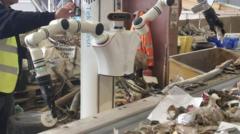
The global waste management sector is currently trapped in a structural pincer movement: a diminishing supply of manual labor intersecting with an increasingly complex material recovery requirement. Conventional sorting facilities (MRFs) rely on human visual acuity and haptic feedback to separate polymers, paper, and metals from contaminated streams. This model is failing. The fundamental constraint is not a temporary labor shortage but an absolute decoupling of wage growth from the harsh environmental conditions of the work. As regulatory mandates for high-purity recyclates tighten, the industry must transition from labor-intensive manual sorting to capital-intensive robotic automation or face total operational insolvency.
The Triad of Operational Instability
To understand why waste firms are pivoting toward robotics, one must first deconstruct the three variables that dictate the failure of manual sorting lines. You might also find this connected story interesting: Why China finally pulled the trigger on its anti sanctions law.
- The Biological Limit of Cognitive Load: Human sorters can typically manage 30 to 40 "picks" per minute. Beyond this threshold, the error rate climbs exponentially as decision fatigue sets in. In a stream moving at standard belt speeds, a human sorter misses a significant percentage of target materials, leading to "slippage"—valuable recyclables ending up in landfills.
- Environmental Hazard Costs: The sorting floor is a high-risk environment characterized by biohazards, sharp objects, and airborne particulates. The cost of labor is not merely the hourly wage; it includes the escalating premiums for workers' compensation, high turnover rates (often exceeding 100% annually), and the constant expense of recruitment and onboarding.
- Material Complexity: Modern packaging uses multi-layer laminates and varied polymer resins that are nearly indistinguishable to the naked eye under industrial lighting. Humans cannot identify a PET bottle from a bio-plastic bottle at a glance with the 99% accuracy required for high-grade secondary commodity markets.
The Mechanistic Advantage of Computer Vision
The transition to robotics is driven by the integration of Near-Infrared (NIR) spectroscopy and Deep Learning (DL) algorithms. While a human uses two sensors (eyes) limited to the visible spectrum, a robotic sorting cell utilizes hyperspectral imaging to see the chemical "signature" of a material.
A robotic arm equipped with a vacuum or pneumatic gripper does not suffer from the physical degradation associated with repetitive motion. The primary advantage lies in the Optimization of the Recovery Curve. In a manual system, as the volume of waste increases, the purity of the output decreases. In an automated system, the relationship is linear. The AI-driven sensor detects the resin type, color, and even the brand of the packaging, executing a pick with a precision that maintains high purity levels even at peak throughput. As highlighted in recent reports by Bloomberg, the implications are widespread.
The Capital Expenditure vs. Operational Expenditure Calculation
The decision to automate is a mathematical trade-off between high upfront Capital Expenditure (CAPEX) and long-term reduction in Operational Expenditure (OPEX). A single robotic sorting unit might cost between $250,000 and $500,000. For many mid-sized waste firms, this appears prohibitive. However, the internal rate of return (IRR) is calculated through the following mechanisms:
- Reduction in Effective Hourly Rate: A robot operates 24/7 without breaks, vacations, or sick leave. When the cost of the machine is amortized over a five-year lifespan, the effective "hourly wage" of a robot is often less than $4.00, significantly below any legal minimum wage in developed economies.
- Yield Improvement: By reducing slippage, the facility captures more tons of sellable material. In a market where high-quality recycled PET or Aluminum fetches a premium, a 5% increase in capture rate can translate to hundreds of thousands of dollars in annual revenue.
- Insurance and Compliance: Removing humans from the dangerous "front-end" of the sorting line reduces the facility’s risk profile, leading to lower insurance premiums and fewer regulatory fines related to workplace safety.
Strategic Bottlenecks in Robot Deployment
Automation is not a universal solution. Several technical and economic bottlenecks limit the pace of adoption. The first is Systemic Rigidity. A manual sorting line is flexible; humans can be reassigned to different belts as the waste composition changes (e.g., more cardboard during holiday shipping peaks). A robot requires re-programming or updated neural network models to recognize new packaging formats.
The second bottleneck is Upstream Contamination. If the incoming waste stream is too heavily contaminated with organic matter or "tanglers" (hoses, wires, plastic film), the mechanical components of the robot—specifically the vacuum grippers and sensors—will fail. Robotics requires a certain level of "pre-sorting" or advanced mechanical screening (trommels, eddy currents) to function at peak efficiency.
Finally, there is the Data Gap. Many smaller firms lack the digital infrastructure to utilize the data generated by these robots. An automated sorter is also a data-gathering device, providing real-time analytics on the composition of the waste stream. Without a strategy to use this data to optimize upstream collection or downstream sales, the robot is merely a fast hand, not a strategic asset.
The Shift to Product-as-a-Service Models
To circumvent the high CAPEX barrier, a new economic model is emerging: Robotics-as-a-Service (RaaS). Instead of purchasing the hardware, waste firms pay a monthly subscription or a "per-pick" fee to technology providers. This shifts the financial burden to OPEX and aligns the incentives of the tech provider with the facility operator. If the robot stops picking, the provider stops getting paid.
This model allows smaller municipalities and private haulers to access technology previously reserved for massive global conglomerates. It also solves the problem of technical obsolescence. As vision algorithms improve and sensor hardware evolves, the RaaS provider handles the upgrades, ensuring the facility always operates at the "state of the art."
Reconfiguring the Labor Force
The narrative that "robots are taking jobs" in waste management is technically inaccurate. In reality, robots are filling "ghost shifts" that firms can no longer staff. The labor that remains in these facilities must undergo a shift in specialization. We are seeing the emergence of the Waste Systems Technician.
This role replaces the manual sorter. The technician does not touch the waste; they monitor the diagnostic feeds of six to ten robotic cells, perform preventative maintenance on pneumatic systems, and calibrate sensors. This work is safer, higher-paying, and more attractive to a younger workforce. The crisis of labor in waste management is actually a crisis of the nature of the labor. By elevating the job description, firms can compete for talent in a way that manual sorting never allowed.
The Thermodynamic Limit of Circularity
We must acknowledge that even with perfect robotic sorting, the "Circular Economy" faces physical limitations. Every time a polymer is processed and sorted, the molecular chains shorten, degrading the material's quality. Robotics can maximize the number of cycles a material stays in the economy, but it cannot override the second law of thermodynamics.
Strategic planning must therefore focus on Feedstock Homogeneity. The more a waste firm can influence how waste is collected (e.g., dual-stream vs. single-stream), the more effective the robotic intervention becomes. Automation is most powerful when it is part of a holistic system design rather than a localized "patch" for a labor shortage.
The Strategic Path Forward
Facility operators must move beyond viewing robotics as a replacement for human hands and start viewing it as a fundamental redesign of the waste commodity value chain. The immediate play is to identify the "high-value, high-fatigue" points on the sorting line—specifically the final quality control (QC) stations for plastics and the recovery of non-ferrous metals. These are the zones where the delta between human error and robotic precision is the greatest.
The objective is to achieve a Dark Sorting Floor capability for at least 70% of the material stream. This requires an immediate audit of current belt speeds, material compositions, and "lost value" metrics. Firms that fail to integrate vision-based sorting within the next 24 to 36 months will find themselves unable to meet the purity standards demanded by the next generation of plastic-to-plastic recycling mandates, effectively devaluing their entire output to landfill-grade residue.