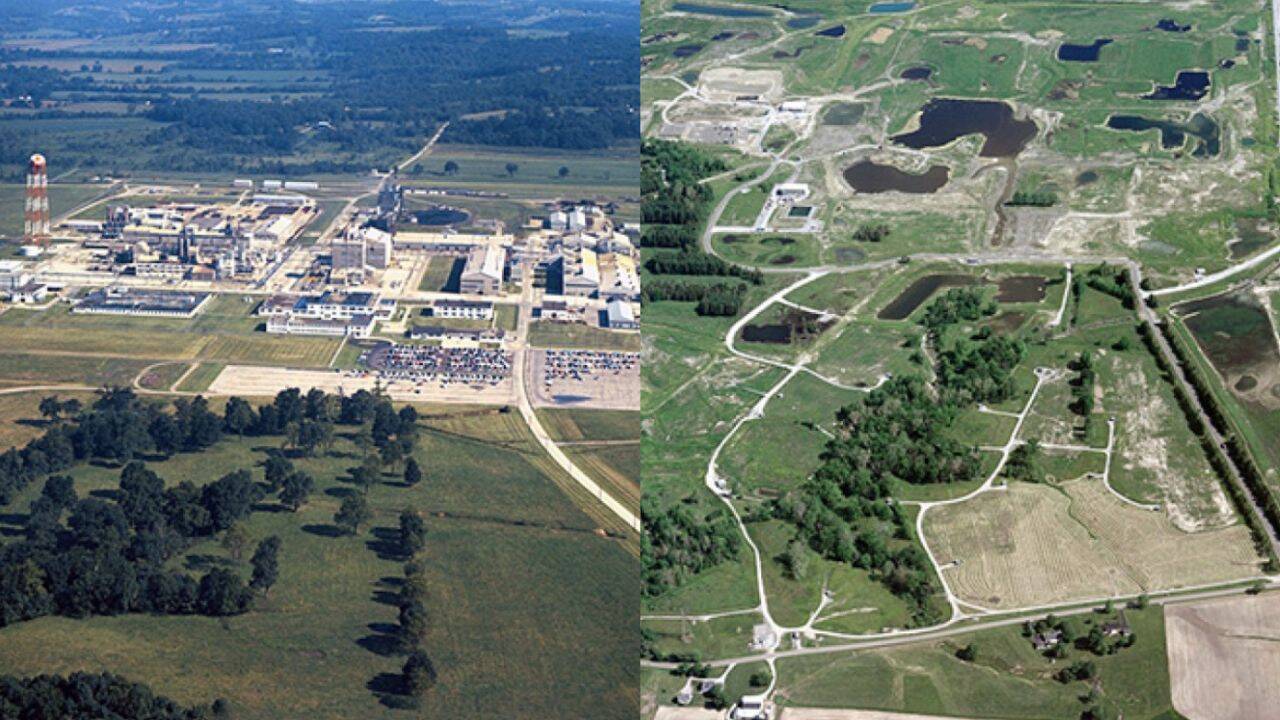
The financial and logistical mechanics of converting a Cold War nuclear production facility into a functional ecological preserve defy standard industrial closure models. When production ceased at Ohio's Fernald Feed Materials Production Center in July 1989, the asset transitioned from a strategic defense producer into an environmental liability with an estimated remediation price tag of $4.4 billion. Deconstructing this transformation requires moving past standard journalistic narratives to analyze the structural, hydrological, and capital allocation frameworks that governed one of the largest environmental cleanups in United States history.
The Three Pillars of Nuclear Remediation Capital Allocation
Managing a defunct uranium processing plant involves balancing distinct operational vectors: structural demolition, waste containment, and hydrological restoration. Each pillar functions under strict regulatory oversight from the United States Environmental Protection Agency and the Ohio Environmental Protection Agency, where project execution speeds directly dictate long-term holding costs. For a different view, check out: this related article.
1. Structural Demolition and Mass Removal
The surface infrastructure of the Fernald site required systematic dismantling to eliminate surface-level radiological hazards. Operations teams demolished 323 structures, which included 10 major uranium production complexes and heavy administrative buildings.
The physical scope of this phase involved managing massive material volumes: Further analysis regarding this has been provided by Financial Times.
- Over 31 million pounds of uranium product were extracted and reallocated.
- More than 100,000 drums of regulated waste were processed and shipped off-site.
- Approximately 1 million tons of waste were excavated from six historical waste pits.
The underlying economic driver here was risk mitigation. Leaving decaying industrial superstructures in place creates continuous inspection overhead and liability exposure. By deploying a scorched-earth deconstruction model, the Department of Energy compressed the project timeline, finishing its primary remediation milestones 12 years ahead of initial baseline projections.
2. On-Site Containment Versus Transport Economics
A core optimization challenge in large-scale remediation is the cost function of transportation versus containment. Transporting millions of cubic yards of low-level radioactive soil and structural debris to remote licensed disposal facilities incurs prohibitive freight and tipping fees.
The Fernald strategy solved this bottleneck by constructing an On-Site Disposal Facility directly on the property. This engineered containment cell swallowed approximately 3 million cubic yards of contaminated soil and demolition debris. By internalizing the disposal mechanism, project managers avoided cross-country hauling expenses, establishing an isolated containment zone engineered to isolate radioactive and chemical residues from the surrounding environment permanently.
3. Subsurface Hydrological Remediation
While surface elements offer visible progress, subsurface remediation dictates the true operational timeline of a nuclear site closure. The Fernald facility sits directly above the Great Miami Aquifer, a designated sole-source aquifer critical to regional water security. Past production practices resulted in a 225-acre plume of uranium contamination stretching into the underlying groundwater table.
Addressing this threat required a complex pump-and-treat infrastructure. Groundwater is actively extracted through a network of recovery wells, routed through specialized treatment systems to strip out uranium particulate, and discharged only after meeting strict regulatory thresholds. More than $300 million was allocated solely to the design, construction, and operation of this hydrological filtration apparatus. Because aquifers do not self-clean on industrial timelines, this phase represents a perpetual operational tail that extends far beyond the initial 2006 project completion date.
Ecological Succession as an Industrial Exit Strategy
Once heavy remediation concluded, the land use designation shifted from a restricted federal industrial zone to a public ecological preserve. This conversion is not merely cosmetic; it serves as a risk management strategy known as institutional control.
Transforming a 1,050-acre industrial footprint into wetlands, native prairies, and upland forests alters the human interaction model with the land. Public access is strictly zoned, agricultural use is prohibited, and natural vegetation root systems stabilize topsoil layers, preventing wind and water erosion from exposing residual subsurface anomalies. The reintroduction of native flora and fauna acts as a biological cap, integrating the remediated footprint into a self-sustaining ecosystem that requires minimal human intervention compared to commercial or residential developments.
Strategic Operational Takeaway
The economic viability of turning a nuclear liability into a green preserve hinges on front-loading capital expenditures to compress remediation schedules. By replacing drawn-out monitoring with aggressive, parallel execution tracks—demolishing structures, building on-site containment, and isolating aquifers simultaneously—program managers avoid the inflationary drift typical of public infrastructure projects. Future nuclear closures must adopt this compressed asset-disposal framework to mitigate open-ended holding costs and accelerate the transition from industrial hazard to permanent ecological stability.