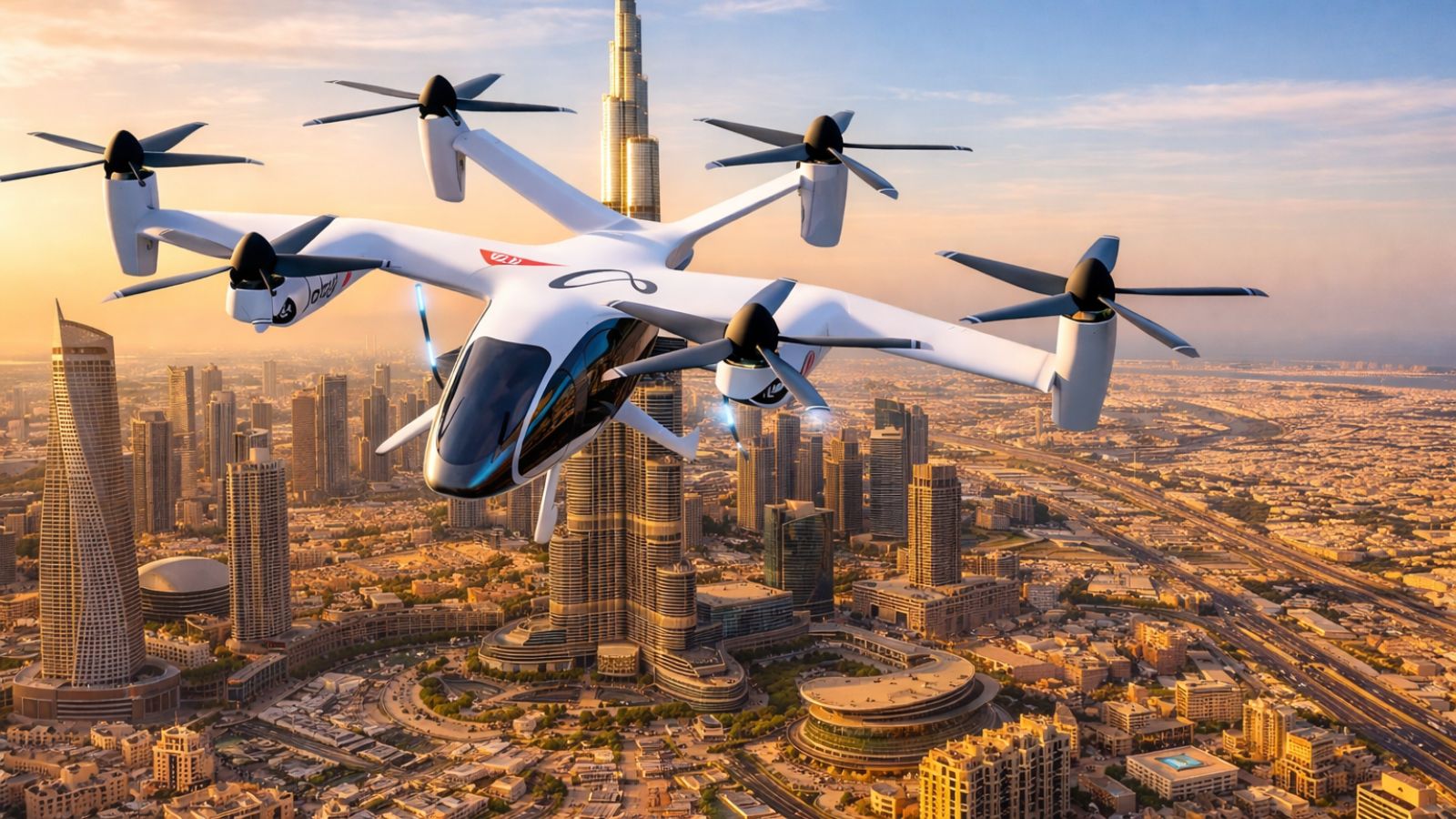
The launch of an aerial taxi service between Dubai International Airport (DXB) and Palm Jumeirah represents more than a luxury transport shortcut; it is a live-market stress test for the viability of Electric Vertical Take-off and Landing (eVTOL) technology in a high-density urban corridor. While traditional ground transport covers this 36-kilometer route in 45 to 60 minutes during peak congestion, the projected 10-minute flight time hinges on a radical shift from two-dimensional traffic flow to a managed three-dimensional airspace. Success depends on the convergence of battery energy density, vertiport throughput, and a pricing structure that can sustain the high capital expenditure of the Joby S4 aircraft.
The Physics of Time Compression
The claim of a 10-minute transit for a 36-kilometer journey implies an average ground speed of approximately 216 km/h. This is well within the 322 km/h maximum capability of the Joby S4, yet the operational reality is governed by the acceleration and deceleration phases of vertical flight. Recently making headlines in related news: The Logistics of Survival Structural Analysis of Ukraine Integrated Early Warning Systems.
The energy penalty of VTOL (Vertical Take-off and Landing) is significant. Unlike fixed-wing aircraft that use aerodynamic lift from the start of the roll, an eVTOL must expend massive amounts of energy to overcome gravity during the hover phase. The efficiency of this route is found in the "cruise-to-climb" ratio. On a short 36-kilometer hop, the aircraft spends a disproportionate amount of its battery cycle on takeoff and landing.
- The Launch Phase: Six tilting rotors provide the thrust-to-weight ratio necessary for vertical lift. This is the highest draw on the 252 Wh/kg battery cells.
- Transition: The rotors tilt forward, shifting the lift load from the motors to the wings. Once in wing-borne flight, the aircraft operates at a fraction of the power required for hover.
- The Descent Profile: To maintain the 10-minute promise, the aircraft must maintain cruise speed until the final approach, necessitating a steep, high-energy deceleration.
Vertiport Infrastructure as a Throughput Bottleneck
The infrastructure at DXB and Palm Jumeirah acts as the primary constraint on the system's total addressable market. A vertiport is not merely a helipad; it is a high-voltage charging hub and a passenger processing terminal. Further information on this are covered by Wired.
The Charging Variable
Current lithium-ion technology requires thermal management during rapid charging. For the service to remain profitable, "turnaround time" must be minimized. If the aircraft spends 10 minutes in the air but 30 minutes on the tarmac charging, the fleet utilization rate drops below the threshold required to amortize the multi-million dollar cost of each unit. The strategy in Dubai involves "top-off" charging—replenishing only the energy used during the 36-kilometer leg rather than a full cycle, which preserves battery health and increases sorties per hour.
Airspace Integration
Dubai’s General Civil Aviation Authority (GCAA) must integrate these low-altitude flights (typically below 500 meters) with the heavy commercial traffic of DXB. The bottleneck here is not the aircraft’s speed, but the "separation buffers" required by air traffic control. If an eVTOL is forced into a holding pattern due to runway activity at DXB, the 10-minute value proposition evaporates.
The Cost Function and Market Positioning
Initial operations will target the "Time-Value Sensitive" demographic. For a business traveler, the delta between a 60-minute car ride and a 10-minute flight is 50 minutes of recovered productivity.
- Fixed Costs: Aircraft procurement (Joby S4 units), vertiport lease, and pilot training.
- Variable Costs: Electricity, landing fees, maintenance-per-flight-hour, and insurance premiums.
Early-stage pricing is expected to mirror premium limousine services or "Uber Black" levels rather than standard taxis. However, the long-term goal of urban air mobility (UAM) is the reduction of variable costs through autonomous flight. By removing the pilot, the aircraft gains a fifth passenger seat (a 25% increase in revenue capacity) and eliminates the highest recurring labor cost. While the 2026 launch will feature piloted aircraft, the structural path to profitability relies on the eventual transition to remotely piloted or fully autonomous systems.
Battery Lifecycle and Environmental Reality
The environmental argument for eVTOLs rests on zero-emission propulsion at the point of use. However, the "green" status of the DXB-to-Palm route is a function of the Dubai power grid's carbon intensity.
The primary technical risk is battery degradation. The high-power draws of VTOL maneuvers, combined with the extreme ambient temperatures of Dubai (often exceeding 40°C), place immense stress on the chemical stability of the cells. Cooling the batteries during flight and charging adds weight and energy consumption. If the battery life cycles are lower than predicted—meaning they must be replaced every 1,000 cycles instead of 2,000—the operating cost per kilometer increases by approximately 30-40%.
Operational Risks and Regulatory Buffers
No transportation system is immune to the "Last-Mile Friction." Even if the flight is 10 minutes, the total trip time includes:
- Security screening at the vertiport.
- Passenger boarding and safety briefings.
- Surface transport from the landing pad to the final destination on the Palm.
If the "pad-to-door" time exceeds 25 minutes, the aerial taxi loses its competitive edge over a well-timed ground transfer. The 2026 rollout must solve for the synchronization of the flight with ground-based ride-hailing to ensure the time savings aren't lost in the lobby.
Furthermore, noise pollution remains a regulatory hurdle. The Joby aircraft utilizes 6 small rotors specifically to keep the noise footprint below 65 dBA, which is quieter than a typical conversation. This is the "Social License to Operate." If the residents of Palm Jumeirah perceive the service as a nuisance, flight paths will be restricted to over-water corridors, potentially adding kilometers and minutes to the route.
Strategic Forecast for the 2026 Launch
The Dubai DXB-Palm Jumeirah corridor is a low-risk, high-visibility entry point. It avoids the complexities of cross-country flight and focuses on a wealthy, concentrated user base. To move from a novelty service to a structural component of the city's transport hierarchy, the following must occur:
First, the establishment of a "Dynamic Airspace" model where flight paths are updated in real-time based on weather and commercial air traffic. Second, a shift toward high-frequency, low-margin operations to capture the middle-market commuter.
The 2026 launch will not immediately solve Dubai's traffic congestion, but it will provide the empirical data needed to quantify the "Power-to-Profit" ratio of electric flight. The critical metric to watch is not the 10-minute flight time, but the Available Seat Kilometers (ASK) and the Load Factor. If the service can maintain a load factor above 70% with a turnaround time under 15 minutes, the model becomes scalable to other hubs like Dubai Marina and Downtown.
The immediate move for stakeholders is the securitization of vertiport real estate. In a 3D city, the value moves from the road frontage to the roofline. Companies that control the landing rights at key nodes like DXB and the Palm will hold the leverage, regardless of which aircraft manufacturer eventually dominates the sky.
Move to secure "Power-at-the-Edge" infrastructure now. The winners in this space will be those who own the high-capacity charging sites, as the aircraft themselves will eventually become commoditized.