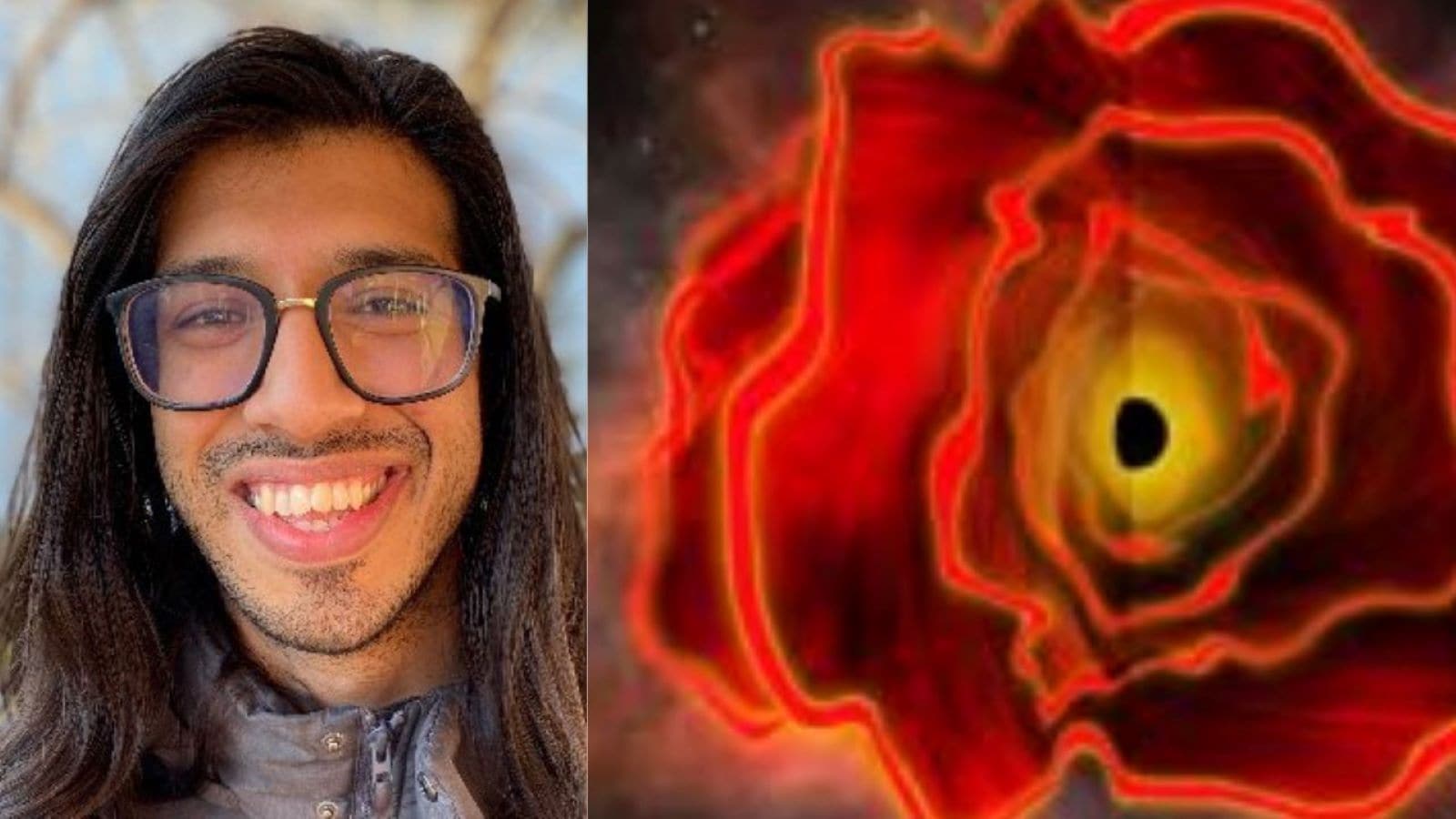
Most eighteen-year-olds are figuring out how to do their own laundry, or staring blankly at university registration portals while their parents breathe down their necks. They are worried about attendance percentages, cafeteria food, and whether their roommate snores.
Rohan Naidu was staring at something else entirely.
He was staring at the end of physics.
Born in Hyderabad, Rohan did what any sensible academic advisor would call career suicide. He walked away from his engineering degree before his twenties had even properly begun. The lecture halls felt too small, the syllabus too slow, the horizon too thoroughly mapped by people who were content coloring inside the lines. So he dropped out. Not to start a garage software company or chase venture capital, but to lose himself in the quiet, violent physics of the cosmos.
Quiet. Violent. Two words that usually do not belong in the same sentence, unless you are talking about what happens when dead stars collapse.
To understand what Rohan chased, you have to throw away everything you think you know about space as a quiet, glittering gallery of distant pinprights. Space is an arena of ghosts. When massive stars die, they do not simply fade away; they implode with a fury that distorts the geometry of reality itself. They leave behind singularities. Black holes.
And then, theoretically, there are the exceptions. The ghosts of ghosts.
Imagine looking at a candle flame through a thick lens, then realizing the flame isn't what's bending the light—it's something entirely invisible, an absolute void wrapped in a shroud of captured radiance. That is the realm of the black hole star, or what astrophysicists conceptualize when matter and extreme gravity lock in a cosmic tango that defies standard categorization. These objects sit on the razor edge between theoretical math and terrifying physical reality.
For most people, this is science fiction. A cool screensaver. A late-night Wikipedia rabbit hole.
For Rohan, it became a obsession. Sitting behind a screen in Hyderabad, far from the ivy-covered cloisters of traditional European or American research institutions, he began tearing through data sets, running complex gravitational equations, and questioning assumptions that senior scientists had treated as gospel for decades.
He didn't have a lab coat. He didn't have a tenured professor signing off on his coffee breaks. He had a computer, an insatiable curiosity, and the kind of radical tunnel vision that only youth can afford.
When you strip away the institutional prestige, science is remarkably democratic. Math does not care if you paid tuition. Gravity does not check your transcripts. The universe keeps its secrets out in the open, waiting for anyone stubborn enough to stare at the noise until a pattern emerges.
Rohan found the pattern.
His research into these extreme stellar configurations began turning heads in academic circles that usually dismiss outsiders. Astrophysics is notoriously insular. It relies on pedigrees, peer networks, and decades of accumulated inertia. Yet, paper by paper, finding by finding, Rohan carved out a space for himself. He wasn't just participating in the conversation; he was rewriting the vocabulary.
Consider what happens when a young mind collides with an intractable problem. Experience teaches caution. Experience whispers, That's impossible, someone smarter than you would have solved it already. But youth, unburdened by the scar tissue of past failures, charges straight ahead. Rohan didn't know what couldn't be done, so he simply did it.
The study of black hole stars requires a delicate balance of imagination and rigorous mathematical discipline. You are dealing with environments where time bends, light breaks, and matter is crushed down to densities that defy human comprehension. To map these phenomena, you cannot rely on intuition. Intuition belongs on Earth, where things fall down and water flows wet. In the vicinity of a singularity, intuition is a liability.
Rohan developed a fluency in that alien language. He mapped the theoretical behaviors of matter caught in the gravitational grip of these cosmic anomalies, shedding light on how they form, how they evolve, and how we might one day detect their faint, distorted whispers across the vastness of space.
It is easy to look at a story like this and turn it into a cliché about following your dreams. But real life is rarely so neat. Dropping out of engineering at eighteen is a gamble with terrifying odds. Most people who try it stumble in the dark and vanish. The survivor bias of success stories hides a graveyard of broken ambitions.
Rohan survived because his rebellion was not fueled by arrogance, but by a profound, almost desperate humility before the majesty of the universe. He didn't think he knew better than the textbooks; he simply thought the textbooks hadn't looked far enough yet.
There is a distinct kind of loneliness that comes with this level of focus. While friends were out celebrating weekends, Rohan was knee-deep in gravitational wave models and relativistic equations. The room was quiet, save for the hum of the computer fan and the distant, muted sounds of Hyderabad traffic drifting through the window.
Darkness outside. Light captured from millions of years ago glowing on a monitor inside.
That is where discoveries are actually made. Not in flash flood press conferences or Nobel acceptance speeches, but in the grinding, unglamorous hours of code-breaking and equation-balancing when you realize that the numbers are telling you something new. Something true.
When the scientific community began to recognize his work, the narrative shifted. The dropout label stopped being a mark of recklessness and became a badge of singular vision. He had bypassed the gatekeepers because he couldn't afford to wait for their permission.
The cosmos does not wait for us to grow up. Supernovae do not schedule their detonations around academic semesters. If you want to understand how the universe works, you have to meet it on its own terms: immediate, uncompromising, and vast.
Rohan Naidu did not just study black hole stars. He proved that the boundaries we draw around education, age, and geography are entirely artificial. The universe is out there, indifferent to our labels, waiting for anyone brave enough to look up, step off the established path, and stare straight into the dark until the light begins to bend.
The night sky is full of things that should not exist, holding together realities we are only just beginning to name. Somewhere out among them, a young man from Hyderabad is still watching, still calculating, still chasing the shadows at the edge of time.