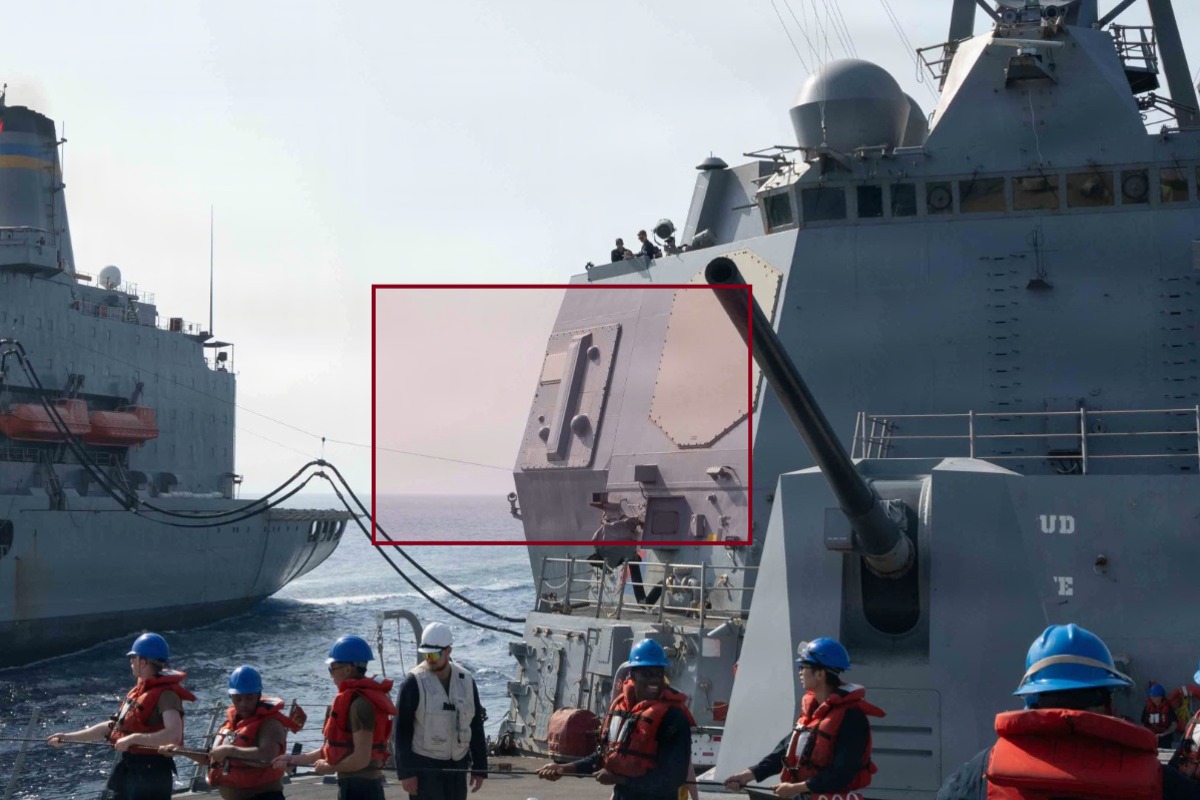
You can't win a modern naval battle if you're constantly burning through multi-million dollar interceptors to knock down cheap enemy drones and anti-ship cruise missiles. The math simply doesn't work. When a surface warship faces a saturated swarm of incoming threats in hostile waters, its physical missile magazines will eventually run dry. That's exactly why the U.S. Navy isn't just buying more kinetic weapons; it's aggressively funding electronic warfare systems that disable incoming threats using the electromagnetic spectrum.
The Pentagon just doubled down on this strategy by greenlighting an additional $312 million to expand production of its primary airborne electronic attack and anti-missile jamming inventory. This massive contract modification targets the deployment of the Next Generation Jammer system, a critical tech platform designed to replace legacy systems like the Cold War-era ALQ-99. By manipulating the radio frequency environment, these advanced jamming pods give naval aviators and surface strike groups the power to deny, distract, and completely disorient adversary tracking networks.
The Absolute Failure of Kinetic Only Defense
For decades, naval doctrine relied heavily on "hard-kill" mechanics. If an enemy fired a missile at your ship, you fired a bigger, faster missile to blow it out of the sky. But look at recent naval operations in highly contested corridors like the Red Sea. Houthi rebels and regional adversaries routinely deploy waves of low-cost loitering munitions mixed with anti-ship ballistic missiles.
Using a $4 million Standard Missile-6 (SM-6) to destroy a drone built for less than $20,000 is a losing strategy over a prolonged campaign. The financial asymmetry is bad enough, but the operational bottleneck is worse. Ships have a fixed number of vertical launching system cells. Once those cells are empty, that warship has to pull out of the combat zone entirely to rearm at a secure port.
Electronic warfare breaks this cycle. Active electronically scanned arrays (AESAs) utilize advanced digital software to generate powerful, focused jamming beams. Instead of hitting a missile with shrapnel, the system overloads the missile's radar seeker with noise or feeds it false target information. The incoming weapon gets tricked into targeting empty ocean miles away from the actual fleet.
Inside the Next Generation Jammer Architecture
The core of this latest $312 million naval investment centers on expanding capabilities within the Next Generation Jammer (NGJ) ecosystem. The Navy split this massive electronic overhaul into three distinct architectural phases based on different sections of the electromagnetic spectrum.
- The Mid-Band Pod (NGJ-MB): Developed alongside international partners like the Royal Australian Air Force, this pod focuses on middle-frequency bands. It handles the bulk of modern surface-to-air tracking radars and anti-ship missile seekers. It recently achieved initial operational capability after testing during active carrier strike group deployments.
- The Low-Band Pod (NGJ-LB): This architecture targets lower frequency ranges, which peer adversaries use for long-range early warning and stealth-detecting radar networks.
- The Mid-Band Expansion (NGJ-MBX): This specific modification extends the operational frequency range of existing systems to counter newly emerged electronic frequencies deployed by foreign militaries.
The magic happens inside the pods via gallium nitride (GaN) transmitters. Gallium nitride handles significantly higher voltages and temperatures than traditional silicon. This allows the jammer to radiate raw radio frequency power at vastly longer distances. The system isn't just shouting louder than the enemy radar; it behaves like a sniper rifle, steering multiple precise jamming beams simultaneously at separate targets across the horizon.
Software Driven Dominance Over Hardwired Threats
Older electronic attack pods were hardwired to jam specific, known frequencies. If an adversary tweaked their radar code or introduced a new missile variant on a different wavelength, the old jammer became useless until engineers could physically rebuild the hardware.
The newer digital software-based architecture completely changes that timeline. These jamming pods operate on an open-architecture framework. When a deployment encounters an unfamiliar signal or an unmapped electronic threat, electronic intelligence teams can analyze the data and push a software update across the entire fleet in days rather than years.
This agility matters because modern defense isn't just about blinding an enemy. Intelligent coordination software can instantly assess an incoming threat matrix and make tactical choices. It automatically calculates whether it should deploy onboard electronic jamming, deploy offboard active decoys, or hand the target off to a physical interceptor weapon.
Fleet Integration and What Happens Next
The U.S. Navy is integrating these electronic warfare pods directly into the carrier air wings via the EA-18G Growler platform. The Growler acts as an electronic shield for the fleet, flying ahead of strike groups to suppress enemy air defenses and scramble the sensors of incoming anti-ship missile batteries before they can establish a lock.
If you are tracking naval procurement or working within the defense technology supply chain, you need to understand that the focus has permanently shifted from hull counts to spectrum dominance. To adapt to this shifting defense landscape, organizations should monitor the expansion of these open-architecture electronic frameworks. The immediate priority for tech developers and defense contractors is ensuring that future hardware components can easily integrate with these software-defined electronic warfare suites. The era of isolated, non-agile weapon systems is officially over.