The air in a professional hockey front office doesn’t smell like ice or expensive cologne. It smells like recycled oxygen and cold coffee. It feels like the static electricity that builds up when a dozen smart people spend eighteen hours a day trying to solve a puzzle that has no edges. For three years, Shane Doan was one of those people. He sat in the chairs, he looked at the screens, and he wrestled with the peculiar, heavy ghost that haunts the Toronto Maple Leafs.
Now, he is gone.
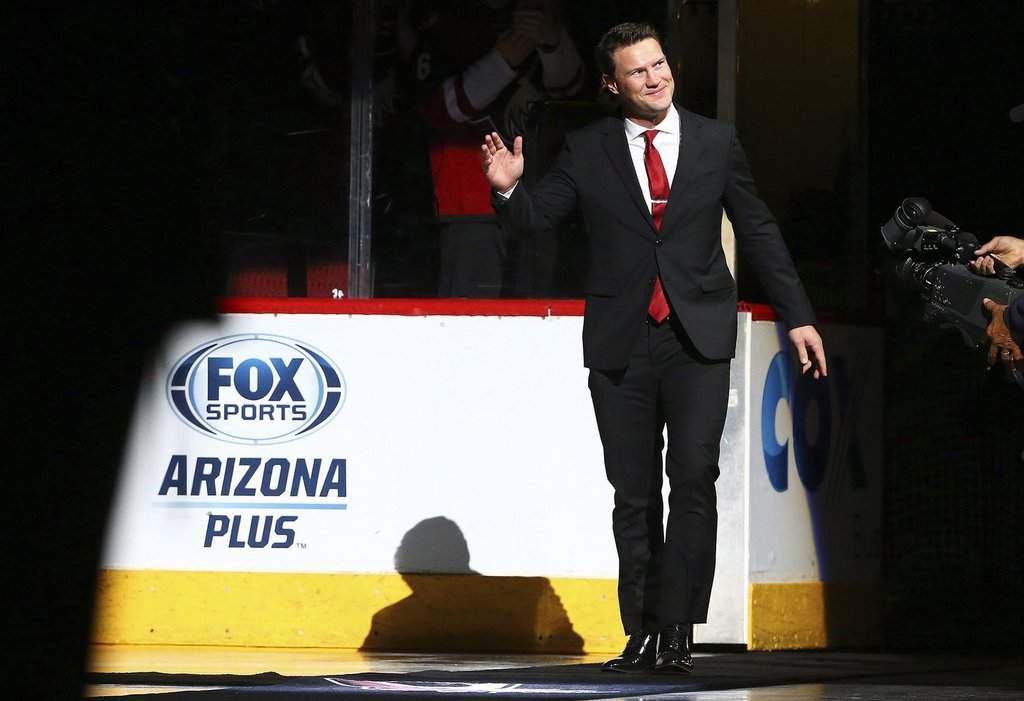
The news broke with the surgical precision of a corporate press release. The Toronto Maple Leafs and Shane Doan, the team’s special advisor to the general manager, have parted ways. It was a brief marriage of necessity and ambition that lasted thirty-six months. To the casual observer, it’s a line in a transaction column. To anyone who understands the delicate ecosystem of a championship pursuit, it’s a tectonic shift in the room where decisions are made.
Think about the weight of a name like Doan. In Arizona, he was a deity. He was the man who stayed when everyone else left, the captain who carried a dying franchise on his back until his knees gave out. He didn’t come to Toronto for the paycheck. He came because Brad Treliving, the man tasked with finally breaking the longest championship drought in the sport, needed a specific kind of soul in the room. He needed a guy who knew what the grind felt like from the inside of a jersey, not just the logic of a spreadsheet.
The chemistry of a front office is a fragile thing. When Treliving took the reins in Toronto, he brought Doan in to be his eyes and ears. It was a partnership built on decades of mutual respect. In the high-stakes theater of the NHL, the general manager is the conductor, but the special advisor is the person who tells the conductor when the violins are out of tune. Doan was the bridge between the suits and the skates. He was the one who could walk into a locker room after a devastating playoff exit and look a twenty-four-year-old superstar in the eye with the authority of someone who had bled for the game.
But the Maple Leafs are not a normal hockey team. They are a psychological experiment disguised as a sports franchise. Every win is over-analyzed; every loss is a national tragedy. The pressure doesn't just sit on the players. It seeps into the walls. It coats the desks. It makes every decision feel like a life-or-death maneuver.
During those three seasons, the "core four" of the roster remained the focal point of every conversation. Can you win with that much money tied up in four forwards? Is the defense rugged enough to survive a seven-game series in May? Doan was there for all of it. He watched the cycles of hope and heartbreak from the inner circle. He saw the team struggle to find that elusive "it" factor—that jagged, uncomfortable edge that separates the talented from the champions.
Why does a man like Shane Doan walk away?
The official narrative usually cites "mutual agreement" or "seeking new opportunities." The reality is often more human. Sometimes, the vision just stops aligning. Sometimes, the constant friction of a market like Toronto wears down even the most resilient spirits. Or perhaps, more simply, the project changed. When Doan arrived, the mission was to stabilize a ship that had just lost its previous captain in a messy, public breakup. Three years later, the ship is stable, but it’s still stuck in the same harbor.
Consider the perspective of a young player in that system. For three years, they had a legend in the building. They had a man who scored 402 goals and played 1,540 games available for a chat in the hallway. That’s an intangible asset. You can’t trade for that, and you certainly can’t replace it with an analytical model. When that presence leaves, there is a vacuum. The room gets a little colder. The perspective gets a little narrower.
The departure coincides with a broader shift in the Maple Leafs' philosophy. We are seeing a tightening of the circle. Treliving is a builder who prizes loyalty and specific archetypes of grit. If Doan is no longer part of that blueprint, it suggests a narrowing of the path forward. It means the "new" era of Toronto management is entering its next phase—one that might be even more clinical, even more insulated.
Loss is a funny thing in sports. We quantify it in goals against or points dropped in the standings. We rarely quantify the loss of a voice. Doan wasn't the one making the trades or signing the checks, but he was the one whispering in the ear of the man who did. He was the sanity check. He was the veteran heartbeat in a corporate machine.
The move leaves the Maple Leafs front office looking different, leaner, and perhaps a bit more mysterious. Without Doan’s public-facing credibility and deep hockey pedigree acting as a buffer, the spotlight shines even brighter on Treliving and his staff. There is no one left to share the shadow.
The sun will come up over the practice facility in Etobicoke tomorrow. The scouts will still report their findings. The agents will still call. The fans will still argue until they are hoarse about power-play percentages and goaltending depth. But there is an empty chair in the war room now. It’s the chair where a guy used to sit who knew exactly what it felt like to give everything to a game and come up short.
In a city that has spent half a century coming up short, that was a voice worth keeping.
The silence that follows a departure like this is rarely permanent. It’s a pause. A breath before the next move. But as the team prepares for another grueling winter, they do so without one of the most respected figures in the sport. They move forward with their spreadsheets and their strategies, hoping that the logic of the plan is enough to replace the intuition of the man.
He walked out the door with his reputation intact and three years of secrets tucked under his arm. The Maple Leafs are left with the same question that has dogged them since 1967. They have the talent. They have the resources. They have the map.
They just keep losing the people who know how to read it.