The risers were built to hold the weight of the world.
In the humid February air of Rio de Janeiro, a team of carpenters spent hours leveling a multi-tiered wooden platform inside the Marina da Glória. They checked the angles. They tested the lighting rigs. They laid down strips of white gaffer tape, each marked with the name of a nation, spacing them precisely twenty-four inches apart so that twenty of the most powerful diplomats on earth could stand shoulder-to-shoulder without their elbows colliding.
Then, the diplomats arrived. And nobody stepped onto the wood.
Silence.
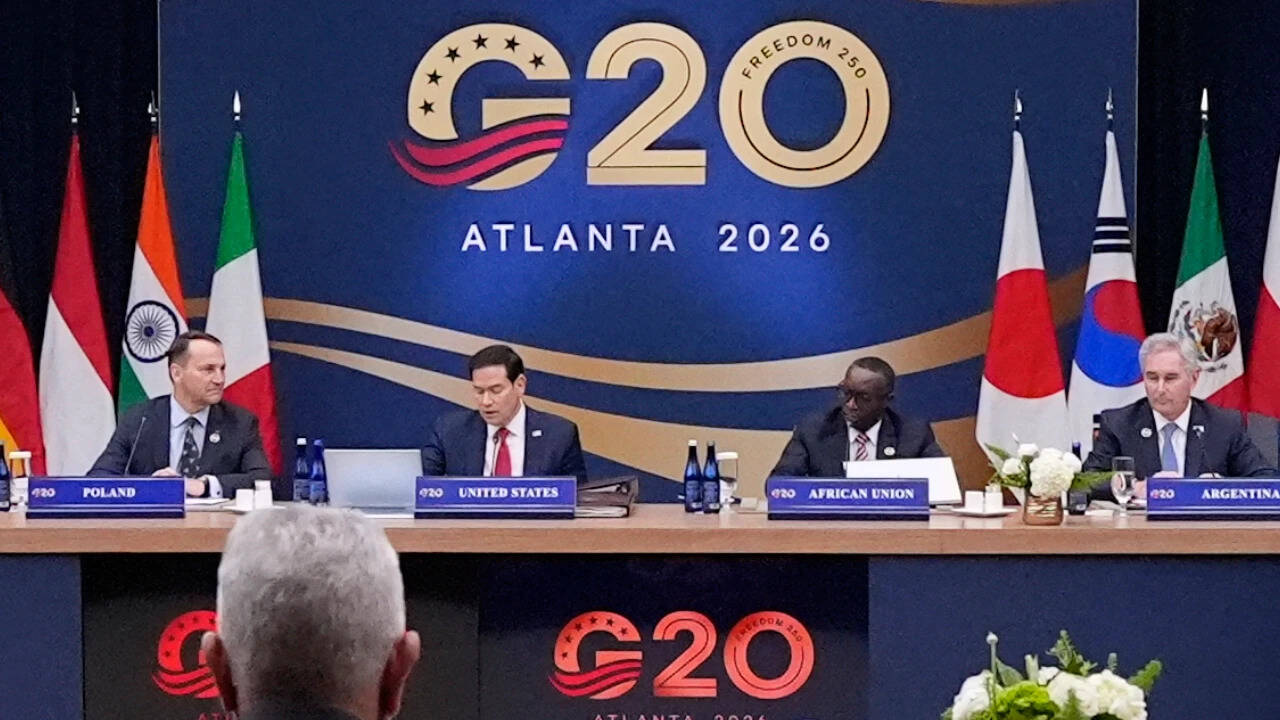
If you blinked while scrolling through your morning feed, you might have missed the wire reports noting that the G20 foreign ministers' meeting opened without its traditional "family photo." To the casual observer, skipping a photo op sounds like a blessing—one less stiff, artificial smile beamed out from a conference hall while the rest of us worry about the price of groceries or the heat waves scorching our summers. Who cares if a bunch of suits refuse to stand on a wooden riser together?
You should. Because in the high-stakes theater of international diplomacy, the photograph is never just a photograph. It is the receipt. It is the visual proof that, despite trade wars, ideological chasms, and proxy conflicts, the adults in the room are still willing to occupy the same physical space long enough to keep the global machinery from grinding to a halt.
When European ministers quietly informed their Brazilian hosts that they would not stand on the same stage as Russian Foreign Minister Sergey Lavrov, they didn't just cancel a press briefing. They pulled the curtain back on a terrifying reality. The old rules of global cooperation are dead, and we are currently living through the awkward, dangerous intermission before anyone figures out what comes next.
The Architecture of a Smile
To understand why an empty wooden platform in Brazil matters to a small business owner in Ohio or a wheat farmer in Kenya, you have to understand what the G20 was actually built to do.
Think of the global economy as a massive, aging suspension bridge. Every day, trillions of dollars, millions of shipping containers, and billions of digital transactions cross over it. For decades, a small club of Western nations—the G7—acted as the sole engineering crew. They inspected the cables. They set the tolls. They decided who got to cross.
Then came the 2008 financial crash. The bridge started swaying violently, and the Western crew realized they didn't have enough steel or manpower to hold it up alone. So, they expanded the team. They invited rising giants like China, India, Brazil, and South Africa, alongside Russia, to form the G20. Together, these nations represent roughly eighty-five percent of the world’s economic output and two-thirds of its population.
The unspoken bargain of the G20 was simple: you don't have to like each other, and you certainly don't have to agree on human rights or border disputes, so long as you show up when the bridge shakes. You stand on the riser. You smile for the cameras. You signal to nervous markets and anxious citizens that the center will hold.
I spent years covering international summits from the press pens, watching the choreography of these moments up close. You learn to read the micro-expressions of power. I remember watching leaders who had spent the previous forty-eight hours trading vicious public insults walk up those carpeted steps, adjust their ties, and force their faces into polite, neutral masks. It was performative, yes. It was often cynical. Yet, that shared performance acted as a circuit breaker. It proved that a baseline of communication existed—a thin, fragile wire stretched across an abyss.
In Rio, that wire snapped.
A Tale of Two Rooms
Consider a hypothetical scenario to see how this diplomatic freeze trickles down into the real world. Meet Elena, a logistics manager at a mid-sized manufacturing firm in Rotterdam, and Mateo, an agricultural exporter in Buenos Aires. Neither of them cares about diplomatic protocol. Both of them care deeply about predictability.
When European ministers refuse to share a frame with Moscow, they are sending an unmistakable message: the war in Ukraine is not a regional dispute that can be compartmentalized while everyone discusses debt relief or climate finance. To stand beside Lavrov, in the eyes of diplomats from Paris, Berlin, and Brussels, is to launder the reputation of an aggressor state. It is to pretend that things are normal when tanks are still rolling across European soil.
On a human level, that refusal is entirely understandable. How do you smile next to the representative of a government bombing your neighbors? You don't. You balk. You protect your moral boundary.
Now look at the room from the perspective of Brazilian Foreign Minister Mauro Vieira, the host left staring at the empty risers.
For countries in the Global South—nations like Brazil, India, and South Africa—the paralysis of the G20 feels like a wealthy family fighting over an inheritance while the house burns down. While Europe and the United States focus intensely on containing Russian aggression, Mateo in Buenos Aires is watching inflation eat his margins. Developing nations are drowning in sovereign debt, hammered by extreme weather events, and starved of the green energy investments they were promised years ago.
These issues cannot be solved by Europe alone. They cannot be solved by Washington alone. They require global consensus, coordinated central bank policies, and shared supply chains. When the G20 splinters into camps that won't even stand in the same twenty-foot radius for ninety seconds, the agenda stalls. The bridge stops getting repaired.
Elena in Rotterdam feels the tremor six months later when a new set of fragmented trade tariffs disrupts her component suppliers. Mateo feels it when international financing for a vital port expansion dries up because global institutions are too polarized to approve the funds. The cold shoulder in Rio becomes a cold reality on a balance sheet thousands of miles away.
The Trap of Performative Purity
We live in an era that rewards moral clarity and punishes compromise. In our personal lives, walking away from someone who violates our core values is hailed as healthy boundary-setting. We project that exact same psychology onto international relations, demanding that our leaders shun bad actors completely.
History suggests this is a dangerous trap.
During the darkest stretches of the Cold War, when the United States and the Soviet Union had thousands of nuclear warheads aimed at each other's cities, diplomats still sat in the same rooms in Geneva and Vienna. They drank bad coffee together. They posed for stiff, uncomfortable photographs. They did this not because they trusted one another, nor because they approved of the other's atrocities, but because proximity was the only alternative to catastrophe.
Diplomacy is the art of dealing with people you despise so that your children don't have to fight them.
When European officials balked at the Rio photo op, they were acting on a deeply ingrained, entirely human instinct for moral consistency. Yet, in doing so, they inadvertently handed Moscow a quiet victory. Russia doesn't need to win the diplomatic argument at the G20; it only needs to prove that the Western-led international order is broken, hypocritical, and incapable of governing. Every empty space on a stage, every canceled joint communiqué, reinforces the Kremlin's narrative that the old world is collapsing.
Worse still, it alienates the very nations the West needs to win over. To a diplomat from Jakarta or Nairobi, watching European ministers boycott a photo op over Ukraine—while those same European nations continue to buy Russian liquefied natural gas through backchannels and struggle to agree on aid for crises in Gaza or Sudan—looks less like principle and more like selective outrage.
The Long Shadow of the Unspoken
I have to admit, there is something deeply unsettling about watching this unfold, because there is no obvious playbook for fixing it. If you force the photo, you validate aggression. If you cancel the photo, you accelerate the fragmentation of the world into hostile, non-communicating blocs.
Either way, something breaks.
Look closely at what happened after the cameras were packed away in Rio. The ministers still held their meetings behind closed doors. They still delivered their prepared remarks. Lavrov still sat at the table, listening through his earpiece as Western counterparts condemned the invasion of Ukraine, before delivering his own predictable rebuttal blaming NATO expansion.
The mechanics of the summit continued, hollowed out like a tree eaten from the inside by termites. From a distance, the G20 still looks like a functioning global steering committee. Up close, it is a collection of parallel monologues. Nobody is listening. Everyone is performing for their domestic audiences back home, crafting soundbites for evening news broadcasts and social media feeds.
This is the invisible cost of our fractured era. We are losing the spaces where nuance can survive.
A group photograph forces a moment of shared humanity, however fleeting and artificial. It requires physical coordination. You have to step aside to let someone pass. You have to nod when your eyes meet. You are reminded, on a visceral, biological level, that the person standing two feet to your left is a flesh-and-blood human being, not merely an avatar of a rival state.
Remove that physical ritual, and it becomes infinitely easier to demonize, to miscalculate, and to drift toward conflicts that nobody actually wants.
A Stage Waiting in the Dark
Later that evening in Rio, long after the motorcades had sped away toward luxury beachfront hotels and the press corps had filed their stories about diplomatic snubs, the cleaning crew entered the Marina da Glória.
They swept up discarded water bottles and stray briefing papers. They wiped down the microphones. And eventually, a team of workers returned with crowbars and drills to dismantle the multi-tiered wooden platform that had never been used.
They pried up the white strips of gaffer tape, rolling them into sticky balls and tossing them into trash bins. France, Russia, the United States, India, Brazil—all the names crumpled together in the dark.
The wood was stacked neatly onto flatbeds and driven out into the humid night, leaving behind nothing more than a faint outline of dust on the convention floor where the world was supposed to stand together.