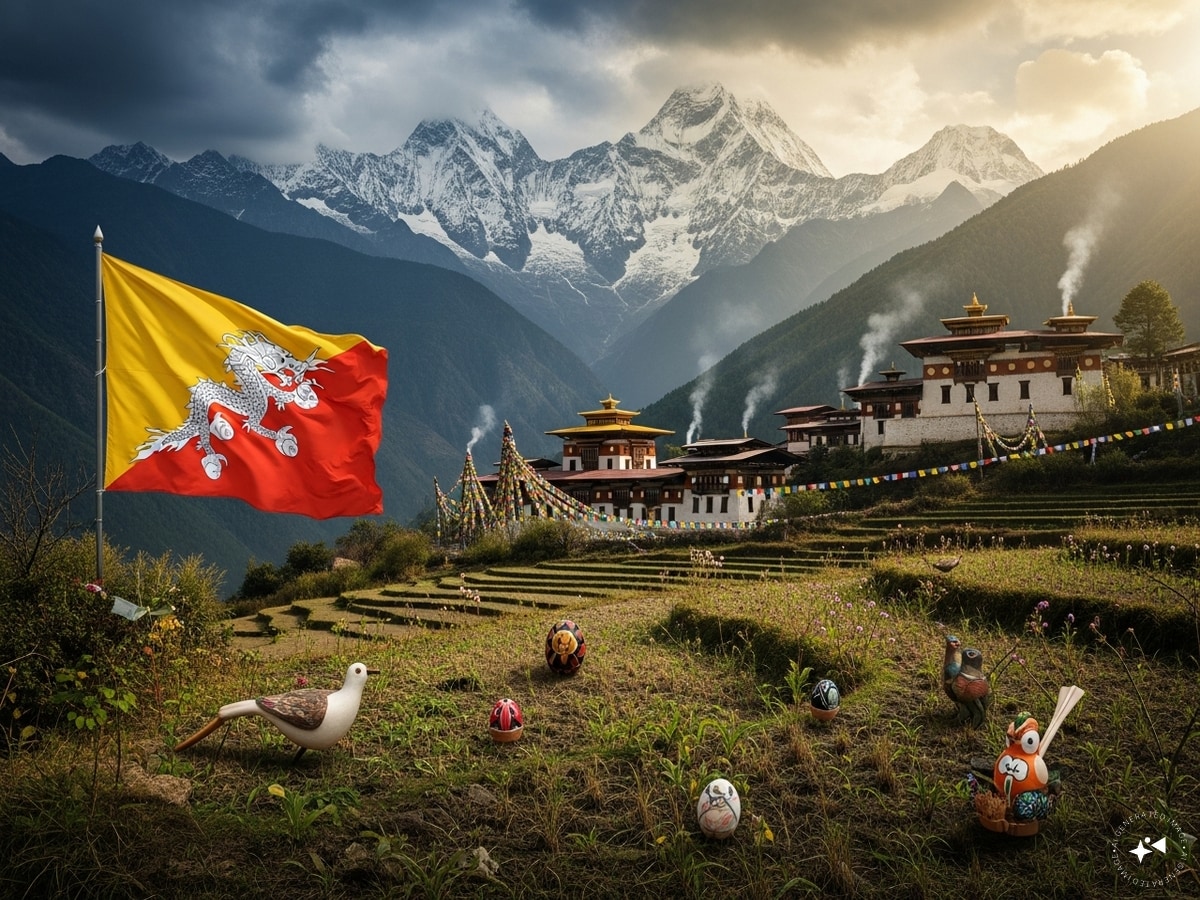
The evening mist rolls over the ridges of Punakha, swallowing the tiered rice paddies in a cold, silent blanket. A generation ago, this hour was the loudest time of day. Courtyards echoed with the shouts of children chasing stray dogs, the clatter of heavy wooden pots, and the deep, reassuring chatter of three generations sharing a single hearth.
Today, there is only the wind.
Consider the home of Karma, a seventy-two-year-old grandfather whose family has farmed this valley since the era of the first King. His house is a masterpiece of traditional architecture, featuring hand-painted wooden cornices and thick mud walls built to withstand the Himalayan winters. But three of its four bedrooms are dark. The heavy woolen blankets remain folded in cedar chests.
Karma’s story is not unique; it is the new baseline of a changing nation. His eldest son lives in Perth, Western Australia, working sixty hours a week between a commercial kitchen and an aged-care facility. His daughter-in-law is there too, studying accounting. His two grandchildren speak English with a distinct Australian drawl, knowing the mountains of their homeland only through the pixelated glass of a WhatsApp video call.
Bhutan, a kingdom globally revered for prioritizing Gross National Happiness over Gross Domestic Product, is quietly emptying out. It faces a dual crisis that threatens its very identity: a cratering birth rate and a historic exodus of its young, educated population. The valleys that once nurtured a deeply communal, spiritual way of life are witnessing an unprecedented transformation.
The Swift Descent
To understand how quickly the ground has shifted, look at the timeline. In the early 1990s, the average Bhutanese woman gave birth to five or six children. Large families were economic necessities for subsistence farming and a cultural norm wrapped in the warmth of community. The government even promoted a "Small Family, Happy Family" campaign to manage population growth.
The campaign succeeded far beyond its original intent.
By 2012, the fertility rate dipped below the global replacement level of 2.1 children per woman. Today, it hovers around 1.8, with some international estimates placing it as low as 1.46. It is one of the fastest fertility transitions in Asian history.
What caused such a sudden halt? The shift is a direct result of Bhutan’s rapid development achievements. Better healthcare reduced infant mortality, meaning families no longer needed to have many children to ensure some survived. Expanded education and career options for women delayed marriages. Urbanization turned children from economic assets on a farm into significant financial responsibilities in city apartments.
But the falling birth rate is only half the equation. The more immediate shock wave is the physical departure of the prime working-age population.
More than 71,000 Bhutanese currently live abroad. For a country of fewer than 800,000 people, that represents nearly nine percent of the total population. Crucially, this group consists almost entirely of the nation's young, educated, and professional class—the exact people needed to birth the next generation and drive the domestic economy.
The Distance of the Dream
The primary destination for this modern exodus is Australia, a country located thousands of miles away from the high-altitude pine forests of the Himalayas. Entire neighborhoods in cities like Perth have become de facto Bhutanese enclaves. In the suburbs of Glendalough and Osborne Park, local grocery stores stock imported red rice and dried yak cheese, while the air carries the scent of chili and cheese stew.
The financial incentive is undeniable. Between 2023 and 2024, Bhutanese living abroad sent home over $210 million in remittances, with the majority originating from Australia. This capital keeps many extended families afloat, paying off mortgages and funding medical care.
Yet, this financial lifeline comes at a steep societal cost.
Consider a hypothetical young couple, Pema and Dorji, both twenty-eight, living in Thimphu. Pema is a junior civil servant; Dorji works in IT. Together, their combined monthly income barely covers the rent of their modest apartment, let alone the rising cost of groceries, utilities, and imported baby formula. A single packet of diapers can cost more than 900 Ngultrum, a significant sum against a modest local salary.
When they look at their peers who moved to Australia, they see a path to financial independence. But when they look at their immediate future in Thimphu, parenthood feels like an economic risk. They choose to delay having children, or opt out entirely, directing their energy toward securing student visas to leave.
This dynamic leaves the homeland caught in a difficult position. The loss of reproductive-age citizens means fewer marriages and fewer births at home. The country is experiencing a profound brain drain, losing its teachers, nurses, and civil servants, while its domestic cradle grows increasingly quiet.
The Cost of Care
In response to what Prime Minister Tshering Tobgay has called an "existential" crisis, the government launched the Third Child Plus program. The initiative is a direct attempt to financialize family growth, offering monthly cash incentives of approximately $105 for a third child and any subsequent children, payable until the child turns three.
But cash transfers rarely alter deeply rooted socioeconomic realities.
For working mothers in urban centers, money is only part of the problem. The real challenge is the lack of structural support. In cities like Thimphu, the traditional safety net of grandparents and aunts has dissolved. Dual-income couples find themselves trapped between demanding work schedules and a lack of affordable, reliable childcare options.
A one-time or temporary cash payout does not address the long-term expenses of raising a citizen—the decades of education, healthcare, and housing. Without subsidized daycare facilities, flexible parental leave, and a stable real estate market that allows young families to buy homes, a financial incentive remains a short-term band-aid on a structural issue.
The consequences of this demographic shift extend beyond economics to touch the core of Bhutanese society. In rural areas, the phenomenon of gungtong—empty houses left behind by families migrating to cities or moving abroad—is rising. More than 4,800 rural households now sit abandoned. Fields that once grew barley and buckwheat are returning to wilderness, wildlife is encroaching on untended borders, and ancient community rituals are fading because there are not enough young hands to carry the ceremonial palanquins.
The Clock is Ticking
Developing nations that face a demographic winter encounter a specific vulnerability that economists describe as "getting old before they get rich."
Wealthier nations like Japan or South Korea have deep financial reserves, advanced infrastructure, and high automation to help cushion the impact of a shrinking, aging workforce. Bhutan does not have that luxury. The proportion of its citizens aged sixty-five and older is projected to rise from six percent to over seventeen percent by 2050.
A small workforce will be left to support a growing elderly population, placing immense strain on the free national healthcare system and threatening the sustainability of the economy. The country risks missing out on its demographic dividend—the economic growth phase driven by a high ratio of working-age citizens—before it can transition into a high-income nation.
To counter this, leadership is looking toward major structural solutions, such as the proposed Gelephu Mindfulness City. The ambitious special administrative region aims to attract international investment, foster mindful economic spaces, and create high-value, modern jobs that can convince young professionals their futures belong within their own borders.
But mega-projects take decades to mature, and the demographic clock is ticking now.
Back in Punakha, the shadows deepen across Karma's empty courtyard. The old man turns on a single solar-powered porch light, illuminating the intricate lotus flowers carved into his window frames. He sits alone with a cup of butter tea, watching the glare of a smartphone screen across the room. On it, a video loop plays of his grandson running through a sunny park in Western Australia, surrounded by eucalyptus trees, a world away from the mountains that shaped his ancestors.