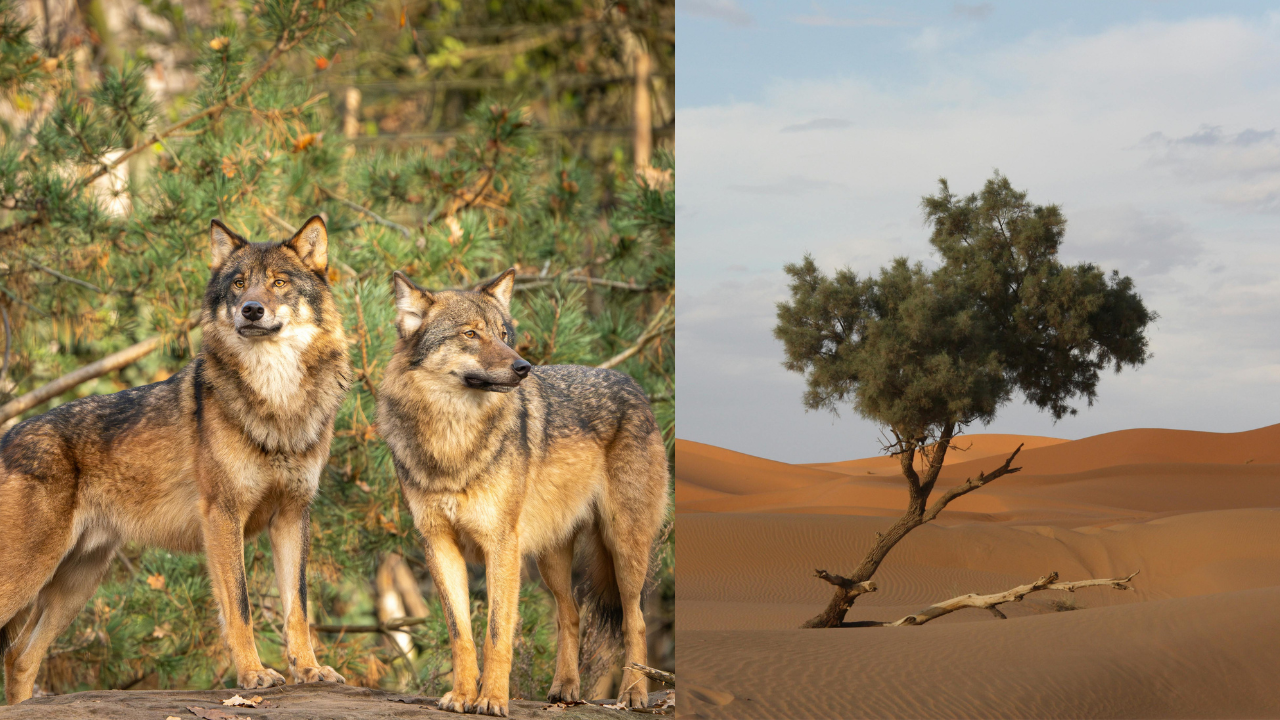
Carnivores are rarely modeled as primary architects of desert plant distribution, yet field observations showing eight plant species' seeds in wolf and fox droppings across arid habitats point to a high-leverage dispersal mechanism in one of Earth's most resource-constrained environments. Conventional ecological models treat hyper-arid and arid systems such as the Sahara through abiotic filters—rainfall scarcity, wind erosion, soil salinity, and extreme thermal swings—while treating predators almost exclusively as trophic regulators of prey populations. When wolves and foxes consume plant matter and deposit intact seeds in scat, they convert mobile hunting routes into directional seed-delivery corridors. Understanding this dynamic requires separating confirmed physical recovery of intact seeds from unverified ecological outcomes, mapping how carnivore movement alters spatial plant patterns, and evaluating where endozoochory actually shifts community structure versus where abiotic mortality overrides it.
This analysis establishes a structured framework for interpreting carnivore-mediated seed dispersal in arid zones without inventing unverified field metrics. Because the source reference provides a headline-level finding rather than a full dataset, exact sample sizes, germination percentages, and feeding frequencies are not asserted as hard numbers. Instead, the article breaks down the biological and spatial mechanisms that govern whether seeds recovered from carnivore droppings become established plants, highlights the causal chains typically overlooked in standard dispersal summaries, and identifies methodological limits that constrain current conclusions.
The Endozoochory Funnel in Hyper-Arid Environments
Seed dispersal by vertebrates—zoochory—operates across distinct stages, and internal transport via ingestion and defecation (endozoochory) imposes sharp mechanical and chemical selection before a seed ever touches soil. In an arid ecosystem, where water availability acts as a severe bottleneck on recruitment, every stage of the funnel filters out the vast majority of propagules. Treating seed presence in scat as proof of successful plant spread conflates transport with recruitment.
A practical way to evaluate carnivore seed dispersal is to trace four sequential stages:
- Encounter and ingestion: A canid encounters fruit, seed-bearing pods, or seed-contaminated prey/herbage and ingests seeds directly or secondarily.
- Gut passage filtering: Mechanical mastication, gastric acidity, enzymatic activity, and gut retention time damage fragile seeds while potentially abrading or scarifying tough seed coats in ways that alter dormancy.
- Spatial deposition: The animal deposits scat along territory boundaries, travel paths, water margins, shade refuges, or denning areas, placing seeds in microsites that differ sharply from random wind or runoff scatter.
- Post-deposition fate: Seeds face desiccation, granivory by ants or rodents, burial depth constraints, and rare moisture windows required for germination and root establishment.
In arid landscapes, the transition from stage three to stage four is where most dispersal events stall. A seed can survive gut passage intact and land inside a fecal pellet, yet fail to germinate if rain does not arrive while the seed remains viable or if scavengers locate the deposit first. Conversely, when a seed survives digestion and lands in a moisture-retentive or nutrient-enriched microsite, a single long-distance movement by a predator can bypass inhospitable barren ground that wind or gravity could never cross.
Why Omnivorous Canids Matter in Carnivore-Dominated Guilds
Wolves and foxes are often categorized mentally as meat-eaters, yet wild canids frequently exhibit omnivorous plasticity depending on season, prey scarcity, and local fruit or seed availability. In arid and semi-arid regions, fleshy fruits, dry pods, or fibrous plant tissues can serve as accessible sources of water, carbohydrates, or micronutrients, or enter the digestive tract incidentally alongside herbivorous prey whose stomachs hold plant material.
This dietary flexibility creates a functional bridge between trophic levels. A predator moving across tens of kilometers in search of prey or water carries internal cargo accumulated across varied patches. Unlike wind dispersal, which is governed by topography and prevailing gusts, or water dispersal, which follows drainage channels and flash-flood paths, canid-mediated movement follows animal behavior: territorial patrolling, ridge and track travel, scent-marking sites, and movement between resource patches.
Hidden Cause-and-Effect Chains in Predator Seed Dispersal
Standard summaries of seed-in-scat findings usually stop at a simple chain: animals eat plants, drop seeds, and spread species. That linear view misses second-order feedbacks that determine whether eight dispersed species represent an ecological driver or a minor sideline.
Microsite Enrichment Versus Nutrient Competition
Fecal matter is not a neutral carrier; it is a localized package of organic matter and moisture retention relative to bare sand or gravel. In nutrient-poor desert soils, decomposition of scat can supply localized mineral nutrients that support early seedling growth once water is available. At the same time, high concentrations of organic waste or dense clusters of seeds can create trade-offs: fungal growth, microbial activity, or intense competition among multiple seeds emerging from the same dropping can disadvantage individual seedlings if moisture is brief.
The net effect depends on timing and matrix contrast. Against a backdrop of wind-scoured stone or shifting sand with almost zero organic retention, even a small organic patch can improve water-holding capacity at the micro-scale. Against a slightly more favorable patch, competition or pathogen pressure may offset the advantage.
Corridor Geometry and Directional Bias
Wind disperses seeds along aerodynamic trajectories; canids disperse seeds along behavioral trajectories. Wolves and foxes regularly use linear features—animal trails, washes, ridgelines, and edges—as low-resistance travel routes and place scats conspicuously as visual and olfactory cues. Over time, repeated deposition along travel paths can align plant occurrence with movement corridors rather than uniform patches.
This spatial bias has a distinct consequence for plant metapopulations. If seeds are repeatedly deposited along travel routes that cross dry inter-patch zones, some seeds land in unsuitable ground and perish, while occasional seeds reach isolated favorable microsites—such as rocky outcrops, ephemeral drainage edges, or sheltered depressions—where water collects during rare rainfall events. Even low per-seed survival can matter over long timescales if no other vector reaches those isolated pockets.
Secondary Dispersal and Granivore Trade-Offs
A dropping on the ground triggers rapid biotic interactions. Dung beetles, ants, rodents, and birds respond to olfactory and visual cues. Some granivores destroy seeds outright, reducing recruitment. Other animals, particularly seed-harvesting ants or scatter-hoarding rodents, may move seeds short distances away from the scat pile, sometimes burying them at depths that protect them from surface heat and desiccation, or leaving them in caches that later germinate if forgotten.
Ignoring post-deposition biotic reworking leads to a common analytical error: assuming a seed stays where the wolf or fox dropped it. In reality, carnivore scat often functions as a staging point rather than a final resting place.
Known Facts Versus Educated Hypotheses
Rigorous ecological analysis requires separating what is directly observed when seeds are found in droppings from what must be inferred through experiments and field tracking.
| Analytical Dimension | Known Fact / Direct Observation | Educated Hypothesis / Mechanism to Test |
|---|---|---|
| Seed presence | Intact seeds from eight plant species were identified in wolf and fox droppings in a Sahara/arid context. | Wolves and foxes act as recurring multi-species seed vectors across broader portions of their range when plant items are available. |
| Gut survival | Those seeds passed through the gastrointestinal tract without complete mechanical or chemical destruction. | Gut passage alters seed coat permeability or dormancy cues for at least some of the eight species, changing germination timing. |
| Spatial reach | Canids travel wide distances across arid landscapes relative to many sedentary seed dispersers. | Predators connect isolated moisture-favored microsites across otherwise inhospitable desert matrices. |
| Population impact | Seed transport occurs via scat deposition. | Endozoochory meaningfully shifts plant range boundaries, genetic connectivity, or patch occupancy compared with abiotic dispersal. |
Conflating the right column with the left column is the fastest way to overclaim ecological significance. Finding an intact seed in feces proves passage and potential viability, not establishment. Demonstrating recruitment requires tracking seedlings through germination, summer heat stress, herbivory, and subsequent dry seasons.
Methodological Limits and Failure Modes
Even well-designed studies of endozoochory in arid carnivores face structural constraints that limit how far a single finding can be generalized.
First, visual seed recovery biases identification. Intact, recognizable seeds are far easier to catalog than heavily digested fragments or microscopic seeds, which can skew which species appear prominent in scat analyses. Second, scat counts do not measure per-capita contribution. A species appearing in droppings may still rely primarily on wind, water, reptiles, birds, or livestock for the bulk of its population turnover. Third, sampling geography and seasonality distort rates. Arid ecosystems experience sharp boom-and-bust pulses tied to sporadic rain; scat collected during or shortly after a fruiting pulse will look very different from scat collected during prolonged drought when plants bear no fruits or seeds.
There are also operational blind spots when analysts treat carnivore conservation and plant conservation as automatically aligned. Protecting wide-ranging predators can support ecological processes like seed movement, yet predator populations in arid zones face pressures from habitat fragmentation, human-wildlife conflict, and prey depletion. If wolf or fox numbers decline or their movement corridors are severed by fencing, roads, or intense disturbance, any directional dispersal they provide along those routes contracts accordingly. Conversely, assuming that carnivore presence alone will restore degraded desert vegetation ignores severe baseline constraints such as soil degradation, overgrazing by domestic livestock, and multi-year droughts.
Translating Scat Findings Into Field and Analytical Action
For researchers, conservation planners, and analysts evaluating arid ecosystem reports, the practical move is to treat a seed-in-scat discovery as a hypothesis generator rather than a finished ecological verdict. A disciplined workflow turns a headline observation into testable operational evidence:
- Stratify species by dispersal and dormancy traits. Group the eight identified species by seed coat thickness, fruit type, known dormancy mechanisms, and primary non-canid dispersal modes to predict which ones are most likely to benefit from gut passage versus incidental survival.
- Map scat locations against micro-topography and moisture catchers. Record whether droppings cluster along travel paths, washes, shade structures, or rocky margins rather than uniform open ground, testing whether deposition aligns with water-accumulation microsites.
- Run paired germination and seedling-tracking checks. Compare seeds recovered from scats against uningested control seeds under controlled moisture regimes, and monitor marked scat deposits in the field across wet and dry windows to separate passage from actual emergence and survival.
- Integrate movement data with landscape barriers. Overlay canid movement corridors and home-range boundaries with linear infrastructure and fragmented patches to identify where movement connectivity supports cross-patch seed flow and where barriers interrupt it.
The most durable strategic takeaway is to stop viewing arid food webs as rigid compartments of hunters, herbivores, and plants linked only by consumption and mortality. In harsh environments where every rare rain event is an opportunity for a seed to take hold, mobile omnivorous predators operate as dynamic logistics networks—moving biological cargo across space even when the primary reason they walk is the hunt. Researchers and land managers who pair predator movement and diet tracking with seedling-level survival checks will capture the true ecological leverage of endozoochory without mistaking a seed in scat for a new forest in the desert.


