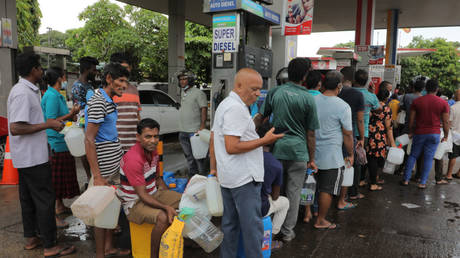
Sri Lanka’s pivot toward Russian energy imports is not a political realignment but a desperate exercise in liquidity-constrained survival. When a nation’s foreign exchange reserves collapse, the procurement of energy ceases to be a function of market preference and becomes a function of credit accessibility. By securing crude from Siberian sources, Colombo is attempting to solve a trilemma of debt-default recovery, domestic power stability, and inflationary cooling. The success of this strategy hinges on the narrow delta between Western sanctions compliance and the physical throughput of the Sapugaskanda refinery.
The Mechanics of Default-Driven Procurement
Standard energy markets operate on a basis of Letters of Credit (LCs) and immediate liquidity. Sri Lanka’s sovereign default in 2022 severed its access to traditional credit lines, leaving the state-owned Ceylon Petroleum Corporation (CPC) unable to bid for Brent or Murban crude in open auctions. This created a structural bottleneck where supply was available globally, but unreachable locally.
Russian crude enters this vacuum as a distressed asset. Because traditional European and G7 buyers have restricted their intake, Russia provides non-traditional credit terms or deep discounts that bypass the immediate requirement for USD-denominated LCs from top-tier global banks. This isn't "cheap oil" in a vacuum; it is "accessible oil" for a bankrupt state. The procurement logic follows a two-factor model:
- Credit Elasticity: The willingness of the seller to accept delayed payments or alternative settlement currencies that don't trigger immediate reserve depletion.
- Refinery Compatibility: The Sapugaskanda refinery, a facility aging into obsolescence, requires specific API gravity and sulfur content profiles. While typically optimized for Iranian Light, the facility must be recalibrated for Russian blends like Siberian Light or Urals, a process that incurs a technical "yield penalty" but remains cheaper than total grid failure.
The Three Pillars of the Sri Lankan Energy Crisis
To understand why Russian oil is the only viable lever, one must dissect the interlocking crises within the Sri Lankan energy ecosystem.
1. The Foreign Exchange Velocity Constraint
Sri Lanka’s primary constraint is not a lack of currency, but a lack of convertible currency. The central bank’s ability to defend the rupee is non-existent while it negotiates IMF restructuring. Every shipment of oil purchased at market rates requires a massive outflow of USD, which accelerates the depreciation of the local currency and spikes the cost of all other imports (food, medicine). Russian oil, often sold at a $20 to $30 discount per barrel relative to Brent, reduces the velocity of reserve depletion.
2. The Power Generation Feedback Loop
Sri Lanka’s energy mix is dangerously interdependent. A shortage of fuel oil for thermal plants leads to daily rolling blackouts. These blackouts halt industrial production (primarily tea and garments), which are the country’s main sources of export revenue. Without export revenue, the state cannot buy more oil. This "Energy-Revenue Spiral" means that even a 10% disruption in fuel supply can lead to a 30% contraction in manufacturing output. Securing a steady, even if controversial, supply line breaks this feedback loop.
3. The Geopolitical Compliance Buffer
Sri Lanka occupies a strategic position in the Indian Ocean, making it a focal point for both Indian and Chinese interests. By engaging with Russia, Colombo is navigating a narrow corridor. The U.S. and its allies have largely tolerated these purchases because the alternative—a total humanitarian and economic collapse of a nuclear-adjacent maritime hub—is considered a greater risk than the marginal revenue provided to the Kremlin.
The Technical Bottleneck: Sapugaskanda’s Yield Problem
A significant misconception in the reporting of this deal is that any oil can be substituted for any other. Crude oil is not a fungible commodity at the point of refining.
The Sapugaskanda refinery has a throughput capacity of approximately 50,000 barrels per day (bpd). Most Russian crude grades, particularly Urals, are "Medium Sour." If the refinery is fed a grade it wasn't designed for, the "Bottom of the Barrel" increases. Instead of producing high-value petrol (gasoline) and diesel, the process yields a higher percentage of low-value heavy fuel oil and bitumen.
The cost-benefit analysis for the Sri Lankan Ministry of Power and Energy involves calculating whether the discount on the raw crude exceeds the loss in refined product value. If Russian Siberian Light is used, the yield remains high. If the heavier Urals is used, Sri Lanka effectively trades a currency crisis for a technical efficiency crisis.
Risk Assessment: The Secondary Sanctions Shadow
While the "Price Cap" mechanism led by the G7 allows for the purchase of Russian oil as long as it is priced below $60 per barrel, the logistics are fraught with hidden costs.
- Freight and Insurance: Traditional Western insurers (P&I Clubs) will not cover ships carrying Russian oil above the cap. This forces Sri Lanka to use a "Shadow Fleet" of older tankers with questionable insurance.
- Transaction Friction: Payments must often move through third-country intermediaries or via non-SWIFT channels. Each layer of intermediation adds a 2% to 5% "risk premium" to the transaction, eroding the nominal discount provided by Russia.
- The Indian Arbitrage: A significant portion of the "Russian" fuel reaching Sri Lanka may actually be refined in India. Indian refineries (such as Reliance or Nayara) import Russian crude, process it, and export the finished diesel to Sri Lanka. This provides Sri Lanka with a layer of "sanctions-laundering," but at the cost of the refiner's margin, making it more expensive than direct crude imports.
The Strategic Play for Stability
Sri Lanka’s move is a pragmatic admission that the global liberal order's rules on trade are a luxury the insolvent cannot afford. The immediate objective is the restoration of the "Grid Trust"—the psychological and economic certainty that power will be available tomorrow.
The primary risk is not diplomatic backlash, but dependency shifting. Replacing a dependency on Middle Eastern spot markets with a dependency on a sanctioned Russian supply chain leaves Sri Lanka vulnerable to shifts in Moscow’s war economy or a tightening of the U.S. sanctions regime.
The strategic recommendation for the Sri Lankan administration is to use the breathing room provided by Russian imports to aggressively transition toward a dual-track energy policy. First, the government must finalize the restructuring of CPC debt to allow for the return of multi-source bidding. Second, the "yield penalty" at Sapugaskanda must be mitigated by investing in modular refinery upgrades that can handle a wider range of crude API gravities.
If Colombo treats this Russian deal as a permanent solution rather than a temporary bridge, it will find itself decoupled from the global financial system precisely when it needs to reintegrate. The goal is to utilize the Russian discount to build the foreign exchange buffers necessary to never need a discount again. Success will be measured not by the arrival of tankers, but by the stabilization of the rupee and the subsequent return of competitive energy tenders.