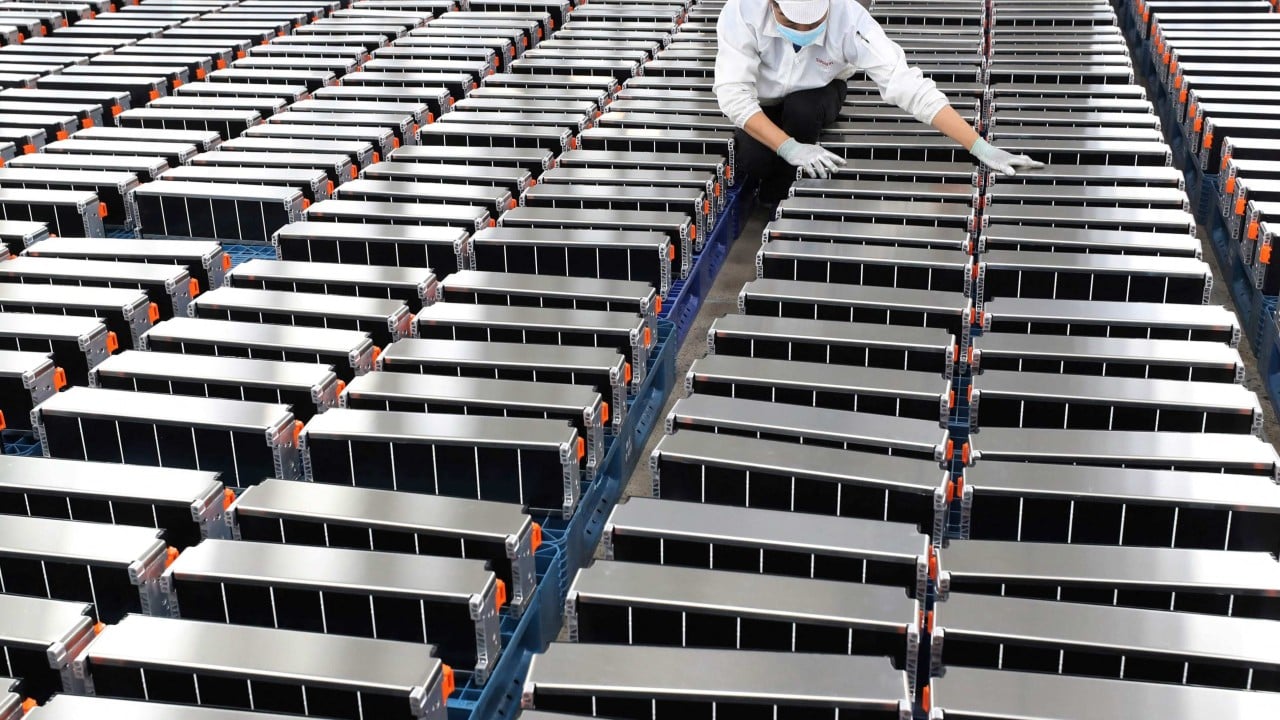
The lithium-ion battery has been the undisputed king of the portable world for three decades, but it is currently hitting a hard physical wall. For years, the electric vehicle industry has survived on incremental gains—3% more efficiency here, a slightly thinner separator there—but the fundamental chemistry hasn't changed enough to kill "range anxiety" for the average driver. That changed recently when a research team from the Chinese Academy of Sciences (CAS) announced a breakthrough in ultra-high-density lithium-ion batteries reaching over 700 Wh/kg. To put that in perspective, the cells currently sitting in a high-end Tesla or BYD chassis typically hover between 250 and 300 Wh/kg. We are looking at a potential doubling of range without adding a single gram of weight to the vehicle.
This isn't just another lab report destined to gather dust. While the industry has been obsessed with "solid-state" as the holy grail, this Chinese development focuses on a sophisticated lithium-rich manganese-based cathode and a ultra-thin lithium metal anode. It addresses the primary bottleneck of modern transport: the brutal trade-off between weight and distance. If this transition from the lab to the assembly line succeeds, the internal combustion engine loses its final logical defense.
The Chemistry of a Seven Hundred Watt Hour Milestone
To understand why 700 Wh/kg is a staggering figure, one must look at the standard limits of nickel-cobalt-manganese (NCM) chemistries. In a typical battery, the cathode acts as a bottleneck. You can only shove so many lithium ions into the structure before it becomes unstable or simply runs out of "room." The CAS team bypassed this by utilizing a lithium-rich layered oxide. By changing how the oxygen and metal ions interact within the lattice, they managed to extract a much higher capacity than previously thought possible.
The second half of the equation is the anode. Most current batteries use graphite, which is reliable but bulky. Replacing graphite with a lithium metal anode is like replacing a heavy filing cabinet with a high-speed hard drive. It stores more "data"—in this case, energy—in a fraction of the space. However, lithium metal is notoriously temperamental. It tends to grow needle-like structures called dendrites during charging. These dendrites can pierce the separator, cause a short circuit, and turn an expensive car into a roadside bonfire. The Chinese researchers claim to have mitigated this through a specialized electrolyte and a modified separator interface that keeps the lithium plating smooth and uniform.
The Thermal Runaway Problem
Critics are right to be skeptical. History is littered with "miracle batteries" that worked perfectly in a climate-controlled room but failed the moment they encountered the vibrations and temperature swings of a real-world highway. High energy density usually comes with a high price tag in the form of volatility. When you pack that much potential energy into a small space, the margin for error shrinks.
The investigative reality is that we still don't have long-term cycle life data for these 700 Wh/kg cells. A battery that gives you 1,000 miles of range but dies after 100 charges is a scientific achievement, not a commercial product. The CAS paper indicates that while the density is record-breaking, the capacity retention over hundreds of cycles remains the primary hurdle. This is the "valley of death" for battery startups: moving from a single, hand-crafted pouch cell to a pack that can survive ten years of New England winters and Arizona summers.
Why China is Winning the Patent Race
This isn't an isolated stroke of luck. It is the result of a decade-long, state-backed push to dominate the entire battery supply chain. While Western companies focused heavily on software and autonomous driving, Chinese entities like CATL, BYD, and various state laboratories poured billions into fundamental materials science. They now control the lion's share of lithium processing and anode production.
By controlling the raw materials, they can iterate faster than anyone else. If a researcher in Beijing needs a specific high-purity manganese variant, it’s available in bulk three miles away. If a startup in California needs it, they are looking at a three-month lead time and a mountain of customs paperwork. This vertical integration allows Chinese scientists to test thousands of cathode variations in the time it takes a Western lab to secure funding for one.
The Solid State Red Herring
For years, Toyota and various American startups have touted solid-state batteries as the inevitable successor to liquid-based cells. Solid-state replaces the flammable liquid electrolyte with a solid ceramic or polymer layer. It promises safety and density, but it has been "five years away" for nearly two decades.
The CAS breakthrough is significant because it suggests we might not need to wait for the complex manufacturing hurdles of solid-state to be solved. By pushing the limits of liquid or semi-solid electrolytes with lithium-metal anodes, China may jump-start the "double range" era using existing, or slightly modified, manufacturing lines. This would be a massive strategic win, effectively side-stepping the multi-billion dollar bet many Western automakers have placed on pure solid-state tech.
The Economic Impact of the Five Hundred Mile Standard
If a 700 Wh/kg battery becomes the industry standard, the economic ripples will be felt far beyond the car dealership.
- Freight and Logistics: Semi-trucks currently struggle with electrification because the batteries required for long-haul trips are so heavy they reduce the amount of actual cargo the truck can carry. Doubling energy density solves this overnight.
- Regional Aviation: Short-haul electric flights become viable. We are talking about 50-seater planes handling 500-mile hops with zero emissions.
- Grid Storage: High-density batteries allow for smaller, more efficient "Powerwalls" and community storage units, making solar and wind power much more reliable.
However, there is a catch. The materials required for these high-spec cathodes—specifically high-purity manganese and lithium—will see a surge in demand that the current mining infrastructure cannot meet. We are trading an oil dependency for a mineral dependency. The "green" revolution is, at its heart, a massive mining project.
Dissecting the Laboratory Claims
When looking at the data provided by the CAS team, one must look at the C-rate. This is the speed at which a battery is charged or discharged. Many high-density breakthroughs only achieve their record numbers at very slow discharge rates. If you tried to floor the accelerator in a car powered by these cells, the voltage might drop instantly, or the internal heat would spike to dangerous levels.
The prototype cells reportedly utilized a thin, high-voltage electrolyte designed to withstand the aggressive chemical environment of a lithium-rich cathode. In my experience covering this sector, the electrolyte is always the silent killer. It’s the part that breaks down first, creating gases that lead to "swollen" batteries and eventual failure. The Chinese team hasn't fully "demystified" (to use a term we avoid) the long-term stability yet; they have proven the physics, but the engineering is still in the crucible.
"The difference between a 700 Wh/kg cell in a lab and a 700 Wh/kg pack in a car is about five billion dollars and seven years of testing." — Anonymous Industry Consultant
The Geopolitical Battery Shield
The United States and Europe are currently scrambling to build their own "gigafactories," but they are largely playing catch-up with technology that China is already preparing to phase out. If the 700 Wh/kg transition happens within the next three to five years, Western factories currently being built for standard NCM cells will be producing obsolete technology before they even reach full capacity.
This is the "sunk cost" trap of the energy transition. We are building the infrastructure for the present while our competitors are designing the infrastructure for the future. To compete, Western firms cannot just build bigger factories; they must find a way to leapfrog the materials science advantage that China has cultivated.
Reality Check on the Horizon
We should expect to see these high-density cells appearing first in niche markets. High-altitude drones, specialized military equipment, and perhaps ultra-luxury "halo" vehicles will be the testing grounds. These applications can afford the high initial cost and the potentially shorter lifespan of early-generation high-density cells.
The consumer version—the one in your daily driver—will likely be a "watered down" version of this tech, perhaps aiming for a more stable 450-500 Wh/kg. Even that would be a transformative jump. It would turn a 250-mile range car into a 400-mile car with a lighter footprint and better handling.
The race isn't just about who can build the most batteries; it’s about who can pack the most energy into a single kilogram of matter. Right now, the momentum is undeniably shifting toward the East, and the 700 Wh/kg mark is the loudest shot fired in this quiet war yet. The physical wall hasn't been torn down, but the Chinese Academy of Sciences just showed the world exactly where the cracks are forming.
Check the current patent filings for "lithium-rich manganese-based oxides" to see which domestic companies are securing the rights to the next decade of energy storage.


