Inspecting eyeglasses and shirt buttons before a standardized test appears extreme until you map the economic incentives driving South Korea's College Scholastic Ability Test, known locally as the Suneung. When a single eight-hour examination dictates university admission, corporate recruitment tracks, and long-term socioeconomic mobility, the expected return on cheating exceeds the perceived risk of detection. Standard anti-cheating protocols—proctor sweeps, basic metal detectors, and signal jamming—fail against miniaturized hardware embedded directly into everyday apparel. To neutralize covert transmission vectors, South Korean education authorities have shifted from passive perimeter defense to granular physical inspection of personal items.
The Economic Payoff Matrix of High-Stakes Testing
Academic dishonesty in ultra-competitive environments operates according to rational choice theory. A candidate evaluates the utility of a higher score against the probability of apprehension multiplied by the severity of the penalty. In South Korea, the Suneung functions as a primary sorting mechanism for entry into top-tier institutions, particularly Seoul National University, Korea University, and Yonsei University. Because admission to these institutions strongly correlates with lifetime earnings and social status, the upside utility approaches an asymptotic maximum for desperate candidates.
Penalties for cheating on the Suneung include immediate invalidation of the current exam, a ban from sitting the test the following year, and potential criminal prosecution under obstruction of business statutes. Despite these deterrents, the high stakes create a persistent market for illicit assistance. This market funds the development and acquisition of specialized micro-electronics designed specifically to bypass standard screening procedures.
Anatomy of Covert Transmission Vectors
Standard examination halls prohibit smartphones, smartwatches, digital cameras, and Bluetooth earphones. In response, illicit hardware suppliers have migrated communication components into passive objects that candidates are permitted to wear or carry. These devices rely on two primary functions: optical capture of test materials and covert audio or tactile reception of answers.
Optical Capture Hardware
To transmit multiple-choice questions to an external accomplice, a candidate needs a lens capable of resolving small printed text at a distance of 30 to 50 centimeters without drawing visual attention.
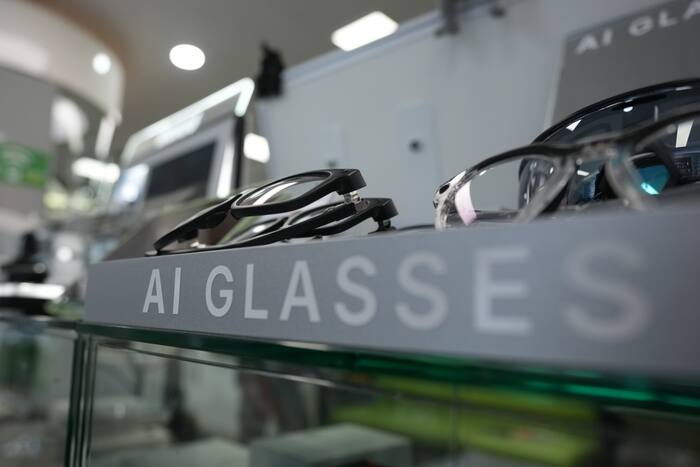
- Eyeglass Frames: Micro-cameras with pinhole lenses measuring less than two millimeters in diameter are embedded into the bridge or temple of standard prescription frames. The battery and low-power transmitter are housed inside the thickened acetate arms, making the weight distribution nearly identical to standard eyewear.
- Apparel Fasteners: Shirt buttons and tie clips provide stable, forward-facing mounting points aimed directly at the desk surface. A camera concealed behind a translucent or perforated button center captures the exam booklet whenever the candidate leans forward.
Covert Reception Mechanisms
Once an external team solves the captured questions, the answers must be relayed back to the candidate inside a silent room where proctors patrol every aisle.
- Inductive Earpieces: Unlike standard Bluetooth earbuds that sit visibly in the outer ear, inductive neckloops worn beneath clothing transmit magnetic signals to a passive, grain-sized receiver resting directly against the eardrum. These receivers contain no internal battery and emit zero radio frequency signals of their own, rendering them invisible to standard RF detectors.
- Tactile Transducers: For candidates unwilling to risk ear canal inspections, micro-vibrators sewn into waistbands or shoe insoles communicate multiple-choice selections through coded pulse patterns—such as one pulse for option A, two for option B.
The Three Pillars of Granular Inspection
Because inductive receivers and micro-lenses evade passive electronic sweeps, testing authorities have redesigned their physical verification protocols around three operational mechanisms.
1. Physical Geometry and Weight Verification
Proctors are trained to inspect eyeglasses not merely by looking at them, but by handling them. Embedded batteries and wiring alter the center of gravity of eyeglass frames and prevent the hinges from folding completely flat. Inspectors examine the bridge and temple joints for unnatural thickness, opaque resin fills, or micro-perforations that indicate a pinhole lens. Similarly, decorative pins, oversized buttons, and metallic accessories are scrutinized for unusual depth or rigid backing plates that house circuit boards.
2. Controlled Standardization of Desk Equipment
To eliminate variables, South Korean testing centers strip candidates of personal stationery. Examinees are prohibited from bringing their own mechanical pencils, erasers, or correction tape, as hollow barrels and paper sleeves easily conceal micro-transmitters or cheat sheets. Instead, the state issues standardized, semi-transparent writing instruments and erasers at the start of the session. Every item on the desk is accounted for, reducing the visual noise proctors must scan during the exam.
3. Multi-Stage Acoustic and RF Sweeps
Physical inspection is paired with handheld metal detectors used during restroom breaks and prior to entry. While passive inductive earpieces contain minimal metal, the neckloop antenna required to power them contains a copper coil that triggers high-sensitivity wands when swept across the collarbone and upper torso. Proctors also use directional RF scanners to detect the burst transmissions required to send high-resolution images of test papers out of the building.
Operational Bottlenecks and Detection Limits
Granular physical inspection introduces severe logistical friction into an already compressed testing schedule. With hundreds of thousands of candidates entering thousands of testing sites simultaneously, proctors have mere minutes to conduct pre-exam verifications without delaying the nationwide start time.
- False Positives and Candidate Anxiety: Heavy prescription lenses naturally require thicker frames, and modern hearing aids share visual characteristics with covert inductive receivers. Distinguishing legitimate medical devices from contraband requires prior medical documentation and careful verification, which can heighten stress for neurodivergent or hearing-impaired students immediately before a career-defining test.
- Inspector Fatigue: A proctor monitoring thirty students for eight hours experiences cognitive degradation. Visual detection of a two-millimeter camera lens on a dark shirt button requires sustained focal attention that declines sharply after the first two exam periods.
- Miniaturization Lag: Regulatory protocols are inherently reactive. By the time education ministries train proctors to spot thickened eyeglass temples, hardware manufacturers shift to flexible printed circuit boards integrated into clothing seams or contact lenses.
Structural Mitigation Over Physical Surveillance
Relying exclusively on physical inspection of clothing and accessories yields diminishing returns as electronics shrink. Education authorities must shift resources from downstream physical detection to upstream test design and transmission disruption. Implementing randomized question ordering and distinct answer-key permutations across adjacent desks neutralizes real-time external solving, because an accomplice cannot map a captured question to the candidate's specific answer sheet without viewing the entire page header. Combining localized, low-power cellular and Wi-Fi jamming inside testing perimeters with dynamically shuffled test booklets eliminates the utility of micro-cameras and button transmitters far more reliably than manual inspection alone.


