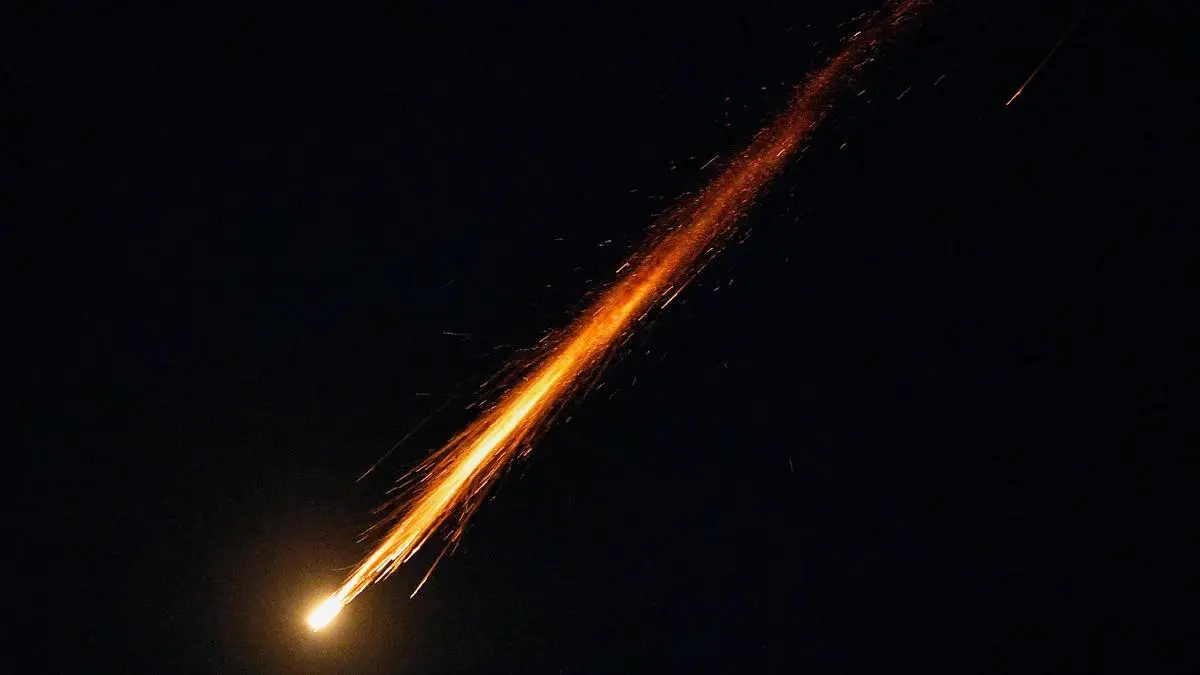
The pre-dawn strikes on the outskirts of Tehran represent more than a localized breach of Iranian sovereignty. When the explosions rocked the Sharif University of Technology and a critical gas storage facility near the capital, they effectively dismantled the fragile remains of a decade-old deterrence strategy. At least 13 individuals are confirmed dead, including technical staff and security personnel, marking this as one of the most brazen kinetic actions within the Islamic Republic’s borders in recent history. While initial reports focused on the immediate carnage, the true significance lies in the surgical selection of targets. This was not a random display of force. It was a calculated dismantling of the infrastructure required for long-range drone production and energy security.
The strikes occurred in a coordinated wave. Eyewitnesses reported the sound of low-flying projectiles followed by massive secondary explosions at a site linked to the Shahid Hemat Industrial Group. This facility is central to Iran’s ballistic missile program. However, the hit on the university district sends a much more chilling message to the academic and scientific community. By striking targets so close to the intellectual heart of the regime, the aggressors have signaled that there are no longer any off-limits zones.
Precision and the Myth of Invisible Borders
Modern warfare has moved past the era of carpet bombing. The munitions used in the Tehran strikes appear to be high-precision, low-collateral-damage warheads designed to penetrate reinforced concrete before detonating. This level of sophistication points toward a state actor with advanced satellite intelligence and real-time ground telemetry.
The strike on the gas site is particularly telling. Iran sits on some of the world's largest natural gas reserves, yet its domestic infrastructure is notoriously brittle. Disrupting a primary storage node during a period of high demand creates an immediate internal political crisis. When people cannot heat their homes or run their businesses, the pressure on the central government shifts from external defense to internal survival.
We are seeing a shift in doctrine. Instead of hitting high-profile political figures—which often triggers a predictable "martyrdom" effect—attackers are now prioritizing the "brains" and "lungs" of the state. The brains are the researchers at institutions like Sharif University; the lungs are the energy grids that keep the economy breathing.
The Failure of the Early Warning Shield
How did sophisticated projectiles bypass the Russian-made S-300 and domestically produced Bavar-373 air defense systems? This is the question currently causing panic in the Iranian Ministry of Defense. For years, Tehran has touted its "impenetrable" sky. That narrative is now in tatters.
The technical reality is likely a combination of electronic warfare and low-observable flight paths. By jamming local radar arrays or using cyber-intrusion to create "ghost" signatures, the attackers were able to fly through the most heavily defended corridors in the Middle East. It reveals a massive gap in electronic counter-measures. If you can't see the threat, you can't shoot it down.
The Role of Domestic Sabotage
It is a mistake to assume this was purely an external operation. No strike of this complexity succeeds without "eyes on the ground." The accuracy of the hits suggests that the attackers had up-to-the-minute data on which specific buildings were occupied and which valves in the gas facility were most vulnerable.
Decades of economic sanctions and political friction have created a reservoir of internal dissent. While the state media blames foreign entities, the intelligence community is quietly looking inward. The possibility of high-level leaks within the Islamic Revolutionary Guard Corps (IRGC) is no longer a fringe theory. It is a working hypothesis.
The Strategic Cost of the University Strike
Targeting a university area is a high-risk maneuver. It risks a massive public backlash and international condemnation. Yet, the Sharif University of Technology is no ordinary school. It is the premier pipeline for the country’s aerospace and nuclear engineers.
By hitting laboratories and nearby administrative offices, the attackers are attempting to "decapitate" the future of Iranian military tech. They aren't just killing soldiers; they are eliminating the people who design the weapons those soldiers use. It is a brutal, cold-blooded form of human capital attrition.
Quantifying the Damage
The death toll of 13 is likely an undercount. In the immediate aftermath of such events, the IRGC typically controls the flow of information to prevent widespread panic.
- Infrastructure: One primary gas distribution hub partially destroyed.
- Scientific Assets: Two advanced propulsion labs severely damaged.
- Military: Unknown number of radar technicians and security details killed.
This isn't just about the hardware. It's about the time lost. You can replace a gas tank in six months. You cannot replace a Ph.D. researcher with twenty years of specialized knowledge in a lifetime.
The Regional Domino Effect
The ripples of the Tehran explosions will be felt in Beirut, Sana'a, and Baghdad. Iran’s "Axis of Resistance" relies on the perception of Iranian strength. When the patron state is hit at home, the proxies feel exposed.
If Tehran cannot protect its own university and its own gas supplies, the Hezbollah leadership in Lebanon must wonder about the security of their own bunkers. This creates a vacuum of confidence. We should expect to see a surge in activity from proxy groups as they attempt to prove their relevance and distract from the embarrassment in the capital.
The Energy Market Reaction
Oil markets are notoriously skittish. Even though Iran is under heavy sanctions, any instability in the Persian Gulf sends prices upward. The strike on the gas site is a reminder that the global energy supply chain is interlinked. If this escalates into a full-scale conflict, the $100 barrel of oil returns almost instantly.
Investors are currently pricing in the "Tehran Premium." They are betting on whether Iran will choose a symbolic, limited retaliation or a wide-scale asymmetric response that targets shipping in the Strait of Hormuz. The latter would be a desperate move, but desperation is the primary export of a nation under siege.
Intelligence Gaps and the New Cold War
The lack of a clear "claim of responsibility" is a hallmark of modern shadow warfare. By staying silent, the aggressor forces Iran to guess. This psychological warfare is often more effective than the physical damage itself. It breeds paranoia. It leads to internal purges.
We are entering an era where the distinction between "peace" and "war" has blurred into a permanent state of high-intensity friction. The strikes near Tehran are a data point in a much larger trend of "non-linear" warfare. In this environment, a laptop is as much a weapon as a cruise missile, and a university lab is as much a battlefield as a trench in the desert.
The Iranian government now faces an impossible choice. To do nothing is to admit weakness and invite further strikes. To retaliate with force risks a full-scale war that the regime's crumbling economy cannot afford. They are trapped in a strategic pincer movement.
The security architecture of the Middle East has changed. The "red lines" that governed the region for the last twenty years have been erased by the smoke rising from the gas sites and laboratories of Tehran. Nations that once relied on traditional borders are realizing that those borders are porous to both code and kinetic energy.
Governments across the globe are watching. They are seeing that even the most militarized states can be pierced if the attacker is willing to ignore the old rules of engagement. The immediate death toll of 13 is a tragedy, but the long-term death of the regional status quo is the far more significant outcome. The quiet in Tehran tonight isn't peace; it's the sound of a system holding its breath before the next inevitable crack.