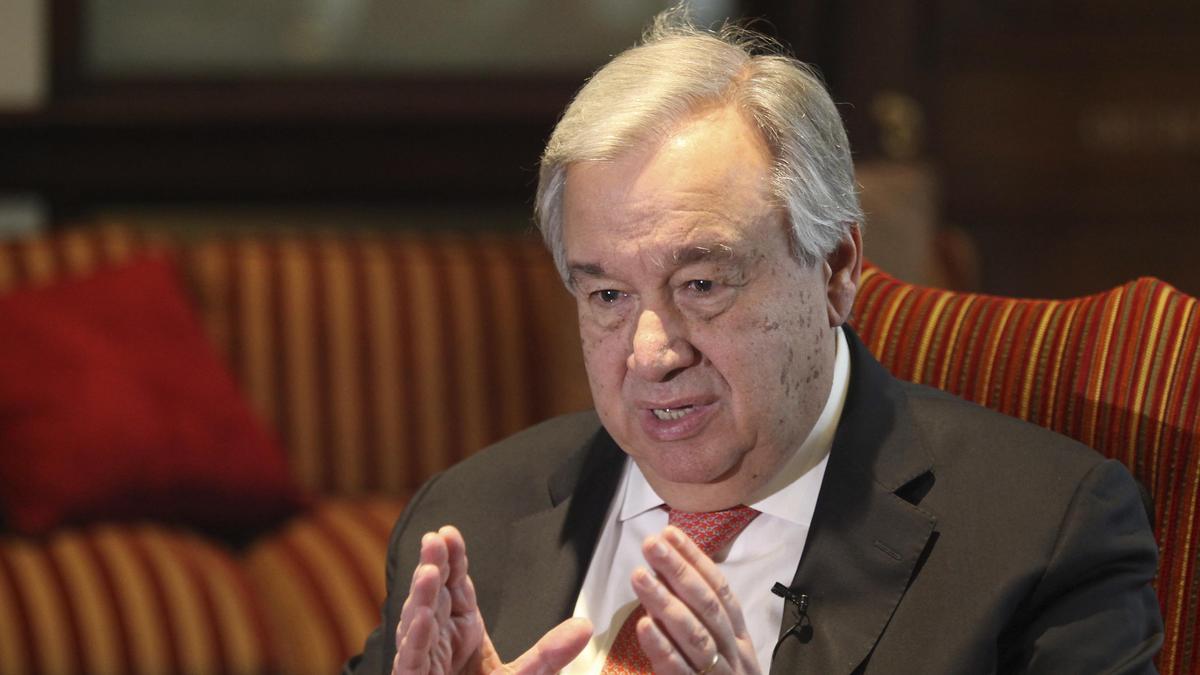
United Nations Secretary-General António Guterres has signaled a profound level of alarm following recent rhetoric from Donald Trump regarding potential strikes on Iranian energy infrastructure. Through his spokesperson, Stéphane Dujarric, the UN chief warned that such a shift in military targeting would represent a catastrophic escalation in a region already balanced on a knife-edge. The primary concern is not just the immediate loss of life or the breach of international norms, but the systematic dismantling of global energy security that could follow a "tit-for-tat" campaign against oil and gas facilities.
For the UN, the stakes transcend regional politics. Guterres is operating on the premise that the targeting of energy assets—specifically those that fuel the global economy—is a genie that cannot be put back in the bottle once released. The rhetoric suggests a departure from traditional military containment toward a scorched-earth economic strategy. This shift threatens to drag the Middle East into a total war scenario where the infrastructure of civilian survival becomes a primary battlefield.
The Shattered Taboo of Energy Warfare
International law generally protects civilian infrastructure, including energy grids and oil refineries, unless they provide an immediate and direct military advantage. However, the rhetoric surrounding Iranian "petro-aggression" has blurred these lines. For decades, a silent agreement existed among global powers: you do not touch the pumps. This wasn't out of kindness. It was out of a mutual understanding that the global economy is a single, interconnected nervous system. If you cut a major artery in the Middle East, the entire body bleeds.
By entertaining the idea of strikes on Iranian energy plants, the political discourse is moving toward the normalization of infrastructure destruction. Guterres views this as a direct threat to the UN Charter’s mandate to maintain international peace and security. If one nation decides that energy plants are fair game, the precedent is set for every other conflict on the map. We are looking at a future where every power grid, water desalination plant, and refinery becomes a high-priority target.
The Mechanics of Regional Contagion
The logic of striking energy plants assumes that the damage can be contained within a single border. This is a dangerous fallacy. Iran’s energy network is integrated into the broader regional economy through various gray-market channels and legitimate trade. A strike on Iranian soil would almost certainly trigger a retaliatory response against the energy infrastructure of neighboring states, many of whom are critical allies of the West.
The Strait of Hormuz remains the ultimate choke point. Roughly 20% of the world's total oil consumption passes through this narrow waterway. If rhetoric turns into kinetic action, Iran’s most likely move is not a conventional naval battle, but the mining of the strait and the targeting of regional processing hubs. We aren't talking about a simple price hike at the gas pump; we are talking about a systemic failure of the supply chain that could take years to repair.
The Economic Ghost in the Machine
Western markets often treat Middle Eastern tension as a temporary volatility spike. This time feels different to the analysts in New York and London. The threat of targeting Iranian oil facilities introduces a level of "permanent risk" into the market that hasn't been seen since the 1970s oil embargo.
The UN’s alarm stems from the knowledge that the world’s most vulnerable populations are the first to suffer when energy prices surge. It isn't just about the cost of heating a home in Europe or fueling a truck in America. It is about the cost of fertilizer, the price of grain, and the ability of developing nations to maintain basic electrical services. Guterres is looking at a map of the world and seeing a chain reaction of civil unrest triggered by a single strike on an Iranian refinery.
Beyond the Rhetoric
Why is this happening now? The shift in tone reflects a growing frustration with the failure of traditional sanctions. For years, the international community has tried to "starve" the Iranian regime through banking restrictions and trade bans. Yet, the oil continues to flow, largely to markets in the East. To some hardline strategists, the physical destruction of the assets is the only remaining lever.
However, this ignores the environmental and humanitarian consequences. A major strike on an oil terminal or a gas processing plant isn't a clean surgery. It results in massive environmental degradation—oil spills that could ruin the Persian Gulf’s desalination capacity and atmospheric pollution that ignores national borders. The UN sees this as a blatant violation of the collective responsibility to protect the planet’s shared resources.
The Failure of De-escalation Channels
Perhaps the most chilling aspect of Guterres’ statement is what it says about the state of diplomacy. Usually, these types of concerns are handled through backchannels. When a UN spokesperson goes public with the Secretary-General’s "alarm," it means the private channels have failed or are being ignored. The diplomatic guardrails that governed the Cold War and the subsequent decades have eroded.
We are currently in a period where "maximum pressure" is being redefined to include the physical elimination of economic pillars. This creates a zero-sum game. If the Iranian leadership perceives that their survival is tied to energy production and that production is under direct threat, they have no incentive to remain within the bounds of the nuclear non-proliferation agreements or regional security pacts.
The Specter of the 1979 Playbook
History provides a grim roadmap. During the Iran-Iraq War, the "Tanker War" phase saw both sides targeting merchant vessels and oil installations. It took nearly a decade to stabilize the region after those hostilities, and the technology involved was primitive compared to today’s precision-guided munitions and drone swarms. A modern version of energy warfare would be exponentially more destructive.
The UN’s position is that there is no "limited" strike on energy plants. The interconnected nature of modern technology means that hitting a digital control center can be just as devastating as a physical bomb. Cyber warfare directed at energy grids is already a reality, but the jump to physical kinetic strikes marks a point of no return.
The Risk of Miscalculation
The greatest danger in the current climate is miscalculation. Rhetoric often has a life of its own. A political leader might use the threat of striking energy plants as a bargaining chip, but the opposing side may view it as an imminent declaration of war. Once the machinery of mobilization starts, stopping it is nearly impossible.
Guterres is trying to inject a dose of cold reality into a heated political environment. He is reminding the world that while political cycles come and go, the physical infrastructure of the global energy market is fragile. It cannot be rebuilt overnight. If the decision is made to target these facilities, the consequences will outlast any specific administration or regime.
The Role of Global Powers
This isn't just a confrontation between two nations. China, India, and the European Union all have a massive stake in the stability of Iranian energy exports, whether they admit it publicly or not. A strike would force these powers to take sides in a way they have desperately tried to avoid. The UN is effectively shouting into a crowded room, trying to warn everyone that the fire exit is blocked.
The silence from other major capitals is equally deafening. While some may quietly cheer the idea of a weakened Iran, the reality of $150-a-barrel oil and a fractured global trade network is a nightmare scenario for any sitting government. The UN is acting as the world’s institutional memory, recalling every time a "quick strike" turned into a generational quagmire.
Sovereignty Versus Stability
There is a fundamental tension between a nation's right to defend its interests and the global community’s need for stability. The UN’s alarm is a defense of the latter. Guterres is arguing that the global interest in preventing an energy-led economic collapse outweighs the strategic objectives of any single player. This is a hard sell in an era of rising nationalism, but it is the core reason the UN exists.
Striking an energy plant is an act of economic execution. It doesn't just target the government; it targets the people’s ability to cook, to travel, and to work. It is a form of collective punishment that history suggests rarely leads to the desired political outcome. Instead, it fosters a deep-seated resentment that fuels future conflicts for decades.
Strategic Alternatives
The veteran analysts within the UN’s orbit know that there are other ways to handle regional threats. Strengthening regional security architectures, engaging in maritime diplomacy, and utilizing targeted, multi-lateral sanctions are the boring, difficult work of statecraft. Bombing a refinery is the "easy" button that actually leads to a much harder road.
The push for energy strikes suggests a lack of imagination in the halls of power. It suggests that the complexity of the Middle East has been reduced to a target list on a map. Guterres is signaling that the world cannot afford this level of simplicity. The global energy market is a delicate ecosystem, and we are currently watching someone walk through it with a torch.
The warning from the UN is not a suggestion; it is a forecast of a potential dark age in international relations. When energy becomes a primary weapon of war, the very foundations of modern civilization are called into question. The rhetoric must be walked back before a single drone is launched, because once the fire starts at the wellhead, no one knows how to put it out.