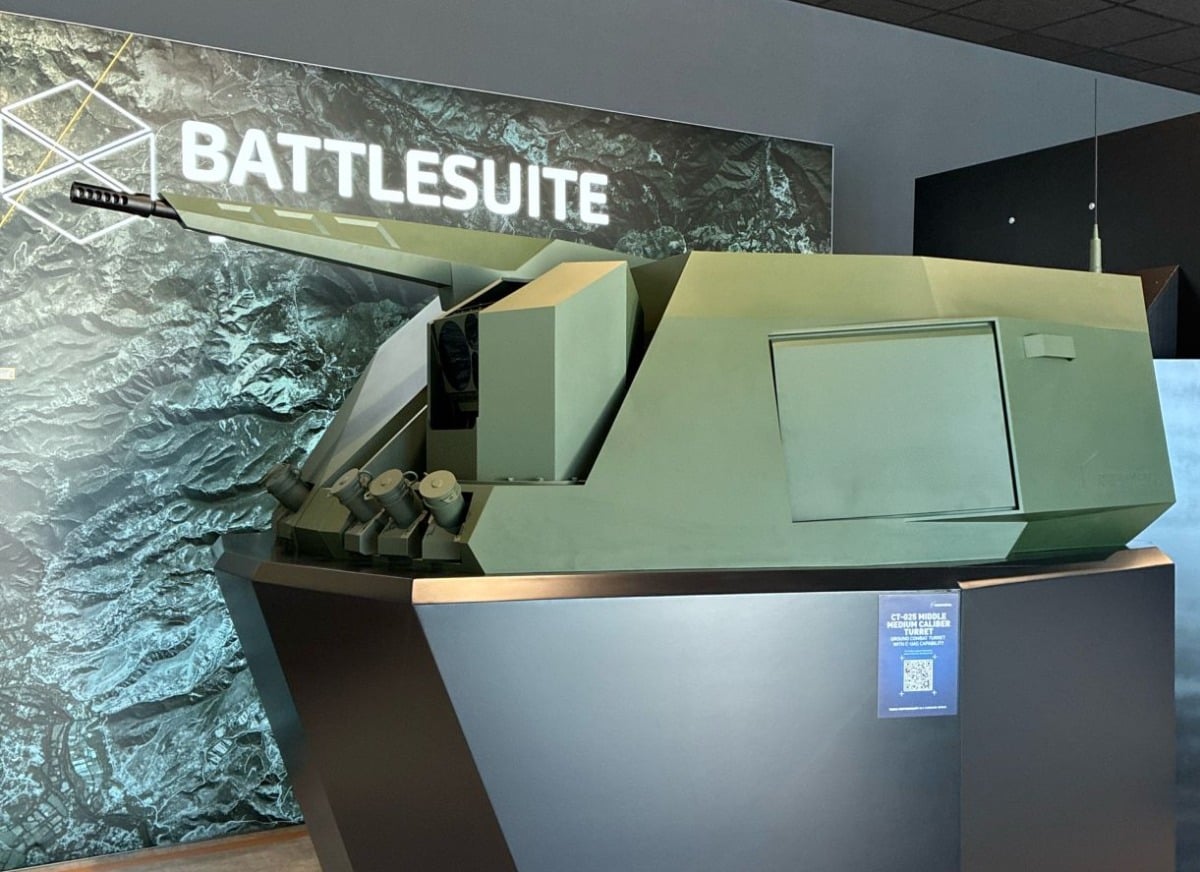
Eurosatory 2024 treated the defense world to its favorite annual ritual: defense contractors wheeling out massive, polished steel turrets designed to swat drones out of the sky. This year, Rheinmetall grabbed the headlines with its Skyranger system, pitching it as the definitive answer to the drone swarms currently rewriting the rules of combat. The industry press swooned on cue, publishing breathless breakdowns of radar ranges, rapid-fire cannons, and integrated missile pods.
They are buying into a dangerous illusion.
The defense establishment is treating the drone threat as a traditional air defense problem that just needs a downscaled solution. It is a fatal conceptual error. Spending millions of dollars per unit to mount a heavy, ammunition-hungry, mechanically complex turret onto an armored vehicle chassis is a textbook example of fighting the last war. We are attempting to defeat a hyper-flexible, asymmetric, software-driven threat with high-margin, industrial-era hardware.
It cannot scale. It will not win.
The Math of the Asymmetric Meat Grinder
Defense procurement officers love kinetic solutions because they look impressive on a testing range. A 30mm programmable airburst round tearing a quadcopter to shreds makes for excellent promotional footage. But the economics of modern attrition warfare tell a much grimmer story.
Consider the basic math governing modern frontline engagements. A commercially available, first-person view (FPV) loitering munition, modified with a 3D-printed bracket and an RPG warhead, costs between $500 and $1,000 to assemble. They are manufactured in makeshift workshops by the tens of thousands.
Now look at the platform meant to stop them. A fully equipped short-range air defense (SHORAD) vehicle easily commands an eight-figure price tag. The advanced tracking radars, the optronic sensor suites, the complex turret rotation mechanisms, and the specialized airburst ammunition are staggeringly expensive.
If an adversary launches a coordinated swarm of fifty cheap drones at a mechanized column, a system like the Skyranger might successfully shoot down forty-five of them. In traditional military doctrine, a 90% interception rate is stellar. In drone warfare, it is a catastrophic failure. The five drones that slip through will strike the air defense vehicle itself, or the high-value assets it was assigned to protect.
An adversary can lose 95% of their deployment and still achieve a massive net positive return on investment. You cannot win a war of attrition when your interceptor ammunition costs more than the target it is destroying, and your multi-million-dollar platform can be blinded by a piece of shrapnel damaging its radar face.
The Kinetic Blind Alley
The industry's obsession with kinetic interception—shooting physical projectiles at physical targets—ignores the physical limitations of ammunition capacity.
A rapid-fire cannon opens up at thousands of rounds per minute. Even firing short, controlled bursts of programmable ammunition to maximize probability of kill ($P_k$), an armored air defense vehicle carries a severely limited magazine. Once those ready-use rounds are spent, the vehicle is nothing more than a highly visible target.
"I have watched defense prime contractors dump tens of millions of dollars into engineering complex mechanical feeders to shave milliseconds off reload times. They are optimizing a flawed premise. In a high-intensity conflict, you do not run out of time; you run out of bullets long before the enemy runs out of cheap plastic propellers."
Furthermore, kinetic systems require a clear line of sight and absolute radar clarity. Modern tactical drones do not fly across open skies like Cold War-era fighter jets. They hug the terrain, mask their approach behind tree lines, utilize urban canyons, and drop from near-vertical angles directly above a vehicle’s radar blind spot.
By the time a heavy turret rotates, tracks, locks, and fires, the window of engagement has already closed.
Dismantling the Smart Ammunition Myth
The common defense of these systems relies heavily on the promise of "smart" ammunition—rounds that receive a programming signal as they leave the barrel, telling them exactly when to detonate to shower a drone in tungsten pellets.
Let us look at the technical reality of how these systems operate under real-world conditions.
To detonate a projectile within a meter of a fast-moving, erratic quadcopter, the system relies on an incredibly tight chain of variables:
$$t_{det} = \frac{D_{target}}{v_{projectile}}$$
Where $t_{det}$ is the precise detonation time programmed into the round, $D_{target}$ is the distance to the target at the moment of firing, and $v_{projectile}$ is the muzzle velocity.
This equation looks clean on a whiteboard, but on a chaotic battlefield, every variable degrades:
- Atmospheric pressure and barrel wear alter muzzle velocity ($v_{projectile}$) continuously.
- Electronic warfare environments degrade the radar tracking accuracy required to lock down the exact distance ($D_{target}$).
- Drones do not fly in straight lines; their sudden velocity changes render the calculated intercept point obsolete the microsecond the round leaves the tube.
If the programming coil in the muzzle suffers from even minor thermal expansion after prolonged firing, the data transfer fails. If the radar experiences minor clutter from rain, birds, or smoke, the calculation breaks down. You are left firing incredibly expensive, unprogrammed metal slugs into empty air.
What the Defense Industry Refuses to Admit
The reluctance to pivot away from massive kinetic turrets is not a technical limitation; it is a business model limitation.
Defense giants are structurally built to manufacture heavy metal, complex hydraulic systems, and proprietary ammunition lines. That is where the highest profit margins lie. A software-defined electronic warfare suite or a distributed network of low-cost acoustic sensors does not generate billions of dollars in recurring hardware maintenance cycles.
We see companies proud of integrating anti-drone missiles onto these turrets. Think about that for a second. Launching a missile that costs $100,000 or more to destroy an off-the-shelf drone is not a victory. It is economic suicide disguised as a tactical success. The enemy is actively trying to draw those missiles out to deplete your inventory before bringing in their primary strike assets.
Shift the Paradigm: The Decentralized Alternative
If heavy, centralized turrets are an evolutionary dead end for drone defense, what actually works? The answer lies in asymmetric, distributed, and software-first architecture.
Instead of mounting a single, massive asset-protection platform in the middle of a convoy, military forces must deploy layered, low-cost counter-UAS (C-UAS) capability across every single node in the network.
1. Ubiquitous Non-Kinetic Disruption
The primary line of defense must be electromagnetic and directed energy, not high-explosive shells. Automated, cognitive electronic warfare (EW) systems that scan the RF spectrum and instantly jam control frequencies or GPS signals are infinitely repeatable. They do not run out of ammunition. They cost pennies per engagement.
2. High-Power Microwave (HPM) over Airburst Cannons
When kinetic-like destruction is necessary to counter shielded or autonomous drones that ignore RF jamming, High-Power Microwave systems are far superior to cannons. An HPM system projects an energy cone that fries the internal circuitry of every drone within an entire sector instantly. It solves the swarm problem because it does not need to track individual targets sequentially. It clears the sky en masse.
3. Distributed Hard-Kill Interception
Instead of an expensive turret on a boxer or a truck chassis, use a swarm to defeat a swarm. Low-cost, reusable interceptor drones equipped with simple netting or small, localized explosive charges can be launched from simple tubes mounted on any standard utility vehicle.
| Feature | Heavy Kinetic Turret (e.g., Skyranger) | Distributed Software/EW Layer |
|---|---|---|
| Cost per Engagement | High ($4,000 - $100,000+) | Extremely Low (Electricity/RF) |
| Swarm Capability | Sequential (One by one) | Simultaneous (Area effect) |
| Ammunition Limit | Strictly limited by physical space | Virtually unlimited |
| Mobility/Weight | High footprint, restricts vehicle choice | Low footprint, adaptable to all platforms |
The True Cost of Tactical Denial
Adopting a distributed, EW-heavy approach has its own distinct downsides. Jamming the radio frequencies used by enemy drones also means polluting the electromagnetic spectrum for your own forces. It requires incredibly sophisticated frequency deconfliction to prevent friendly units from losing their own communications and situational awareness.
It also requires accepting that you cannot achieve a 100% clean record. Drones will get through. Therefore, armor doctrine must change to focus on passive protection—such as advanced top-attack mitigation styling and integrated signature reduction—rather than relying on a big silver bullet turret to keep the skies clear.
But these operational challenges are far easier to solve than the fundamental economic crisis of kinetic air defense.
Stop celebrating the engineering marvels of the 30mm airburst turret. It belongs in a museum of 20th-century warfare, right next to the battleship. The future of tactical air defense belongs to the invisible, the cheap, and the infinite. If we continue to build heavy armor to fight light software, we will simply continue to fund our own obsolescence.