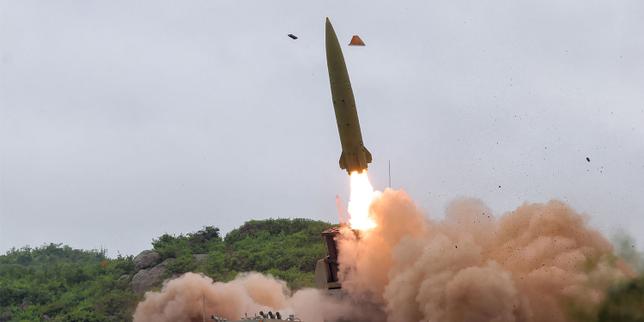
Every time a metallic cylinder arcs across the Korean peninsula and splashes into the cold waters of the East Sea, the international press corps treats it like a global cardiac arrest. Headlines scream about escalation, provocation, and the brink of annihilation. Seoul issues emergency alerts. Tokyo scrambles surveillance vectors. Washington issues a sternly worded condemnation written five years ago and saved in a draft folder.
It is theater. Expensive, highly choreographed, predictable theater.
If you still believe these routine ballistic tests represent an unpredictable lunge toward mutual destruction, you are falling for the oldest cheap trick in geopolitics. The lazy consensus in mainstream reporting insists that Pyongyang operates in a vacuum of irrational hostility, waking up each morning to roll the dice on World War III. That narrative is lazy, intellectually bankrupt, and structurally wrong.
Let us look at the mechanics of what is actually happening.
The Economics of Loud Noises
We need to talk about resource allocation and state survival. North Korea is an isolated economy running on fumes, international sanctions, and a severe deficit of hard currency. When you cannot trade freely on global markets, how do you signal value to domestic elites and foreign adversaries?
You test hardware.
Military hardware has an expiration date. Solid-fuel motors degrade, guidance systems require calibration, and engineers need empirical telemetry to justify their budgets. If you never fire the missile, your R&D program dies on the drawing board. But more importantly, in the bizarre marketplace of nuclear diplomacy, volume equals leverage.
I have spent years watching defense analysts panic over every telemetry blip, ignoring the fundamental law of coercive statecraft: nations do not launch devastating wars when they are broadcasting their exact launch windows to international radar networks in advance. Real aggression looks like silence, deception, and operational security. Pyongyang does the exact opposite. They telegraph their punches so everyone in the region has time to put on a show for their respective domestic audiences.
Seoul panics because panic keeps defense budgets fat. Washington expresses deep concern because deep concern justifies maintaining regional force postures. Pyongyang fires the rocket because a quiet nation is a forgotten nation. It is a closed loop of mutual political utility.
Decoding the Noise Machine
Let us dismantle the common panic points one by one.
When a missile lands in the sea, the immediate reaction asks: Is this the one that starts the war? That question is framed incorrectly. The better question is: What domestic political or diplomatic leverage point is this specific trajectory buying them at the negotiating table?
Let us look at the timeline of previous launches over the last decade. They almost always correlate with one of three events:
- Joint military exercises between the United States and South Korea.
- Domestic political transitions or leadership pressure within Washington or Seoul.
- Desperate demands for humanitarian aid or sanctions relief disguised as defiance.
Whenever regional diplomacy stalls, the hardware starts moving. It is not an erratic tantrum. It is a calibrated escalation ladder designed to force Washington back into bilateral talks on Pyongyang's terms. It is aggressive diplomacy executed with high-explosive payloads instead of diplomatic cables.
Does this make the regime benevolent? Absolutely not. It is an authoritarian state built on repression, starvation, and fear. But confusing an authoritarian survival strategy with a suicidal desire for total annihilation is dangerous. It blinds analysts to the actual incentives driving the behavior.
The Downside of the Contrarian View
Every intellectual stance carries a blind spot, and mine is no exception. Treating these launches purely as predictable leverage mechanisms risks complacency.
What happens if the math changes? What if a miscalculation occurs in crowded airspace, or a guidance system fails and a warhead clips a populated landmass instead of an empty patch of ocean? The margin for error in rocket science is thin. When you normalize the noise, you risk ignoring the structural danger of accumulating volatile materials in a volatile region.
Complacency kills just as surely as hysteria does. But hysteria guarantees that we misdiagnose the disease every single time. We treat a chronic, managed geopolitical stalemate as an acute emergency, which prevents anyone from building a functional long-term framework to handle it.
Stop Buying the Script
The next time an alert flashes across your screen warning of an imminent launch toward the sea, take a breath. Look past the breathless anchor voice and the stock footage of marching soldiers.
Ask yourself who benefits from the panic today. The defense contractors? The politicians looking to rally their base? Or the regime trying to force a superpower to answer its phone calls?
Stop treating predictable state theater like an apocalyptic surprise. Recognize it for what it is: a loud, expensive negotiation tactic executed by a cornered regime that knows exactly how to manipulate the global news cycle.
Until we stop reacting to the noise and start starving them of the theatrical attention they crave, the rockets will keep flying, and we will keep dancing to their tune.