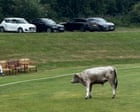
You think you've seen every possible reason for a cricket match to hit a brick wall. Rain delays are part of the British summer DNA. Bad light sends players packing all the time. Pitch tampering or dangerous bounces can cut a day short. But nothing prepares a opening batsman for the sight of an 800-kilogram juvenile bull charging down the pitch from the direction of cow corner.
That is exactly what went down at Burnopfield Cricket Club, just outside Newcastle. A high-stakes North East Premier League fixture between Burnopfield CC and Hetton Lyons came to a grinding halt because an escaped farm animal decided the outfield looked like a prime spot for a rampaging sprint. It sounds like something straight out of a comedy sketch, but when a massive, highly athletic beast is stamping its hooves on your local ground, the humor evaporates pretty fast.
Amateur sport thrives on unpredictable chaos, but this specific interruption sets a completely new benchmark. Let's unpack exactly what happened on that chaotic afternoon, why the usual containment strategies failed, and what this means for the teams left stranded by one of the most bizarre match abandonments in modern sporting history.
The Burnopfield Pitch Invasion You Have to See to Believe
The match was progressing like any other intense league fixture. Burnopfield CC had put up a solid performance, racking up 226 runs in their innings. Their opponents, Hetton Lyons, were just starting their chase and found themselves at 12 for the loss of one wicket. The tension was building. The afternoon sun was out. Then, around 3:00 PM, everything went sideways.
A young bull managed to break out from a farm roughly a mile away from the ground. It didn't just wander onto the grass to graze. This animal was frightened, disoriented, and packed with adrenaline. It charged onto the playing field, instantly scattering players, umpires, and spectators who realized this wasn't a friendly local dog looking for a stray ball.
Club director Martin Oswell described the animal as incredibly fit and athletic. This wasn't a slow, lumbering farm animal. It was a fast, aggressive juvenile capable of doing serious damage. When an animal that heavy starts moving at speed, standing your ground is a terrible idea.
Why the Cow Trick Failed Miserably
When a massive animal takes over a sports facility, you can't exactly tackle it to the ground. The local response required some quick, unconventional thinking. The bull's owner rushed to the Burnopfield ground with a plan that sounds brilliant on paper but turned out to be totally useless in reality.
The farmer drove a live cow straight onto the cricket club premises. The logic was simple. Use the cow as romantic or social bait to entice the spooked bull off the playing surface and into a secure transport pen.
It didn't work. The bull was far too spooked by the commotion, the bright whites of the cricketers, and the open space of the boundary ropes. Instead of calming down and following its companion, the bull doubled down on its erratic behavior. It began charging at the farmers who were desperately trying to corner it. One farmer took a direct hit from the animal. While he escaped serious injury, the incident proved that trying to bargain with a terrified 800-kilogram beast using basic cattle herding techniques wasn't going to cut it.
Eventually, local police had to be called to manage the escalating safety risk. The stand-off lasted for hours. The bull didn't leave because of clever traps or professional wrangling. It simply decided it had enough of the sport and wandered off the field of its own accord once the excitement died down. By that time, the official cutoff time for the match had passed. The umpires had absolutely no choice but to call the game off.
The Brutal Reality of League Points and Abandonments
For Burnopfield CC, the timing of this livestock invasion couldn't have been worse. The club sits second in the North East Premier League. They were in a strong position after scoring 226 runs and had already claimed an early wicket against Hetton Lyons. A win here would have been massive for their campaign.
Instead, they walk away with a frustrating match abandonment. In league cricket, when a game is called off due to circumstances beyond anyone's control, the points are typically shared. It feels incredibly unfair when you have the upper hand, but the rulebook doesn't have a specific clause that awards a victory to the home side just because a rogue bull decided to defend the crease.
Local sports leagues are built on rigid frameworks, yet they constantly get tested by the absurdities of rural life. This wasn't a case of poor pitch maintenance or bad club management. It was pure, unadulterated bad luck that highlights the vulnerability of open village grounds.
A History of Wildlife Stopping Play
While the Burnopfield bull incident stands out for its sheer danger, cricket has a long, storied relationship with uninvited animal guests. Open fields and quiet outfields are naturally attractive to local wildlife.
Dogs are the most frequent offenders. We've seen matches stopped in the middle of international fixtures because a stray hound wants to chase the ball or get a belly rub from a deep mid-wicket fielder. During an Indian Premier League match back in 2009, a dog famously evaded multiple security guards, running circles around stars like Sachin Tendulkar before finally leaving the grass.
Insects can cause even more chaos than large mammals. A match between South Africa and Sri Lanka was completely halted by a massive swarm of bees. The players didn't run away. They actually had to lie flat on their faces in the dirt for several minutes until the swarm drifted over the stadium.
Then you have the truly bizarre moments, like the time a spectator smuggled a live pig into the Gabba during an Ashes test match in Australia. The pig had nicknames written on its sides and caused absolute mayhem for the security staff. But none of those situations carried the raw physical threat of a charging juvenile bull. The Burnopfield incident reminds everyone that village sports grounds are deeply connected to the surrounding countryside, for better or worse.
How Local Clubs Can Prepare for Livestock Intrusions
If you manage a local sports club, especially one bordered by farmland, you can't assume this is a one-time freak event. Escaped animals happen. When they do, your response determines whether everyone goes home safe or someone ends up in the back of an ambulance.
You need a clear plan of action before the situation arises. Relying on makeshift solutions or hoping the animal wanders off isn't a strategy. Here are the immediate steps your club needs to implement to handle sudden large animal intrusions effectively.
Establish an Instant Clearance Protocol
The moment a large animal enters the playing area, play must stop immediately. Umpires and team captains need to prioritize human safety over the state of the game.
- Evacuate the playing circle: All players, officials, and ground staff must move behind secure barriers or inside the pavilion immediately.
- Keep spectators back: Do not allow curious onlookers to approach the boundary ropes to take photos or videos. A spooked animal will charge at the nearest target.
- Secure the pavilion doors: Ensure that common entry points are closed so the animal cannot enter enclosed spaces where people are sheltering.
Coordinate with Local Agricultural Networks
Don't wait for emergency services to arrive if you know you are surrounded by active farms. Building a quick contact list can save hours of chaos.
- Identify neighboring farmers: Keep a list of phone numbers for landowners whose property borders the sports facility. They have the equipment, trailers, and knowledge to handle loose livestock.
- Do not attempt amateur herding: Unless you are a trained professional, do not wave cricket bats, jackets, or flags at a bull or cow. It will view these actions as a threat and attack.
Know Your League Rules on External Disruption
When the dust settles, you still have to deal with the administrative side of the sport. Make sure your committee understands the exact wording of your league's constitution regarding abandoned matches.
- Document the timeline: Record the exact time the animal entered the field, the actions taken, and the time the match was officially called off by the umpires.
- Take photographic evidence: You will need to submit a report to the league organizers explaining why the match could not be completed. Photos of the animal on the pitch prevent any disputes from the opposing team regarding the legitimacy of the abandonment.
- Check insurance policies: Large animals can cause immense damage to expensive cricket squares, covers, and outfield turf. Verify that your club's public liability and property insurance covers damage caused by stray livestock.
Don't let your club get caught off guard by the absurdities of the countryside. Secure your perimeters, keep your heads cool, and remember that no match points are worth a trip to the emergency room. Let the Burnopfield incident be the ultimate warning story for every village team across the country.