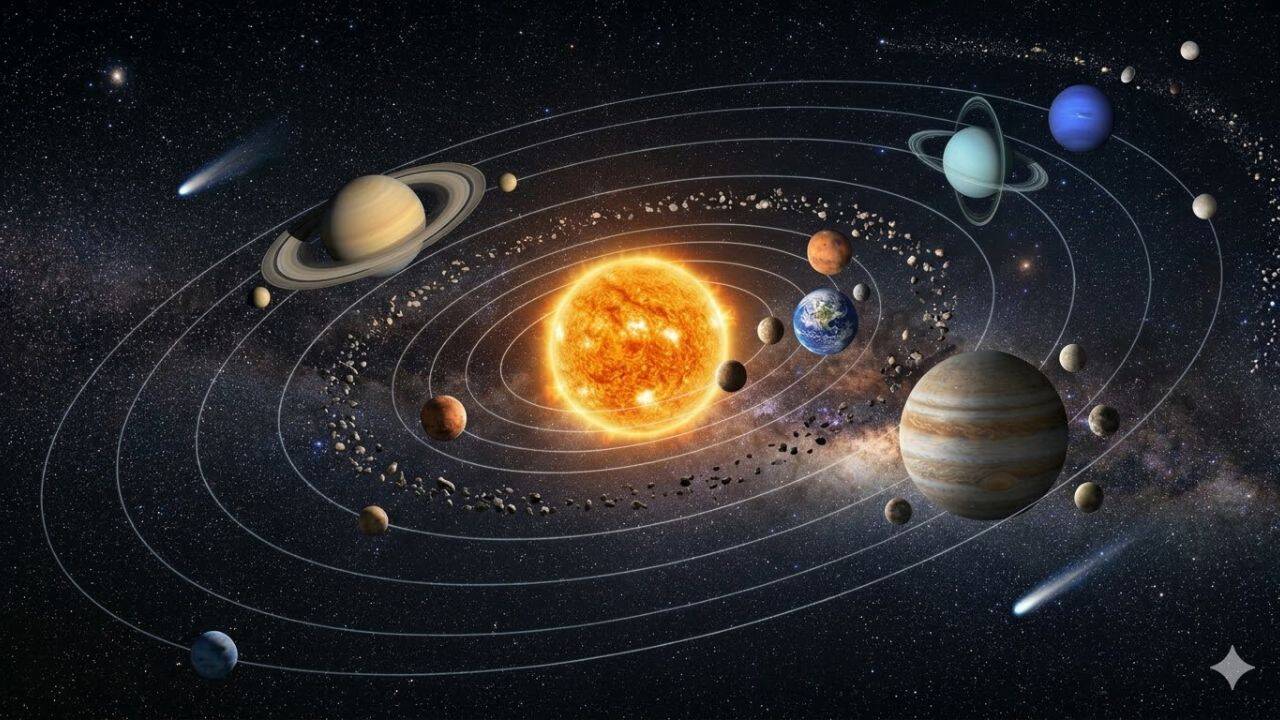
Most people still picture the solar system as a neat, static map from a third-grade textbook. You probably imagine a giant sun in the middle, some colorful marbles spinning in perfect circles, and a lot of empty space. That's a lie. Or at least, it’s a massive oversimplification that misses how chaotic and weird our neighborhood actually is.
If you want to understand the real solar system, you have to look at the edge cases. You have to look at the places where physics starts behaving like a fever dream. Our solar system isn't just a collection of rocks. It's a high-speed projectile screaming through the Milky Way at 448,000 miles per hour. It’s a place where it rains diamonds, where volcanoes spew ice, and where the most "Earth-like" place isn't even a planet.
The Sun Is Not a Stationary Ball of Fire
We’re taught the planets orbit the Sun. While that’s technically true from a local perspective, it ignores the bigger picture. The Sun is dragging us through the galaxy. Because the Sun is moving, the planets actually trace out a massive, corkscrewing helix through space. It’s more like a cosmic vortex than a flat record player.
Also, the Sun isn't "on fire." Fire is a chemical reaction requiring oxygen. Space is a vacuum. The Sun is a giant nuclear fusion reactor. It's smashing hydrogen atoms into helium. Every second, it converts about 600 million tons of hydrogen into helium. In that process, it loses about four million tons of mass, which gets turned into energy. If you think your electric bill is high, consider that the Sun produces enough energy every second to power the entire Earth for half a million years.
Jupiter Is the Solar System's Garbage Disposal
We owe our lives to Jupiter. Seriously. Without that gas giant, Earth would likely be a shooting gallery for every stray asteroid in the neighborhood. Jupiter's massive gravity—it’s 318 times more massive than Earth—acts as a vacuum cleaner. It pulls in long-period comets and asteroids that would otherwise slam into the inner solar system.
We saw this in action in 1994. Comet Shoemaker-Levy 9 got ripped apart by Jupiter's gravity and smashed into the planet. The resulting scars were visible from Earth for months. The impact flashes were larger than our entire planet. Jupiter takes the hits so we don't have to. It's the ultimate cosmic bodyguard.
There Is a Planet Where It Rains Glass Sideways
If you think the weather in London or Seattle is bad, look at HD 189733b. Okay, it's an exoplanet, but it's a window into how extreme planetary systems get. Within our own backyard, we have Neptune. The wind speeds on Neptune can reach 1,200 miles per hour. That’s faster than the speed of sound on Earth.
Then there's the pressure. On Uranus and Neptune, the atmospheric pressure is so intense it can crush carbon atoms into diamonds. Scientists believe there are literally "diamond rain" storms occurring deep within these gas giants. You can't visit, though. The same pressure that creates the diamonds would turn a human into a thin layer of molecules in less than a second.
Venus Is a Glimpse Into a Hellish Future
Venus is often called Earth’s twin. They’re roughly the same size and made of similar stuff. But Venus is what happens when a greenhouse effect goes completely off the rails. Even though Mercury is closer to the Sun, Venus is hotter. Its surface temperature sits around 900 degrees Fahrenheit. That’s hot enough to melt lead.
The Russian Venera probes that landed there in the 70s and 80s only lasted about two hours before being crushed and fried. The atmosphere is mostly carbon dioxide, and the clouds are made of sulfuric acid. It’s a caustic, pressurized oven. When people talk about climate change on Earth, Venus is the extreme cautionary tale. It shows what happens when a planet loses its ability to regulate heat.
The Asteroid Belt Isn't a Crowded Minefield
Star Wars lied to you. In the movies, flying through an asteroid belt involves frantic maneuvers to avoid colliding with giant rocks every two seconds. In reality? The asteroid belt is mostly empty space.
If you stood on an asteroid in the belt, the next nearest asteroid would be miles away. You probably couldn't even see it with the naked eye. NASA has sent plenty of spacecraft through the belt—Pioneer, Voyager, Galileo, Cassini—and they didn't have to dodge a single thing. The odds of hitting an asteroid by accident are about one in a billion. It’s a vast, lonely stretch of rubble, not a cosmic traffic jam.
Saturn's Rings Are Basically Just Dirty Snowballs
Saturn’s rings look solid from a distance. Up close, they're a chaotic mess of water ice, dust, and rocks. Some pieces are as small as a grain of sand. Others are the size of a mountain.
What’s wild is how thin they are. The rings are about 175,000 miles wide, but only about 30 feet thick in most places. If you built a scale model of Saturn out of a piece of paper, the rings would be thinner than the paper itself. They’re also temporary. Data from the Cassini mission suggests the rings are disappearing. They’re being pulled into the planet by gravity and will likely be gone in another 100 million years. You’re lucky to live in the brief window of time where Saturn looks the way it does.
There Is a Moon With Giant Water Geysers
Forget Mars for a second. If you want to find aliens, look at Enceladus. This tiny moon of Saturn is covered in a clean, white coating of ice, making it one of the most reflective bodies in the solar system. But underneath that ice is a global ocean of liquid water.
The Cassini spacecraft flew through plumes of water vapor shooting out of "tiger stripes" at the moon’s south pole. These geysers blast water hundreds of miles into space. We found organic molecules in those plumes. It has heat, water, and chemicals—the three ingredients for life. NASA is already planning missions to go back and sniff those plumes more closely. It’s the most promising lead we have for finding life outside Earth.
The Edge of the Solar System Is a Wall of Fire
Technically, it's called the heliopause. This is where the solar wind—the stream of charged particles from the Sun—crashes into the interstellar medium. Voyager 1 and Voyager 2 both crossed this boundary.
When they did, they detected a massive spike in temperature. We’re talking about a wall of plasma that’s roughly 30,000 to 50,000 degrees Celsius. It sounds terrifying, but the plasma is so thin that the spacecraft didn't melt. It’s a boundary of energy, not a physical wall of flame. Beyond that lies the Oort Cloud, a theoretical shell of icy debris that extends halfway to the next star. We haven't even come close to the "end" of the solar system yet.
Earth Is Inside the Sun’s Atmosphere
You don't live "away" from the Sun. You live inside it. The Sun’s outer atmosphere, the corona, extends far beyond its visible surface. The solar wind creates a bubble called the heliosphere that envelopes all the planets.
This bubble is our primary defense against cosmic radiation. Without the heliosphere, high-energy particles from exploding stars would shred our DNA. We're effectively passengers on a ship, and the Sun is the hull. Everything we do happens within the Sun’s extended influence.
Pluto Is Still the Weirdest Thing Out There
Pluto got demoted to a dwarf planet in 2006, which honestly felt like a personal insult to anyone born before 1990. But whether you call it a planet or not, it’s fascinating. When New Horizons flew by in 2015, we expected a dead, cratered rock. Instead, we found a giant, heart-shaped glacier made of nitrogen ice.
Pluto has blue skies, red snow, and mountains made of water ice that are as tall as the Rockies. It even has a "binary" relationship with its largest moon, Charon. Charon is so big that the two of them actually orbit a point in space between them. They’re essentially a double-planet system, locked in a permanent dance where they always face each other.
To get a real sense of the scale here, stop looking at posters. Use a tool like "If the Moon Were Only 1 Pixel" to scroll through a scale model of the solar system. It’ll give you a visceral sense of how much "nothing" is actually out there. Once you realize how small and fragile our pocket of the universe is, the fact that we're here at all starts to feel like a miracle. Go outside tonight, find Jupiter—it’s usually the brightest "star" that doesn't flicker—and remember it's the only reason you aren't currently being hit by a comet.