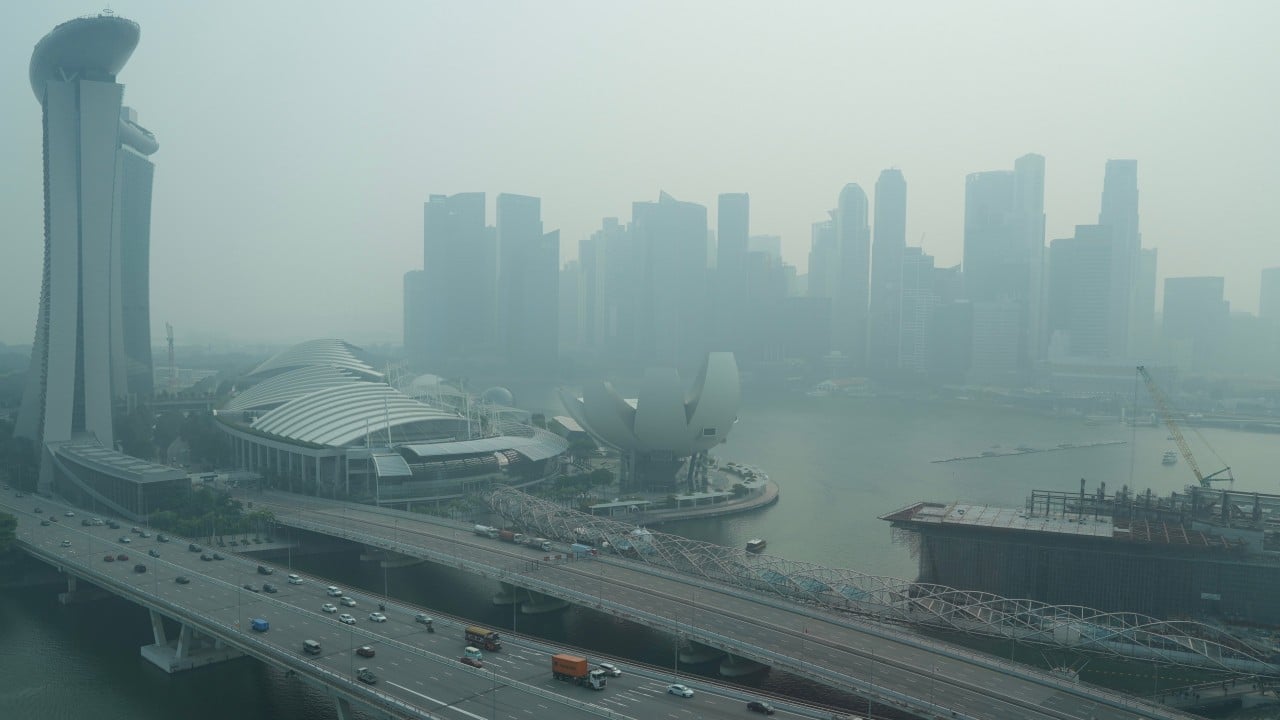
Singapore’s expansion of its transboundary haze investigation to ten palm oil and forestry firms exposes the structural friction between sovereign jurisdictional limits and regional supply chain economics. Under the Transboundary Haze Pollution Act (THPA), Singapore asserts extraterritorial jurisdiction over entities whose land-clearing practices outside its borders generate hazardous particulate matter within its airspace. Yet expanding a legal probe from initial suspects to a wider cohort of ten corporations does not automatically translate into immediate financial deterrence or atmospheric relief; instead, it reveals a complex operational bottleneck where satellite telemetry, opaque corporate ownership structures, and cross-border diplomatic constraints collide.
To evaluate the efficacy of this regulatory escalation, one must dissect the underlying economic incentives driving slash-and-burn agriculture, the evidentiary architecture required to prosecute corporate parents across borders, and the asymmetric market penalties that ultimately enforce compliance where statutory fines stall.
The Economic Engine of Peatland Ignition
Transboundary haze in Southeast Asia is not an accidental byproduct of agriculture; it is a rational, albeit destructive, capital allocation decision driven by land-clearing cost functions. Industrial palm oil and pulpwood expansion frequently targets tropical peatlands—waterlogged ecosystems containing massive deposits of partially decayed organic matter. Converting primary or degraded peatland into productive plantation acreage requires two sequential capital expenditures: drainage and clearing.
- Mechanical Clearing vs. Controlled Burning: Mechanical land clearing using heavy excavators and mulchers requires substantial upfront capital expenditure, high fuel consumption, and prolonged mobilization timelines. Conversely, setting fire to drained peatland reduces clearing costs by orders of magnitude while simultaneously depositing a temporary layer of nutrient-rich ash that lowers initial fertilizer inputs.
- The Discount Rate Asymmetry: Plantation operators and their subcontractors operate under high short-term discount rates. The immediate cash flow benefits of rapid planting and minimized clearing expenses outweigh the discounted, probabilistic risk of future regulatory penalties—particularly when enforcement mechanisms historically fail to pierce the corporate veil.
- Peatland Combustibility: Once drained via canals to make the soil viable for oil palm (Elaeis guineensis) or acacia plantations, peat dries out and becomes hyper-combustible. Surface fires routinely penetrate deep underground, smoldering for months beneath the water table. Extinguishing subsurface peat fires requires massive hydrological intervention—re-wetting the landscape by blocking drainage canals—which is operationally impossible once ignition spreads across thousands of hectares during El Niño-induced dry spells.
When Singapore’s National Environment Agency (NEA) expands its probe to ten firms, it is attempting to alter this cost function by introducing a severe expected-value penalty. Under the THPA, liable entities face statutory fines of up to S$100,000 per day of haze pollution, capped at S$2 million, alongside civil liability for economic damages suffered by Singaporean entities. However, a S$2 million statutory cap remains a minor operational surcharge relative to the multi-billion-dollar capitalization of major agribusiness conglomerates, meaning the primary threat of the probe lies not in the direct fine, but in reputational contagion and supply chain exclusion.
The Evidentiary Architecture of Extraterritorial Attribution
Prosecuting a corporation in a Singaporean court for a fire burning on an island in Sumatra or Kalimantan requires bridging an immense evidentiary gap. Traditional environmental enforcement relies on physical inspection, chain-of-custody sampling, and local police affidavits—tools entirely unavailable to Singaporean investigators operating outside their sovereign territory. Consequently, the NEA relies on a remote-sensing and corporate-mapping stack that must withstand rigorous judicial scrutiny.
Thermal Anomaly Detection and Atmospheric Trajectory Modeling
The evidentiary chain begins in orbit. Investigators utilize Moderate Resolution Imaging Spectroradiometer (MODIS) and Visible Infrared Imaging Radiometer Suite (VIIRS) sensors aboard polar-orbiting satellites to detect thermal anomalies—commonly termed hotspots—at resolutions down to 375 meters. Thermal data alone, however, only proves combustion, not causation or transboundary impact.
To establish the causal link required by the THPA, meteorological agencies must run backward and forward atmospheric dispersion models, such as the Hybrid Single-Particle Lagrangian Integrated Trajectory (HYSPLIT) model. By integrating wind vector fields, atmospheric pressure gradients, and boundary layer dynamics, analysts trace particulate matter ($PM_{2.5}$ and $PM_{10}$) recorded at Singaporean monitoring stations directly back to specific geographic coordinates over a precise temporal window.
Concession Mapping and the Corporate Veil Problem
Pinpointing a burning coordinate is useless without a legally binding link to a specific corporate balance sheet. Investigators overlay satellite hotspot coordinates onto digital land-use concession maps (Hak Guna Usaha or HGU boundaries in Indonesia) to identify the legal leaseholder.
Here, the probe encounters its sharpest operational friction:
- Data Sovereignty Barriers: Official, up-to-date digital concession maps are frequently treated as state secrets or proprietary commercial data by host governments. Without certified government GIS shapefiles, prosecutors must rely on publicly available datasets, NGO-compiled registries, or historical concession disclosures, all of which are vulnerable to evidentiary challenges regarding boundary accuracy.
- Subcontractor Buffering: Major plantation groups rarely clear land using direct payroll employees. Instead, they engage tiers of local contractors and smallholder cooperatives. When fires ignite, parent companies routinely claim the blazes originated on adjacent, unassociated community lands and spread inward, or that rogue subcontractors violated explicit zero-burning contract clauses.
- Layered Holding Structures: Agribusiness conglomerates frequently insulate their core assets behind multi-tiered holding companies registered across Singapore, Malaysia, Indonesia, and offshore jurisdictions. Demonstrating "management or control"—the statutory threshold required under the THPA to hold a parent entity liable for a subsidiary’s actions—demands forensic accounting to prove operational directives, shared directorships, and consolidated financial flows.
The Mechanics of Presumption Clauses
To prevent defendants from exploiting these evidentiary bottlenecks indefinitely, the THPA incorporates strict statutory presumptions. In standard civil or criminal litigation, the burden of proof rests entirely on the plaintiff or state to establish direct causation. Under the THPA, once the NEA establishes through satellite imagery and meteorological modeling that smoke from a specific parcel of land entered Singapore, the law presumes that the owner or occupier of that land caused or condoned the haze.
This legal mechanism shifts the burden of proof onto the targeted corporation. To rebut the presumption, the firm cannot simply issue a corporate press release touting its sustainability commitments; it must produce verifiable operational evidence demonstrating it took all reasonable steps to prevent ignition, detect hotspots early, and deploy firefighting infrastructure immediately upon detection.
Expanding the probe to ten firms indicates that Singaporean regulators have accumulated sufficient geospatial and corporate linkage data to issue formal legal notices—requiring company directors to attend interviews in Singapore or provide documentation detailing their concession boundaries, fire-suppression protocols, and supplier relationships. For firms with corporate headquarters, treasury operations, or senior executives residing in or transiting through Singapore, ignoring these notices carries the immediate risk of arrest warrants and asset seizures. For firms with zero physical footprint in Singapore, however, the statutory reach hits a hard jurisdictional wall.
Jurisdictional Friction and Diplomatic Asymmetry
Extraterritorial legislation inevitably collides with the principle of non-interference, a foundational tenet of the Association of Southeast Asian Nations (ASEAN). While all ten ASEAN member states ratified the ASEAN Agreement on Transboundary Haze Pollution, the treaty lacks binding enforcement mechanisms, financial penalties, or mandatory data-sharing protocols.
When Singapore investigates ten firms operating abroad, it triggers a subtle diplomatic tug-of-war:
- Sovereign Sensitivity: Host nations often view extraterritorial environmental probes as an infringement on their domestic regulatory sovereignty and an implicit critique of their own forestry enforcement agencies.
- Judicial Non-Enforcement: A fine levied by a Singaporean court against an Indonesian or Malaysian corporate subsidiary without Singapore-based assets cannot be automatically enforced in the host country’s courts without bilateral judicial enforcement treaties—which largely do not exist for regulatory penalties.
- Information Asymmetry: Host governments control access to on-the-ground forensic verification. If a host ministry declines to validate concession boundaries or share local police investigation files regarding arson suspects, Singaporean prosecutors are forced to build cases entirely on remote telemetry and corporate disclosures.
This jurisdictional limit explains why direct statutory fines rarely bankrupted a non-compliant plantation operator. The real mechanism of compliance operates outside the courtroom, within the architecture of global capital and consumer supply chains.
Market-Driven Deterrence and Supply Chain Contagion
The true strategic leverage of naming or investigating ten firms under the THPA lies in triggering secondary market penalties. Singapore is not merely a downwind recipient of particulate pollution; it is the primary financial, trading, and logistics hub for Southeast Asian commodities. By formally placing ten companies under investigation, regulators inject massive compliance risk into the commercial ecosystems surrounding those firms.
- The "No Deforestation, No Peat, No Exploitation" (NDPE) Chokepoint: Over 80% of global palm oil refining capacity operates under strict NDPE commitments. Major downstream buyers—consumer goods manufacturers, food processors, and global commodity traders—monitor regulatory probes closely. When a supplier is linked to an official transboundary haze investigation, downstream refiners face immediate pressure from institutional investors and environmental watchdogs to suspend procurement contracts. Losing access to NDPE-compliant supply chains forces the offending producer into the "leakage market"—selling crude palm oil at steep discounts to less scrupulous domestic or regional buyers, directly eroding operating margins.
- Trade Finance and Credit Rating Compression: Agribusiness relies heavily on revolving credit facilities, trade finance, and syndicated loans arranged through major financial institutions headquartered in Singapore. Banks operating under Monetary Authority of Singapore (MAS) environmental risk management guidelines are required to assess the environmental, social, and governance (ESG) exposure of their borrowers. An active NEA probe triggers mandatory enhanced due diligence, resulting in higher borrowing costs, covenant restrictions, or the outright non-renewal of credit lines.
- Retail and Certification Boycotts: Singaporean retail chains and consumer protection associations have previously demonstrated a willingness to pull paper products and cooking oils linked to investigated firms off supermarket shelves. Simultaneously, bodies like the Roundtable on Sustainable Palm Oil (RSPO) initiate parallel grievance procedures that can strip a producer of its sustainability certification, severing access to lucrative European and North American export markets.
Operational Limitations of the Regulatory Probe
Despite the potency of market-driven contagion, relying on an expanded regulatory probe to eliminate transboundary haze carries severe structural limitations.
First, the traceability gap in third-party supply chains obscures the ultimate origin of fresh fruit bunches (FFB). Independent smallholders and local dealers frequently aggregate harvests from both legal, fire-free plantations and illegally cleared peatlands, blending them at the mill gate. Even if the ten investigated firms clean up their direct concessions, they may continue processing tainted fruit through third-party mills unless strict polygon-level traceability is enforced across every tier of procurement.
Second, climate volatility overrides corporate governance. During severe El Niño events, prolonged drought drops water tables across millions of hectares of previously degraded peatland. Under these extreme meteorological conditions, a discarded cigarette or an unmonitored smallholder land-clearing fire miles away can ignite an unstoppable subsurface firestorm that sweeps across corporate concession boundaries regardless of the leaseholder’s fire-prevention budget.
Third, fragmented corporate ownership allows asset shell-games. When a specific corporate entity becomes too toxic for international banks and NDPE buyers due to an NEA investigation, parent conglomerates can execute corporate restructurings—spinning off the tainted subsidiary, transferring concession management rights to opaque domestic entities, and isolating the legal liability while continuing to extract cash flows from the underlying agricultural assets.
The Strategic Imperative for Agribusiness and Regulators
The expansion of Singapore’s probe to ten firms marks a transition from symbolic legal posturing to systematic supply chain pressure, yet statutory enforcement alone cannot extinguish peatland fires. For regulators, the definitive play is to shift focus from pursuing elusive extraterritorial fines against upstream growers to enforcing strict liability and mandatory traceability disclosures on the midstream traders, refiners, and financial institutions physically domiciled within Singapore’s jurisdiction. Requiring Singapore-based commodity financiers and refiners to verify polygon-level, fire-free provenance as a condition of their operating licenses closes the jurisdictional gap far more effectively than issuing cross-border subpoenas.
For agribusiness operators across Southeast Asia, the strategic takeaway is unambiguous: treating environmental compliance as a public relations exercise or relying on subcontractor buffer zones is a failing risk-management model. Capital allocation must immediately pivot toward permanent hydrological restoration—constructing concrete canal-blocking infrastructure to keep peatland water tables above critical ignition thresholds—paired with automated, real-time satellite monitoring across 100% of direct and third-party supplier concessions. In an era where orbital telemetry and financial regulation operate in lockstep, corporate opacity is no longer a viable shield against transboundary liability.


