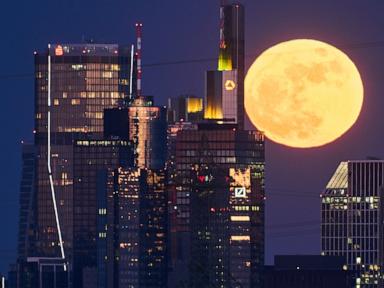
The full moon peaking at 08:45 UTC on May 31, 2026, will look like a normal, ivory-white sphere to anyone standing outside. It will not be sapphire, it will not look like a tiny speck, and it will not warp the fabric of local astronomy. Yet digital media networks are treating this upcoming weekend lunar alignment as a generational event, blinding audiences with a double-barreled designation: the "Blue Micromoon."
The terms driving this viral cycle are not rooted in classical astronomy. They are products of 20th-century publishing errors and modern internet algorithms engineered to turn standard orbital mechanics into clickable spectacles. The May 31 event is simply the second full moon in a single calendar month, occurring roughly 19 hours before the moon hits apogee, its furthest orbital distance from Earth. While clickbait framing promises a shrunken, color-shifting anomaly, the reality is a lesson in perspective compression and media manipulation.
The Mathematical Accident of the Calendar Blue Moon
The moon requires 29.5 days to complete a full cycle from one new moon to the next. Because our standard calendar months run 30 or 31 days, a simple mathematical drift occurs. Every two to three years, those accumulated spare days force two full moons into a single month. May 2026 started with a full moon on May 1 and concludes with this second one on May 31.
Historically, the term "Blue Moon" meant something entirely different. The traditional Maine Farmers' Almanac used it to mark the third full moon in an astronomical season containing four. The modern definition—the second full moon in a month—was born out of a literal mistake. In 1946, an amateur astronomer writing for Sky & Telescope misinterpreted the almanac's complex system. He published a simplified, incorrect definition. Decades later, a popular radio show picked up the error, and by the time internet search engines began cataloging human knowledge, the mistake had become the dominant rule.
The moon will only alter its physical hue under severe atmospheric conditions. If a massive volcanic eruption or a historic wildfire chokes the stratosphere with particles exactly 1 micron wide, red wavelengths of light are scattered while blue light passes through. The cataclysmic 1883 eruption of Krakatoa created literal blue moons for months. The orbital position of the moon on May 31 has zero impact on atmospheric chemistry; it will shine with its usual brilliant, silvery-white intensity.
The Reality of Apogee and the Diminishing Disk
The second half of the viral moniker relies on the "micromoon," an informal term invented to counter the sensationalism of the "supermoon." The moon orbits Earth along an ellipse, not a perfect circle. At its closest approach, known as perigee, it sits roughly 225,000 miles away. At its furthest point, apogee, it drifts out to more than 252,000 miles.
On June 1, less than a day after reaching its peak full phase, the moon will hit apogee at a distance of 406,366 kilometers. This makes the May 31 event the smallest full moon of 2026.
Lunar Disks: A Visual Comparison of Apparent Sizes
+-------------------------------------------------------+
|  [●] Supermoon (Perigee)     ~33.5 arcminutes          |
|  [●] Average Full Moon       ~31.0 arcminutes          |
|  [●] Micromoon (Apogee)      ~29.4 arcminutes          |
+-------------------------------------------------------+
The mathematical reality is stark. The apparent disk of this micromoon will be roughly 6% smaller and 10% dimmer than an average full moon. Human eyes cannot detect this shift in isolation. Without a side-by-side photographic comparison using identical focal lengths, a casual observer standing in a backyard cannot look at the sky and see a "micro" object. The human brain lacks the baseline memory to notice a 6% variance in a solitary white disk floating in an open sky.
The Horizon Deception and the Scorpion's Heart
While the physical size of the moon is smaller, it may actually look gargantuan to observers looking East right after sunset on May 30 and May 31. This is the moon illusion, a psychological trick of the mind that completely overpowers the physical reality of a micromoon.
When the moon sits low on the horizon, the human brain compares it to foreground objects like trees, buildings, and hills. Lacking an open sky for scale, the mind miscalculates the distance and scales up the object, rendering a massive golden orb that appears twice its actual size. The atmosphere near the horizon will also scatter shorter wavelengths of light, painting the micromoon in deep shades of amber and orange before it climbs higher into the sky.
For observers in the Northern Hemisphere, the moon will drift through the constellation Scorpius, sitting right next to Antares, a massive red supergiant star. This pairing offers a genuine target for binoculars.
South of the equator, the event shifts from a cosmetic grouping to a violent cosmic eclipse. Across parts of Argentina, Chile, and Antarctica, the moon will pass directly in front of Antares, completely blocking the star from view. This lunar occultation is the true scientific event of the weekend, allowing researchers to track precise orbital alignments by measuring the exact microsecond a star vanishes behind the lunar limb.
The Packaging of the Night Sky
The rise of the "Blue Micromoon" phrase highlights a growing trend in digital media: the branding of ordinary natural cycles into unmissable internet phenomena. Because digital algorithms reward novelty and urgency, standard lunar milestones are routinely repackaged with dramatic adjectives to capture fleeting public attention.
True astronomy requires patience, dark skies, and an understanding of incremental orbital shifts. The viral cycle does the opposite, promising an immediate, radical visual transformation that the sky cannot deliver. When casual viewers go outside and see a normal, slightly yellow moon, the resulting disappointment undercuts genuine public interest in the sciences.
The May 31 moon is worth watching, but not for the reasons flashing across social feeds. It is a quiet reminder of how human calendars fail to neatly box up the mechanics of space, and how easily our minds are fooled by a horizon line. Turn off the screen, step outside after dusk, and look toward the southeast. Just leave the viral expectations behind.