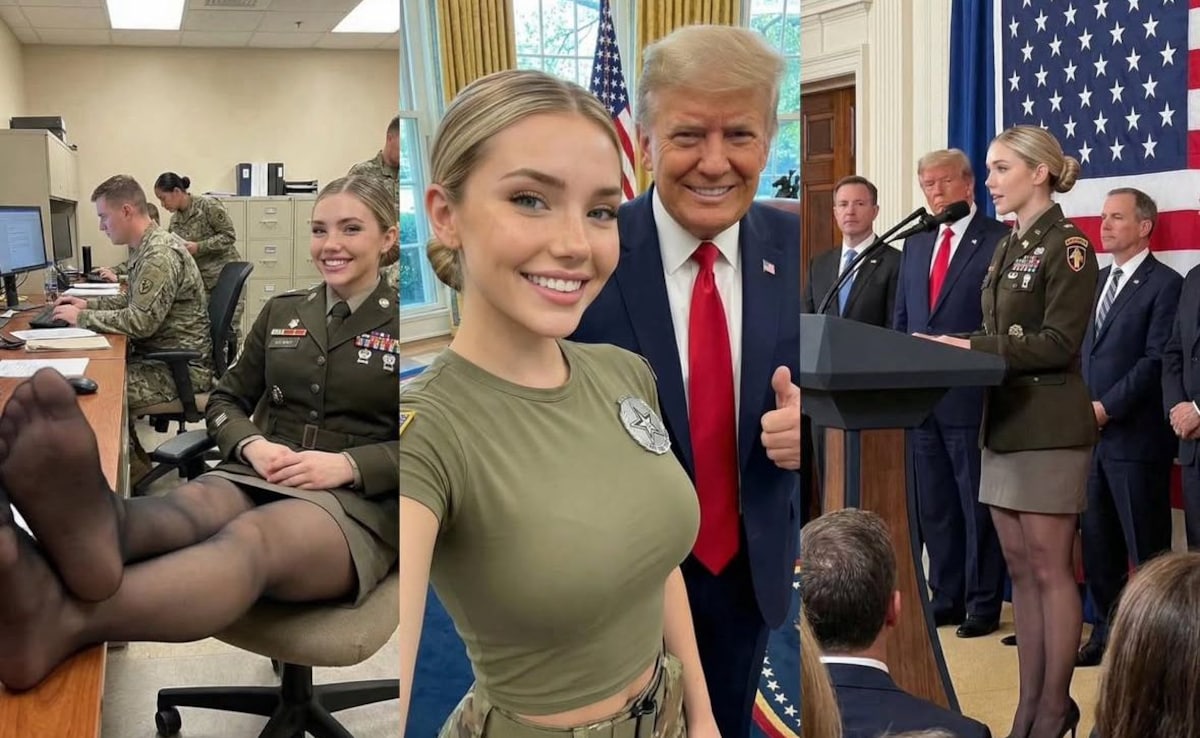
The internet is currently having a collective meltdown over a blonde woman who doesn't exist. You’ve seen the photo: a generic, "perfect" US Army soldier posing with Trump, Putin, and Zelensky. The mainstream media is tripping over itself to label this a "sophisticated disinformation campaign." They want you to believe we are entering a dark age where truth is extinct and AI-generated blondes are the new nukes.
They are wrong. Dead wrong.
The panic surrounding the "AI Soldier" isn't about technology; it’s about the fact that we have spent decades training humans to be as uncritical as a beta-version chatbot. The media wants to "demystify" (a word they love, though I loathe it) the tech, but they refuse to address the underlying rot: the human desire to be lied to as long as the lie fits the vibe.
The Lazy Consensus of "Deepfake Armageddon"
The standard narrative—pushed by every major outlet from the BBC to tech blogs—is that AI images are a threat to democracy because they look "too real."
I have spent fifteen years in the guts of digital forensics and behavioral data. I can tell you that the "realness" of the image is the least important part of the equation. The blonde soldier photo was technically mediocre. It had the classic AI hallmarks: uncanny valley lighting, questionable skin textures, and a general "plastic" sheen.
If you looked at it for more than three seconds, you knew it was fake. But people didn't look for three seconds. They looked for 0.5 seconds, felt a surge of partisan dopamine, and hit "share."
We aren't fighting a war against sophisticated algorithms. We are fighting a war against Confirmation Bias at Scale. The AI didn't trick anyone; it simply provided a visual mirror for what people already wanted to believe about their political heroes or villains.
Why "Fact-Checking" is a Failed Project
Every time a fake image goes viral, the response is a flurry of "How to Spot an AI Image" guides. They tell you to look at the fingers. Look at the earlobes. Check the background text.
This is useless advice.
By the time a user is counting fingers on a digital soldier, they’ve already processed the emotional payload of the image. The brain decides if it likes the "truth" of the image before the conscious mind analyzes the pixels.
I’ve seen intelligence agencies spend millions on detection software that flags AI with 99% accuracy. It doesn't matter. If a voter sees an AI image of a politician they hate doing something terrible, no "Verified Fake" badge from a fact-checker will erase the visceral disgust they felt.
The industry is obsessed with fixing the output (the image) when the problem is the input (the human brain). We are trying to patch a software bug in society with a hardware solution.
The Blonde Soldier as a Rorschach Test
Let’s dismantle the specific case of the blonde soldier. The mainstream commentary focuses on the "danger" of using a female soldier to bridge the gap between warring leaders.
The real story? This image is a masterclass in Generic Appeal.
The creator didn't need to make a "good" fake. They needed to make a "comfortable" fake. A blonde woman in uniform is a universal symbol of Western stability and traditional values. She is the ultimate neutral vessel. By placing her between Trump, Putin, and Zelensky, the creator wasn't trying to change minds; they were trying to harvest engagement.
The "threat" isn't political subversion. It’s the commodification of attention through aesthetic perfection. AI allows us to generate the "Perfect Average." It is the McDonald's of visual content—consistent, low-quality, and highly addictive.
The Myth of the Sophisticated Actor
Most "disinformation experts" love to hint at shadowy state actors or Russian troll farms. It makes the problem feel grand and cinematic.
In reality, most of these viral AI images are created by bored teenagers or low-level "engagement farmers" in Eastern Europe and Southeast Asia who want to juice their ad revenue. They aren't trying to collapse the US government; they’re trying to get a $400 check from a programmatic ad network.
The "Industry Insider" secret nobody wants to admit: The AI is just a more efficient way to spam. Before AI, these people used Photoshop and did a bad job. Now, they use Midjourney and do a "good enough" job. The intent is the same. The result is the same. The only difference is the volume. If we want to stop this, we don't need better AI detection; we need to kill the financial incentives that reward viral falsehoods.
Digital Literacy is a Dead Concept
We keep talking about "digital literacy" as if we can teach our way out of this. We can’t.
Imagine a scenario where 90% of all online content is AI-generated by 2027. In that world, "checking the fingers" becomes a full-time job. Human beings are not wired for constant skepticism. We are wired for heuristics—mental shortcuts that save energy.
The contrarian truth? We should stop trying to teach people how to spot fakes and start teaching them to distrust everything by default.
The current "trust but verify" model is broken. The new model must be "disregard unless authenticated." This is a massive shift in how we consume information. It requires a move toward Cryptographic Proof of Origin, not just visual inspection.
If an image doesn't have a verifiable chain of custody (like a C2PA metadata tag from a physical camera), it should be treated as fiction. Period.
The Technical Reality: The "Uncanny Valley" is Closing
While I’m attacking the social response, let’s be real about the tech. The "blunders" in the blonde soldier image—the weird lighting and the generic faces—are temporary.
Within 18 months, the visual flaws will be gone. We are moving from the era of "AI Detection" to the era of "AI Perfection."
When the pixels are perfect, what do the fact-checkers have left? Nothing but "context." And context is the first thing to die in a social media feed.
The industry is currently patting itself on the back for debunking a "blonde soldier." That’s like bragging about catching a shoplifter while the bank vault is being cleaned out. We are focusing on the most obvious, low-rent examples of AI while the truly dangerous stuff—synthetic audio for kidnapping scams and hyper-realistic deepfakes used in private extortion—is exploding in the shadows.
Stop Moralizing the Tools
The outcry over the blonde soldier often carries a tone of moral superiority. "How could people be so stupid?" ask the pundits.
This elitism is why the "disinformation" fight is losing. People don't like being told they are stupid. When you "debunk" an image they liked, you aren't correcting a fact; you are attacking their identity.
The blonde soldier image worked because it felt like a "peace" image. It felt hopeful to some, or like a "strongman" fantasy to others. When you tell someone that their hope or fantasy is "AI-generated misinformation," they don't thank you. They dig in.
The fix isn't more "truth." The fix is Better Friction.
We have made it too easy to share. We have made it too easy to generate. The solution is to re-introduce the cost of production. If it costs $0.001 to generate a fake soldier, we will have billions of them. If we force platforms to verify the identity of every high-reach uploader, the "blonde soldier" disappears overnight.
The Pivot You Aren't Ready For
We need to stop asking "Is this image real?"
The better question is: "Why does it matter if it's real?"
If an AI image of a soldier makes a million people feel a certain way, the feeling is real. The political consequence is real. The pixels are irrelevant.
We are entering an era of Post-Functional Truth. In this era, the "facticity" of a piece of media is secondary to its "utility." The blonde soldier was useful to the people who shared it. It served a purpose.
Until we address the fact that our society now values Utility-Truth over Objective-Truth, we will keep falling for the next blonde soldier, the next fake explosion, and the next synthetic scandal.
Stop looking for the AI. Start looking at the person who wants you to see it.
Turn off the "AI detector" in your browser. It’s a security theater that gives you a false sense of safety. Instead, start treating every single image on your screen as a high-budget hallucination designed to pick your pocket or your brain.
The blonde soldier didn't lie to you. The screen did. And you let it.
Verify the source, or don't click at all.