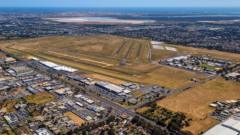
Two lives ended when a small aircraft slammed into a hangar at an Australian airfield, leaving a trail of wreckage and a community searching for answers. While the immediate focus of investigators rests on the twisted metal at the crash site, the real story lives in the systemic gaps that continue to haunt light aircraft operations. This wasn't just a mechanical failure or a momentary lapse in judgment. It is the latest entry in a grim ledger that suggests our approach to private flight oversight is lagging behind the risks inherent in the cockpit.
The incident occurred during what should have been a routine departure or arrival sequence. Instead, the aircraft deviated from its intended path, striking a structure with enough force to ensure a catastrophic outcome. Emergency crews arrived to a scene that has become far too familiar to those in the aviation industry—a localized tragedy that rarely captures national headlines for more than a day, yet speaks volumes about the fragility of the general aviation sector.
The Anatomy of an Airfield Disaster
When a plane hits a hangar, the investigation starts with the "Man, Machine, and Medium" framework. Investigators from the Australian Transport Safety Bureau (ATSB) are currently scrubbing through flight data, if available, and wreckage patterns. However, light aircraft often lack the "black boxes" found on commercial jetliners. This leaves a vacuum of information that must be filled by forensic engineering and witness accounts.
The speed and angle of impact suggest a loss of control at a critical altitude. In these scenarios, the pilot has seconds to react. If the engine coughs or a control surface jams during a low-level maneuver, the margin for error evaporates. Airfields are cluttered environments. Hangars, while necessary for storage, represent unforgiving obstacles for an aircraft that has lost its ability to maintain a stable flight path. We have to ask why the aircraft was in a position to strike a stationary building in the first place. Was it a botched emergency landing, or did the pilot suffer a medical episode that rendered the controls useless?
The Hidden Pressures on Private Pilots
We often romanticize the private pilot as a master of the skies, but the reality is frequently more grounded in stress and eroding skill sets. Unlike commercial pilots who fly hundreds of hours a month with a co-pilot to check their every move, general aviation pilots often fly sporadically. This lack of "recency" is a silent killer.
Skill decay happens faster than most hobbyists care to admit. A pilot who hasn't practiced emergency stalls or engine-out procedures in six months is not the same pilot who passed their check-ride. When something goes wrong at a low altitude, muscle memory is the only thing that saves you. If that memory is rusty, the results are often fatal.
Furthermore, the Australian climate adds a layer of complexity. High density altitude—where hot air makes the plane "feel" like it is flying much higher than it actually is—can gut engine performance and lift. A plane that took off easily in the cool morning might struggle to clear a hangar fence in the heat of the afternoon. Many pilots underestimate this physical reality until the wheels are off the ground and the climb rate stays stubbornly at zero.
Mechanical Integrity and the Cost of Maintenance
Owning and maintaining a small plane is an expensive proposition. As inflation bites and parts become harder to source, there is an unspoken pressure to stretch maintenance intervals. This is where the "Machine" element of the crash comes into play.
- Age of the Fleet: The average age of general aviation aircraft in Australia is over 30 years. These are machines built in a different era, maintained through decades of heat, vibration, and wear.
- Component Fatigue: Metal fatigue in engine mounts or control cables isn't always visible during a standard pre-flight walkaround.
- Regulatory Lag: While commercial aviation has moved toward predictive maintenance using sensors, many light planes still rely on "fix it when it breaks" or strictly hourly-based inspections that might miss environmental corrosion.
The ATSB will look closely at the maintenance logs of the aircraft involved. They will look for skipped inspections or "deferred" repairs. Even a minor leak in a fuel line or a fraying wire can become a primary cause of a fire or engine failure at the worst possible moment.
Rethinking Airfield Infrastructure Safety
The location of the crash—a hangar—raises questions about airfield design. Many small airports have grown organically over decades, with buildings squeezed closer to runways and taxiways as demand for storage increases. This creates a high-stakes environment where a minor deviation from the centerline puts wings in close proximity to corrugated iron.
We need to evaluate the "obstacle-free zones" at regional airfields. If a pilot loses an engine on takeoff, they should have a clear path to put the plane down. When hangars are built directly adjacent to high-traffic areas, we are essentially placing walls in the middle of a safety margin. It is a spatial trade-off where convenience and revenue often win over risk mitigation.
The aviation community often bristles at more regulation, fearing it will price people out of the sky. But the cost of these accidents is higher. Every time a small plane goes down, insurance premiums rise, public perception of light flight sours, and more importantly, families are shattered.
The Human Factor and Decision Making
Beyond the mechanics and the geography lies the most complex element: the human brain. Most general aviation accidents are attributed to "pilot error," but that term is a lazy catch-all. We should be looking at Aeronautical Decision Making (ADM).
Why did the pilot decide to fly that day? Were they pushing a deadline? Did they ignore a minor warning light because they were "almost there"? This is known as "get-there-itis," a psychological trap where the desire to reach a destination overrides the cold logic of safety. In a small plane, you are the captain, the navigator, and the safety officer all at once. There is no one to tap you on the shoulder and say, "Let’s stay on the ground."
The investigation into this specific crash will eventually release a report, likely months from now. It will list the wind speeds, the engine condition, and the pilot's hours. But the industry shouldn't wait for a paper report to acknowledge the obvious. General aviation is operating with a safety margin that is increasingly thin. We are flying older planes into more crowded airfields with less frequent training than the modern environment demands.
The two individuals lost in this crash are not just statistics in a database. They are a warning. To ignore the systemic issues of pilot currency, aging airframes, and airfield congestion is to accept that these tragedies will continue to happen with rhythmic regularity. Safety isn't a destination we reach; it is a constant, expensive, and often exhausting pursuit of mitigating the "what-ifs." When we stop asking those questions, the ground eventually catches up.
Tighten the inspection requirements for airframes over 40 years old. Mandate more frequent emergency procedure reviews for private pilots. Re-evaluate the placement of permanent structures within the takeoff and landing corridors of regional strips. These aren't radical ideas; they are the bare minimum required to stop the bleeding in an industry that cannot afford many more days like this one.