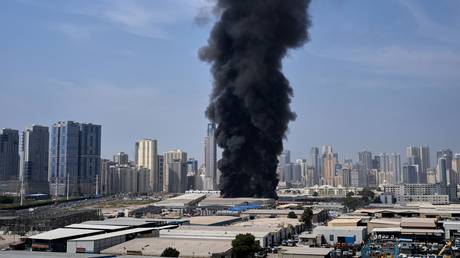
The recent warnings issued to Dubai-based influencers regarding posts depicting war damage aren't about "sensitivity" or "safety." That is the lie fed to the masses. If you believe the official narrative—that the UAE is simply trying to protect its digital stars from legal gray areas—you have already lost the plot.
This isn't a regulatory hiccup. It is a fundamental shift in the economics of soft power.
For a decade, the Dubai influencer model was built on a single, fragile premise: The Erasure of Reality. You come for the gold-plated steaks; you stay because the sun never sets on a construction crane. But when global conflict spills into the feed, that "neutral" luxury playground suddenly looks like a gated community in a hurricane.
The warnings aren't there to protect the influencers. They are there to protect the Brand Equity of Stability. ## The Myth of the Neutral Platform
Mainstream media frames these warnings as a clash between free speech and local law. That’s amateur hour.
In reality, the UAE has perfected the art of "Digital Feudalism." In this system, influencers are not independent creators; they are temporary tenants of a high-end digital estate. When an influencer posts a photo of a bombed-out building or a protest in a neighboring region, they aren't "raising awareness." They are introducing Systemic Risk to the local economy.
Dubai’s GDP is tied to its image as a frictionless hub. Friction is what happens when people remember that the Middle East is a complex, often volatile geopolitical theater. By posting war damage, influencers are inadvertently reminding investors that the Burj Khalifa is located in a zip code, not a vacuum.
I have sat in boardrooms where "brand safety" was used as a euphemism for "political hygiene." When a government warns an influencer, they are really saying: “We gave you the backdrop; don’t ruin the set.”
The Influencer as a Geopolitical Asset
Most people ask: "Why can't they just post what they want?"
The better question is: "Why did we ever think they were independent?"
Let’s look at the numbers. The influencer marketing industry in the GCC (Gulf Cooperation Council) is projected to reach billions in the coming years. This isn't just about selling teeth whitening strips. It is about Destination Branding. When an influencer receives a "warning," it is a margin call. The state has invested in the infrastructure that makes their lifestyle possible—the tax-free environment, the luxury visas, the pristine beaches. In exchange, the influencer provides a 24/7 stream of curated tranquility.
Breaking character by showing the "real world" is a breach of contract.
The Logic of Curated Silence
The competitor articles suggest that influencers are "confused" by these rules. They aren't. They are terrified because they finally realize they are part of the machine.
Consider the mechanics of a "Peace Brand." To maintain a status as a neutral trade hub, you must strictly control the narrative of conflict. If you allow influencers to become political activists, you transform your city from a "Safe Haven" into a "Debate Floor."
- Safe Haven: Attracts $100M penthouses and hedge fund relocations.
- Debate Floor: Attracts sanctions, protests, and volatility.
The UAE is choosing the former, and they are using their most visible citizens—the ones with the 10-million-follower counts—to enforce it.
The Death of the "Authentic" Travel Creator
We are witnessing the final nail in the coffin of "authentic" content.
The industry likes to use words like "engagement" and "community." Forget them. The only metric that matters in this context is Narrative Alignment. If you are an influencer in Dubai, you are a commercial actor in a state-sponsored movie. When you start improvising your own lines about foreign policy or human rights, the director cuts the scene. The "warning" is just the red light on the camera turning off.
I’ve seen influencers lose everything because they thought their "brand" was bigger than the soil they stood on. It never is. In the world of high-stakes geopolitics, a million followers is a rounding error compared to a sovereign wealth fund’s reputation.
The Strategy for Survival (And Why It’s Dying)
Most "experts" will tell influencers to just "stay neutral."
That is terrible advice.
In a polarized world, neutrality is seen as complicity by the audience and as a liability by the state. The middle ground is where you get hit by cars from both directions.
The contrarian move? Double down on the Hyper-Real. If the state wants a dreamworld, give them the most extreme version of it. Don't try to be "real." Authenticity is a liability in a managed economy. The influencers who will survive this purge are the ones who lean so far into the luxury aesthetic that they become indistinguishable from the architecture itself.
Why You Are Asking the Wrong Question
You’re asking: "Is this censorship?"
The answer is: "Who cares?"
The real question is: "Is the influencer business model compatible with a multipolar world?"
For the last twenty years, we lived in a world where you could pretend that business and politics were separate. You could have a tech hub in a war zone. You could have a fashion show in a site of historic trauma. That era is over.
Every post is now a data point in a larger ideological struggle. If you aren't being paid to post it, you're likely the product being sold to satisfy a diplomatic requirement.
The Brutal Truth About "Digital Rights"
There is a common misconception that digital platforms offer a level playing field. They don't. They offer a Leased Field. When you operate in a jurisdiction like the UAE, you are signing a Terms of Service agreement that is written in the national law, not a California tech office. The "warning" issued to influencers is a courtesy. In many other sectors, you don't get a warning; you get a deportation order or a frozen bank account.
The reality of the "Dubai Dream" is that it is a highly regulated, high-performance product. Like a Ferrari, it’s amazing to drive, but you can’t take it off-road. War posts are "off-road."
Stop Crying for the Influencer
The "war damage" controversy is a distraction. It's a shiny object designed to make you think about "freedom of speech" while the actual mechanics of State-Led Content Creation continue to expand.
Governments globally are realizing that they don't need to own the TV stations if they can just "guide" the people who own the eyeballs. Why run a propaganda department when you can just have a brunch with twenty people who have 50 million combined followers?
This isn't a crackdown. It's a Standard Operating Procedure.
If you are a follower, stop looking for "truth" in a feed designed for "transaction." If you are an influencer, stop pretending you are a journalist. You are a salesperson for a lifestyle that requires the absence of reality to function.
The next time you see a Dubai influencer post a sunset instead of a news report, don't blame their "ignorance." Respect their business sense. They know exactly who pays the bills, and it isn't the people clicking the "like" button. It's the people who own the sand under their feet.
Quit looking for a conscience in a spreadsheet.