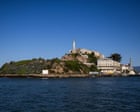
The request for $152 million to restore Alcatraz Island as a functional federal penitentiary represents a fundamental shift from heritage preservation to high-security infrastructure investment. This capital expenditure is not merely a budgetary line item; it is a complex intersection of historical remediation, maritime logistics, and modern carceral requirements. To evaluate the feasibility of this proposal, one must move past the political optics and analyze the structural, operational, and economic variables that dictate the cost of rehabilitating an island-based high-value asset.
The primary challenge lies in the "Island Premium"—a well-documented economic phenomenon where construction and maintenance costs on offshore sites scale exponentially rather than linearly. Every metric ton of concrete, every kilowatt-hour of power, and every gallon of potable water must be transported across a high-current maritime corridor. On Alcatraz, this premium is exacerbated by over 60 years of salt-air corrosion and the degradation of reinforced concrete structures that were never designed for a century-long lifespan.
The Triple Constraint of Alcatraz Restoration
Recommissioning a site that has functioned as a National Park Service (NPS) landmark since 1973 involves three conflicting priorities: structural integrity, modern security compliance, and environmental sustainability.
1. Structural Remediation and Seismic Hardening
Alcatraz sits in a high-activity seismic zone. The Main Cellhouse, constructed in the early 20th century, utilized unreinforced masonry and early-stage reinforced concrete. Saltwater intrusion has led to "concrete cancer," where the internal steel rebar oxidizes, expands, and causes the concrete to spall and crack. A $152 million budget must first address the stabilization of the "Model Industries Building" and the "New Quarters," both of which are currently in various states of collapse. Modernizing these for inmate habitation requires seismic retrofitting that meets 2026 California building codes—a process that often costs more than ground-up construction on a mainland site.
2. The Logistics of Maritime Utility Chains
The island currently lacks a permanent connection to the San Francisco power grid or water supply. It relies on aging diesel generators and water ferried in by barge.
- Water Security: A functional prison requires roughly 100 to 150 gallons of water per inmate per day. For a 500-inmate facility, that necessitates a desalination plant or a multi-mile sub-sea pipeline.
- Waste Management: Unlike a tourist site with limited hours, a 24/7 correctional facility produces a constant stream of greywater and sewage. Installing a self-contained treatment plant on a 22-acre rock with zero soil absorption is a feat of specialized civil engineering.
- Energy Density: Transitioning from NPS-level lighting to ADX-level (Administrative Maximum) security—including perimeter sensors, 4K thermal imaging, and electronic cell locks—increases energy demand by a factor of ten.
3. Regulatory and Environmental Conflict
The island is a sanctuary for nesting seabirds and falls under the strict jurisdiction of the Golden Gate National Recreation Area. Reintroducing a high-security human population triggers a collision with the National Environmental Policy Act (NEPA). The noise pollution from heavy construction and the eventual light pollution from high-intensity security arrays create a legal bottleneck that could consume 15% to 20% of the allocated $152 million in litigation and environmental impact reporting before a single brick is laid.
Operational Expenditure and the Staffing Gap
While the $152 million request covers capital expenditure (CAPEX), the long-term failure point of the Alcatraz proposal is operational expenditure (OPEX). The Bureau of Prisons (BOP) currently faces a systemic staffing crisis.
The cost of living in the San Francisco Bay Area is 80% higher than the national average. To staff a high-security facility on an island, the government must account for:
- Hazard and Commute Pay: Every shift change requires a coordinated maritime transit. Staff must be paid for transit time, or "portal-to-portal," which effectively adds two hours of non-productive labor cost to every eight-hour shift.
- Emergency Response Lag: In a riot or medical emergency, the "Golden Hour" is compromised by the San Francisco Bay's unpredictable weather and fog. Maintaining a high-level medical suite on-island is mandatory, further inflating the per-inmate cost.
The United States currently spends an average of $35,000 to $45,000 per year to house a medium-security inmate. Based on the geographic and logistical constraints of Alcatraz, that figure is projected to exceed $120,000 per inmate. This creates a fiscal paradox: the facility would be the most expensive piece of real estate in the federal system, yet its capacity would be limited by the island’s fixed 22-acre footprint.
The Security-Technology Interface
Restoring a prison built in the 1930s for 21st-century threats requires an overhaul of the technology stack. The original "The Rock" relied on the physical barrier of the Bay. Modern escapes are increasingly digital or aerial (drones).
The $152 million must fund a comprehensive "Digital Perimeter." This includes:
- Acoustic Underwater Sensors: To detect submersible or diver-based approaches.
- RF Jamming and Drone Detection: To prevent the delivery of contraband via autonomous flight.
- Biometric Internal Transit: Replacing physical keys—which are a high-risk failure point in salt-corroded environments—with iris or vascular scanners.
The reliability of these systems in a high-humidity, high-salinity environment is low. Electronic components fail at a rate 3x higher in coastal environments than in inland facilities like ADX Florence. This creates a perpetual maintenance cycle that the $152 million budget does not explicitly solve.
Strategic Forecast: The Pivot to Federal Symbolism
The request for funding is likely a strategic "stress test" for federal infrastructure spending. If the goal is truly to increase bed capacity, $152 million would be more efficiently spent expanding existing facilities in low-cost-of-living regions like the Midwest or the South, where land is cheap and labor is abundant.
Choosing Alcatraz suggests a move toward "Symbolic Deterrence." The island carries a psychological weight that no modern facility can replicate. However, the delta between the $152 million request and the actual cost of a fully operational, code-compliant, maritime-hardened prison is likely several hundred million dollars.
The most probable outcome is a phased restoration where the funds are used to stabilize the crumbling exterior under the guise of "security readiness," while the actual recommissioning as a prison remains a multi-decade project stalled by the California Coastal Commission and environmental litigation. The strategic recommendation for stakeholders is to treat this as a heritage-stabilization project rebranded as a security initiative to bypass traditional NPS budget caps.
Any entity looking to bid on this contract must prioritize maritime logistics and salt-resistant material science over traditional masonry. The "Alcatraz Project" will be won or lost not on the quality of the cells, but on the robustness of the sub-sea utility umbilical and the reliability of the desalination infrastructure.