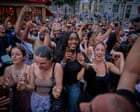
Every June, the global press prints the exact same copy-pasted narrative about Paris. They call it a "massive open-air rave." They swoon over the "spontaneous joy" of two million people flooding the asphalt. They quote city officials bragging about democratic culture while meteorologists issue dire warnings about incoming heatwaves.
It is a beautiful lie.
The lazy consensus treats the Fête de la Musique as a triumph of cultural expression over urban friction. Mainstream outlets frame the looming logistics night, the suffocating humidity, and the gridlocked transit as minor speed bumps in the pursuit of sonic liberation. They tell you that packing two million sweaty bodies into ancient, stone-paved corridors during a climate spike is a testament to the Parisian spirit.
As someone who has spent fifteen years managing large-scale European cultural events and analyzing urban crowd dynamics, I see something entirely different.
The Fête de la Musique is not a triumph. It is an annual, subsidized disaster template. It is a high-risk infrastructure failure masquerading as a bohemian carnival, and the refusal to admit this is putting lives at risk while actively draining the local creative economy it claims to support.
The Myth of the Romantic Heatwave
Let’s dismantle the biggest piece of romantic nonsense first: the idea that heatwaves are just a dramatic backdrop to summer revelry.
When a city like Paris hits high temperatures during a mass gathering, the thermodynamics of the urban heat island effect change the math completely. This is not about people feeling uncomfortable or needing to buy extra bottles of water.
Ancient European cities are literal heat sinks. Stone buildings, asphalt streets, and a distinct lack of green canopy absorb thermal radiation all day. By nightfall, when the music starts, that stored heat radiates back into the streets. Add the metabolic heat of two million tightly packed bodies, and you create localized microclimates where the ambient temperature can spike significantly higher than the official meteorological readings.
Mainstream reporting treats hydration as an individual responsibility. "Bring a bottle, find a fountain." This is a fundamental misunderstanding of crowd psychology and fluid dynamics.
Imagine a scenario where thirty thousand people are jammed into the narrow streets around the Place de la République. The temperature at chest level is suffocating. To get to a water source or an emergency medical tent, a person has to fight through a dense human wall. The friction slows movement to centimeters per minute. By the time someone realizes they are experiencing heat exhaustion, they are effectively trapped.
We are relying on pure luck. The moment that luck runs out, the narrative changes from "vibrant cultural festival" to "preventable urban tragedy" in a fraction of a second.
How Free Culture Bankrupts Local Creatives
The second flaw in the festival’s premise is economic. The Fête de la Musique operates on a mandate of mandatory amateurism and zero-cost entry. Anyone can set up a speaker; no one gets paid.
This sounds beautifully democratic on paper. In reality, it acts as a massive economic siphon that hurts the very people who keep the city’s music scene alive the other 364 days of the year.
Think about the local club owner, the independent venue operator, or the professional working musician. These entities pay taxes, maintain insurance, comply with strict noise ordinances, and pay licensing fees year-round. On June 21, the city effectively suspends the rules for everyone else.
The streets fill with deafening, uncurated sound systems blasting blown-out MP3s. The professional venues—the ones that actually invest in local talent and provide sustainable creative employment—are left empty or inaccessible due to street closures.
Worse, it trains the public to believe that music has a market value of zero. It normalizes the expectation that artists should perform for "exposure" and the sheer joy of public space.
"When you subsidize chaos and mandate that performance must be free, you do not democratize culture. You devalue it."
I have seen city budgets pour hundreds of thousands of euros into emergency cleaning crews, extra policing, and transit adjustments for this single night. That is public money spent to facilitate an uncurated, chaotic corporate marketing opportunity for alcohol brands and fast-food chains, while independent music spaces face rising rents and zero municipal support.
The Flawed Premise of "Spontaneous" Gathering
People always ask: How does Paris handle two million people so easily every year?
The brutal, honest answer is that it doesn’t. The city doesn’t handle the crowd; the crowd simply tolerates the systemic failure until morning.
The premise that you can safely inject two million people into an unchanged transit network during an extreme weather event is mathematically broken. The Paris Métro system, while extensive, relies on underground tunnels that turn into literal ovens during heatwaves.
When the festival ends, hundreds of thousands of people descend into these un-air-conditioned subterranean chambers simultaneously. The air quality plummets, the platforms overcrowd, and the risk of a crowd-surge event increases exponentially.
The conventional advice is always the same generic, useless checklist:
- Wear light clothing.
- Stick to the main boulevards.
- Take the Métro early.
This advice is useless because it ignores reality. If everyone takes the Métro early, the bottleneck just moves up two hours. If everyone sticks to the main boulevards, those spaces become impassable bottlenecks.
Disrupting the Model: A Blueprint for Survival
If we want to save public cultural celebrations, we have to stop romanticizing the chaos and start treating them like the complex logistical operations they are. This requires an immediate, uncomfortable shift in strategy.
Decentralize by Force
Stop letting the historic core of the city bear the entire weight of the festival. The city must enforce strict zoning laws that push major sound systems out of narrow medieval alleyways and into expansive, peripheral green spaces or repurposed industrial zones. If a street is less than twelve meters wide, amplified music should be strictly prohibited. No exceptions.
Value the Sound
End the ban on commercial ticketing for designated festival zones. Allow professional curatorial bodies to manage specific squares, charge a nominal fee, use the revenue to pay the performing artists a living wage, and cap the capacity to guarantee safety and hydration access.
Thermal Infrastructure Investment
If the state insists on hosting massive summer gatherings during a climate crisis, it must invest in temporary, high-volume cooling infrastructure. This means mobile misting corridors, mandatory municipal water distribution stations every fifty meters, and active, real-time crowd density monitoring using automated sensor networks to shut down street access before overcrowding reaches a critical mass.
The contrarian approach is undeniably harder. It requires bureaucracy, enforcement, and an end to the utopian fantasy that crowds can self-regulate in a crisis. It turns a free-for-all party into a highly regulated urban event.
But the alternative is maintaining a status quo built on wishful thinking. We cannot keep pretending that romanticism is an acceptable substitute for infrastructure. The current model is an archaic relic of a cooler, less crowded past.
Stop treating the Fête de la Musique as a triumph of freedom. Start treating it as a ticking logistical clock.
Turn off the amplifiers in the alleyways, pay the musicians, cool the streets, or cancel the party entirely before the city forces you to do it the hard way.