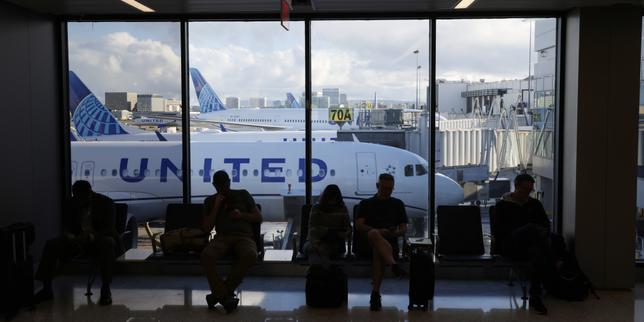
Silence in an airport terminal is unnatural. It carries a heavy, metallic taste, like a coin pressed against your tongue before a storm breaks.
You expect the low roar of rolling suitcases over terrazzo floors, the sharp chime of gate announcements, and the rhythmic hiss of espresso machines behind glass counters. You do not expect ten thousand people staring simultaneously at departure boards that have suddenly turned into rows of identical, glowing red rectangles. Canceled. Delayed. Grounded.
When a nationwide aviation outage halts commercial air traffic across the United States, the immediate chaos looks like a logistical puzzle on television news maps. Tiny yellow airplane icons freeze over the Midwest. Pundits point at screens and talk about software patches, server redundancies, and Federal Aviation Administration protocols.
On the ground, at Gate B14 in Chicago or Terminal 4 in Atlanta, the failure feels entirely different. It feels like a trap.
Consider a hypothetical traveler named Elena, a pediatric nurse flying from Denver to Boston with a cooler of time-sensitive biological samples packed in dry ice at her feet. When the screens go red, Elena does not care about legacy mainframe architecture or congressional appropriations committees. She watches the digital thermometer on her cooler tick upward by a tenth of a degree every forty minutes while a gate agent repeatedly hits a dead refresh key on a monochrome keyboard that looks older than Elena’s youngest child.
That keyboard is not a metaphor. It is the physical artifact of an invisible crisis that has been building inside American airspace for thirty years.
The Architecture of a Quiet Collapse
To understand why a single system failure can paralyze the busiest aviation network on earth, you have to look behind the drywall of America’s air traffic control centers.
For decades, the American sky has been managed by a patchwork of aging mainframes, copper wiring, and software languages written when disco was still on the radio. The Federal Aviation Administration moves roughly forty-five thousand flights and nearly three million passengers every single day through a system that relies on brittle digital bridges. One corrupted data file, one overloaded database, or one unpatched vulnerability in a secondary messaging network—like the Notice to Air Missions system—can trigger a nationwide ground stop.
Think of the national airspace system like an aging suspension bridge carrying ten times the traffic its engineers projected in 1975. Every year, mechanics weld new steel plates over rusted joints and apply fresh coats of grey paint. From the highway above, the commute looks smooth. Underneath, the cables are fraying under constant vibration.
I have spent enough nights sleeping on carpeted terminal floors beside power outlets that no longer hold a plug to recognize the sound of systemic neglect. It is the sound of a public address system crackling to life at 2:15 in the morning to announce that the crew has timed out, the computer system in Washington is still rebooting, and there are no hotel vouchers left within forty miles.
When that system finally snaps, the economic shockwave moves faster than any jet stream. Airlines lose tens of millions of dollars an hour. Perishable cargo rots on tarmacs in Miami and Memphis. Hospitals miss transplant windows. Small business owners miss contract signings that took two years to negotiate.
And before the last stranded passenger has even retrieved a lost suitcase from a carousel in Newark, the political battle over the wreckage begins.
Turning a Ground Stop into a Weapon
In Washington, a crisis of this scale never stays technical for long. Following a massive aviation outage and nationwide flight suspension, the Trump administration moved rapidly to seize the narrative, transforming an infrastructure failure into a blunt political instrument and demanding fifty billion dollars from Congress to overhaul the nation’s air traffic control system.
The strategy was immediate and unmistakable. Rather than treating the outage as a complex engineering failure rooted in decades of bipartisan underinvestment, administration officials framed the frozen tarmac as living proof of bureaucratic decay, regulatory bloat, and the failures of their political predecessors.
Press briefings shifted seamlessly from aviation safety to ideological warfare. Cabinet secretaries stood before cameras and pointed directly at the stranded families in airport terminals, arguing that outdated federal management had turned American skies into a third-world bottleneck. The message to lawmakers on Capitol Hill was simple: hand over fifty billion dollars for a sweeping, top-to-bottom modernization push—or own the blame the next time the planes fall out of the sky.
Fifty billion dollars is a staggering sum, even by the numbing standards of federal spending. To put that figure into perspective, it is more than double the entire annual budget of the Federal Aviation Administration. It is enough money to build several major international airports from empty farmland, or to fund NASA’s planetary science division for nearly two decades.
Yet the administration’s demand did not arrive with a line-by-line engineering blueprint. It arrived as an ultimatum wrapped in populist fury.
The Hidden Price Tag of Urgency
Fear is an extraordinary fundraiser. When millions of voters have just spent forty-eight hours eating stale pretzels on airport floors, very few politicians want to be caught on camera arguing against aviation safety.
That is precisely why massive emergency spending bills are so dangerous.
When fifty billion dollars is pushed through Congress under the banner of an immediate national emergency, traditional guardrails vanish. Competitive bidding processes get shortened or waived entirely. Massive defense and aerospace contractors line up outside committee rooms, ready to absorb multi-billion-dollar no-bid contracts for proprietary radar arrays, satellite tracking networks, and cloud migration schemes that rarely deliver on time or on budget.
We have seen this movie before. Look back at the rollout of NextGen, the FAA’s multi-decade effort to transition air traffic control from ground-based radar to satellite-based navigation. Launched with sweeping promises of shorter flight times, lower fuel burn, and bulletproof reliability, NextGen has already consumed tens of billions of dollars over twenty years while repeatedly missing deadlines and leaving core legacy systems intact.
Money alone does not fix broken institutional habits.
If you pour fifty billion dollars into an agency without fixing how it procures technology, trains controllers, and manages software transitions, you do not get a modern aviation network. You get the most expensive beta test in human history.
Worse still, politicizing the outage obscures the quiet, unglamorous realities that actually keep planes separated at thirty-five thousand feet. Air traffic controllers across the United States are already working mandatory six-day weeks and ten-hour shifts because the national workforce is thousands of certified controllers short of safe staffing targets. A shiny new satellite console does nothing if the human being sitting in front of it is operating on four hours of sleep and a third cup of burnt coffee.
The Leverage of the Tarmac
Why push for fifty billion dollars right now, in the immediate aftermath of a nationwide shutdown, rather than through the standard congressional appropriations process?
Because leverage has a short half-life.
Political strategists understand that public outrage over a travel meltdown fades within three weeks. Once the flight schedules normalize and passengers return to complaining about legroom and baggage fees, the sense of existential urgency evaporates. Senators start asking uncomfortable questions about who controls the money, which states get the research centers, and whether privatization of air traffic control is secretly tucked into page four hundred of the legislative text.
By tying the fifty-billion-dollar demand directly to the visceral trauma of grounded flights, the administration forces Congress into a binary trap. Vote yes, and hand the executive branch an unprecedented war chest with sweeping authority to reshape American aviation and reward favored industry partners. Vote no, and face attack ads accusing you of leaving American travelers stranded and vulnerable.
It is a masterclass in political theater, executed while the jet engines are still cooling on the runway.
What Happens When the Next Screen Goes Dark
Walk back into that terminal in your mind. Look at Elena, the pediatric nurse sitting beside her cooler at Gate B14.
She does not vote for budget resolutions. She does not lobby aerospace committees. She simply trusts that when she buys a boarding pass in the richest, most technologically advanced nation in history, the invisible machinery guiding her aircraft through the clouds will not collapse because a twenty-year-old database choked on a routine update.
Right now, that trust is hanging by a thread.
Modernizing America’s air traffic control infrastructure is not optional. Every serious aviation engineer, pilot union, and safety investigator agrees that the current patchwork of aging hardware cannot survive another decade of rising air traffic volume, commercial space launches, and autonomous drone corridors. The wires behind the drywall have to be replaced.
The tragedy is not that Washington is finally talking about spending real money on the skies. The tragedy is that the conversation has been hijacked before the blueprints are even drawn.
When infrastructure becomes a partisan cudgel, engineering takes a back seat to optics. Shortcuts get rewarded. Dissenting safety experts get sidelined as obstacles to progress. And the taxpayer ends up paying twice—once at the Treasury, and a second time at the departure gate when the bright, expensive new system crashes under the weight of its own rushed design.
Somewhere tonight, in a windowless room humming with cooling fans beneath an air traffic control center in Virginia or Texas, a technician is watching green text scroll across a black monitor, praying that a piece of code written during the Cold War holds together until sunrise. Outside, thousands of red tail lights blink steadily through the dark as planes line up for takeoff, carrying millions of people who assume someone in charge actually has a plan.