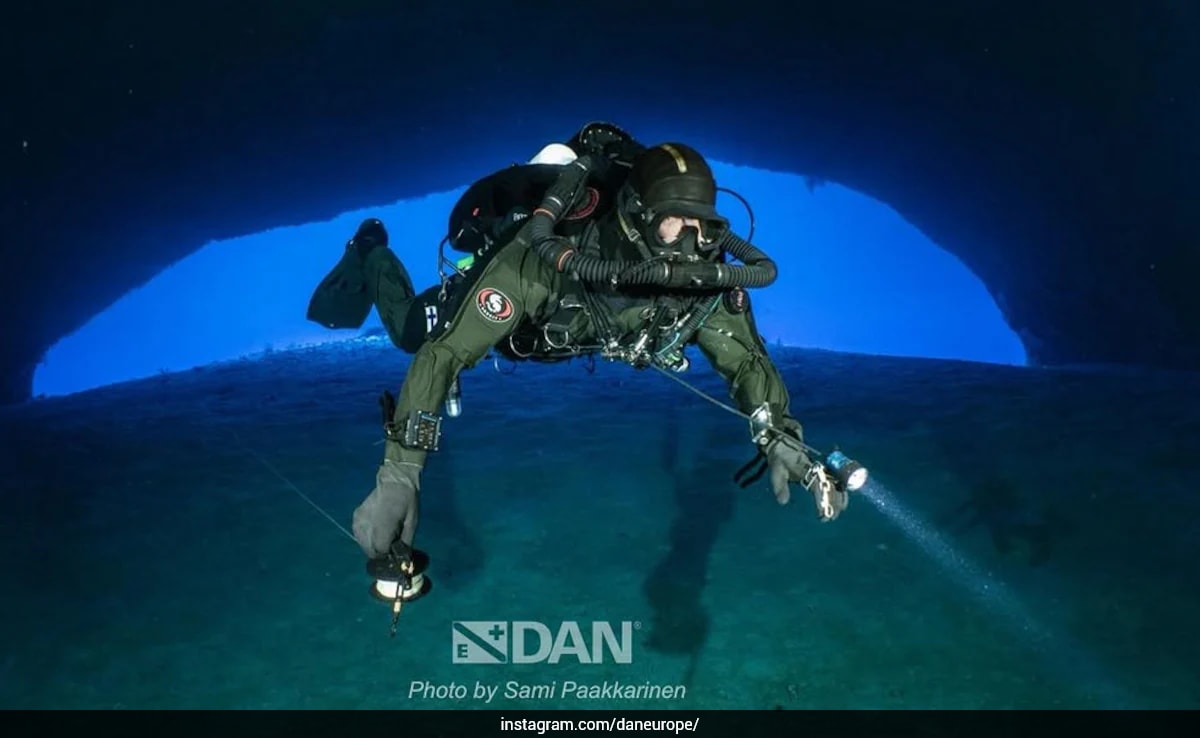
The water in a subterranean cave does not move like the ocean. It does not roll or breathe. It sits in absolute, heavy stillness, preserved in pitch darkness for thousands of years until a human hand breaks the surface. When you submerge yourself into that environment, the world changes from three dimensions to just two: the distance ahead of you, and the volume of gas strapped to your back.
In the diving community, we talk about the line. It is a simple nylon cord, usually no thicker than a shoestring, woven through the labyrinth of underwater cave systems. That line is not a guideline. It is life itself. If you lose it, the world dissolves into an undulating cloud of silt where up, down, left, and right cease to exist.
Two experienced divers entered the water near the island of Dhiffushi in the Maldives. They were not amateurs. They understood the pressure, the physics, and the silent arithmetic of depth. Yet, they never came back up.
Their story is not a cautionary tale about recklessness. It is something far more terrifying. It is a story about how microscopic the margin for error truly is when human beings venture into spaces where they were never meant to survive.
The Weight of the Ceiling
Imagine walking into a room and knowing that if you suddenly feel panicked, you cannot stand up.
To understand cave diving, you must first shed the romanticized image of open-ocean scuba diving. There are no coral gardens here. There is no sunlight filtering through the waves like cathedral glass. There is only the overhead environment. The ceiling is solid rock.
Every diver carries a finite amount of time, measured in bars of pressure inside steel or aluminum cylinders. The golden rule of exploration in these spaces is the Rule of Thirds. You use one-third of your gas to venture into the cave. You reserve one-third to get back out. The final third is a sacred reserve, untouched unless disaster strikes. It is a beautiful, logical system on paper.
But logic relies on a predictable landscape.
The cave system off Dhiffushi is beautiful, jagged, and deceptive. When the two divers dropped below the surface, the water would have been crystalline. In the initial minutes of a dive, everything feels controlled. Your breathing is a steady, rhythmic hiss-click, hiss-click through the regulator. The light from your primary torch cuts through the blackness, turning the ancient limestone walls into a private gallery seen only by a select few.
Then comes the turn.
A Ghost in the Silt
It takes less than a second to make a mistake that takes hours to kill you.
Reports from the recovery efforts indicate that the divers took a wrong turn at a critical junction inside the cave. In an open environment, a wrong turn means a longer walk or a simple U-turn. In a flooded cavern, a wrong turn alters the geometry of survival.
Consider what happens next:
You reach a fork in the passage. Perhaps the visibility is slightly reduced, or perhaps the adrenaline of exploration causes a momentary lapse in navigation. You turn left instead of right. For fifty meters, seventy meters, a hundred meters, the passage looks identical to the one you surveyed on the way in. The walls are just as rough, the darkness just as absolute.
But the exit is no longer behind you.
When a diver realizes they are lost, the physiological response is immediate and violent. The heart rate spikes. Breathing accelerates. That steady hiss-click becomes a frantic, ragged gasp. This is where the physics of the human body betrays the explorer. When you breathe faster, you consume your limited gas supply at twice or thrice the normal rate. The one-third reserve you counted on begins to evaporate.
Worse, the panic itself changes the physical environment.
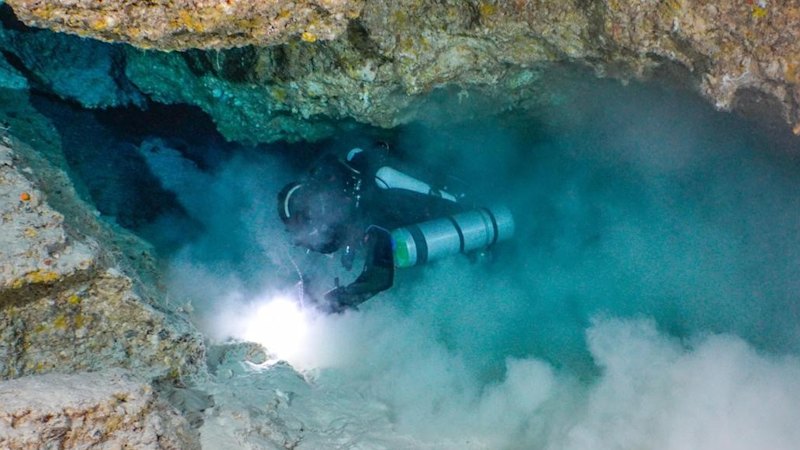
A single frantic kick of a fin against the floor or ceiling of a limestone cave triggers what divers call a silt-out. The floor of these caverns is covered in thousands of years of fine, powdery sediment. Once disturbed, it does not settle back down for days. It hangs in the water like a thick, milky fog.
Suddenly, your powerful dive light is useless. It reflects off the suspended silt particles, blinding you, much like high beams in a midnight snowstorm. You can hold your hand directly in front of your mask and see absolutely nothing.
The Accounting of the Depths
The search and rescue teams, alongside local authorities who eventually recovered the bodies, faced the grim task of piecing together the timeline. It is a quiet, devastating puzzle.
When a diver runs out of air in an overhead environment, there is no dramatic struggle visible to the outside world. The surface of the Maldivian water remains completely flat, reflecting the tropical sky and the palm trees on the shore. Tourists a few hundred yards away are swimming, laughing, and ordering drinks.
Below, the silence is total.
The tragedy of the Dhiffushi incident highlights a harsh truth that the adventure tourism and exploration industries often gloss over: expertise can breed a dangerous comfort. The more comfortable we become with risk, the more easily we forget that the environment is entirely indifferent to our skill level. The ocean does not care how many certifications you hold, how expensive your rebreather is, or how many hours you have logged in the logs back at the shop.
The margin was likely a matter of inches. A line missed by seventy centimeters. A visual marker obscured by a shadow.
When the recovery teams brought the two men back to the surface, the narrative shifted from a rescue operation to an accounting of facts. Investigations commenced to determine if equipment failure played a role, but the haunting consensus pointed toward navigation. A simple, human error magnified by the unforgiving physics of the deep.
The Allure of the Invisible
Why do we go down there?
It is a question asked by every family member who has ever watched a loved one pack a gear bag with heavy lights, reels, and redundant regulators. The danger is not hidden; it is explicit. It is written on every warning sign posted at the mouth of underwater caves worldwide, usually featuring a graphic of the Grim Reaper holding a scythe.
The answer lies in the human desire to see what has never been seen. To stand—or float—in a space that feels entirely alien, detached from the noise and chaos of modern existence. In those caves, there are no notifications, no deadlines, no societal expectations. There is only the breath, the light, and the rock.
But that peace is a loan, and the interest rates are catastrophic.
The loss of these two lives in the Maldives leaves a void in the global diving community and an indelible scar on the local island of Dhiffushi. It serves as a stark reminder that the boundary between an unforgettable adventure and a permanent tragedy is paper-thin.
The gear is cleaned. The boats return to the docks. The sun sets over the Indian Ocean, painting the water in shades of amber and gold. Below the surface, the silt slowly begins to settle back onto the limestone floor, covering the tracks of the intrusion, returning the cave to its ancient, undisturbed dark.