History isn't locked behind glass museum cases. Sometimes, it's sitting in a dusty cardboard box, mislabeled and ignored for centuries, waiting for a bored volunteer to flip the page.
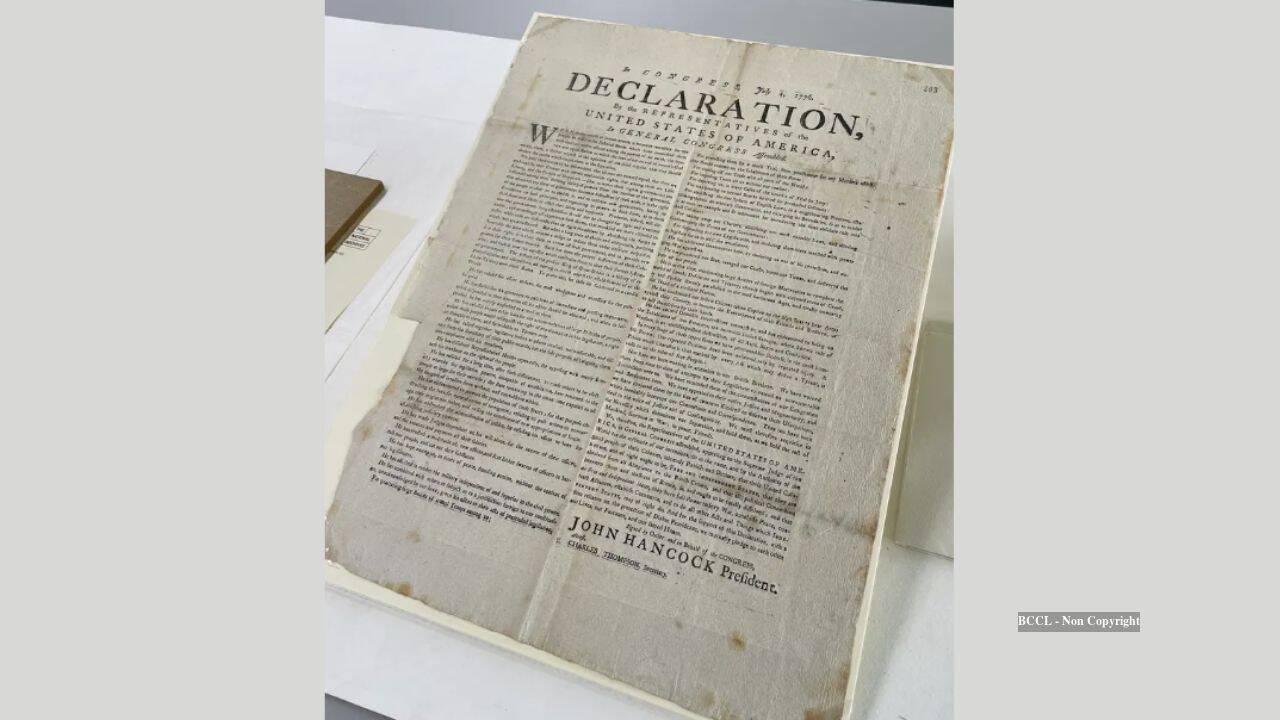
That is exactly what happened at the UK National Archives in London, where a retired insurance broker named Michael Scurr was casually sorting through uncatalogued 18th-century Royal Navy correspondence. Stucked inside a volume of Admiralty papers was a fragile, yellowed broadside. At the top, printed in stark letters, was a word that changed the room: Declaration. For a different look, read: this related article.
It wasn't just any old document. It was a rare, surviving copy of the United States Declaration of Independence, printed in Exeter, New Hampshire, between July 16 and July 19, 1776. Out of all the broadsides printed to spread the word that the colonies had severed ties with Britain, only 11 copies of this specific Exeter printing are known to exist. Even wilder? This is the only known copy located outside the United States.
The Story Behind the Capture
How did a foundational American document end up locked away in British military records? The paper trail leads straight to the high seas during the height of the Revolutionary War. Related insight regarding this has been published by Wall Street Journal.
On Christmas Eve in 1776, a British warship named the HMS Raisonnable chased down an American privateer vessel called the Dalton off the coast of Portugal. After a brutal seven-hour pursuit, the British captured the ship. The Dalton was a privateer—a privately owned armed ship authorized by the Continental Congress to disrupt British trade.
When the Royal Navy seized the vessel, they confiscated its papers as wartime evidence. Those documents included letters, commissions, and yes, a copy of the Declaration of Independence that the crew carried with them. The papers were shipped back to the Admiralty, filed away in boxes, and completely forgotten for more than 230 years.
Historians point out that finding the document on a privateer ship gives us a rare glimpse into how the war was actually fought on an ideological level. The crew of the Dalton wasn't just fighting for local grievances or coin. They were carrying a physical manifesto. Captains would routinely read orders and proclamations aloud to their crews. Reading the Declaration transformed a dangerous naval skirmish into a fight for a massive, global ideal.
What Happened to the Crew
The romantic notion of a revolutionary manifesto at sea quickly met the harsh reality of 18th-century warfare. The 120-man crew of the Dalton didn't just hand over their ship and walk away. They were dragged back to England and locked up in Plymouth harbor aboard prison ships like the HMS Belleisle, later transferred to the notorious Old Mill Prison.
Conditions were brutal. Prisoners dealt with rampant disease, starvation, and psychological breaking points. Among the captured crew was a 19-year-old sailor named Charles Herbert. Herbert kept a meticulous secret diary detailing the misery of captivity, including an elaborate, desperate attempt by the prisoners to dig a tunnel right out from beneath the jail.
Most of these men were ordinary workers, immigrants, and even free Black sailors who took immense risks under authorization from John Hancock and the Continental Congress. Their grueling imprisonment shows the steep human cost behind the grand political prose printed on that newly discovered broadside.
Inside the Archives Conservation Lab
Once Scurr flagged the document to his supervisors, it was handed over to preservation experts at the National Archives. Saving a 250-year-old piece of flimsy wartime paper isn't easy.
The broadside had been glued directly into a heavy book of correspondence belonging to Captain Thomas Fitzherbert. Conservators had to use an ultrasonic humidifier to introduce micro-doses of moisture into the air, slowly softening the antique animal-glue adhesive without ruining the ink. Using a fine spatula, they peeled the document away from the binding.
Scientists then put the paper under specialized lighting. Raking light revealed the original fold lines from when some British sailor folded it up on a warship in the Atlantic. Microscopic analysis showed the paper was made from recycled textiles mixed with plant fibers like hemp hurd. It wasn't luxury stationary. It was cheap, rushed, wartime print meant to be read, pinned up, and passed around before fading away.
Why Archives Still Matter
In an era where everyone assumes every historical text has been digitized, scanned, and uploaded to the cloud, this discovery proves the exact opposite. Millions of historical documents sit unindexed in boxes across the world, waiting for human eyes.
You don't need a PhD in history or a multi-million-dollar grant to rewrite the history books. Sometimes, you just need patience, a sharp eye, and an afternoon volunteering in a basement archive.
The Exeter printing now takes its rightful place in the spotlight, anchoring the National Archives' "Revolution 250" exhibition. It serves as a permanent reminder that the history of the American Revolution wasn't just written in Philadelphia. It was fought on the open ocean, seized by the British Empire, and hidden in plain sight for centuries.