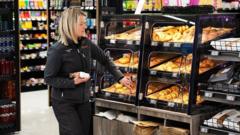
If you walk into a Prisma or K-Citymarket in Helsinki today, you’ll see the usual: rows of rye bread, towers of oat milk, and people quietly scanning their own groceries. It looks like any other peaceful European retail scene. But look closer at the logistics, the floor plans, and the legal contracts behind those sliding glass doors. In Finland, the supermarket isn't just a place to buy dinner. It’s a hardened node in a national security network designed to keep the country running if the worst happens.
Finland shares a 1,340-kilometer border with Russia. Because of that geography, the Finns don't take "business as usual" for granted. While other nations dismantled their Cold War stockpiles, Finland kept theirs and then expanded the concept. They call it comprehensive security. It means that when a crisis hits—be it a cyberattack, a pandemic, or a military threat—every part of society has a pre-assigned job. The retail sector’s job is arguably the most vital: ensuring 5.6 million people don't go hungry while the military does its work. You might also find this connected article useful: Strategic Asymmetry and the Kinetic Deconstruction of Iranian Integrated Air Defense.
The National Emergency Supply Agency and the Retail Pact
The magic happens through a public-private partnership coordinated by the National Emergency Supply Agency (NESA), or Huoltovarmuuskeskus. This isn't just a government department; it’s a bridge between the state and the private companies that actually own the food.
In most countries, the government might try to seize control of food distribution during an emergency. Finland does the opposite. They’ve integrated the two biggest retailers—S Group and K Group—directly into the national defence planning. These companies control about 80% of the Finnish grocery market. By working with them, the state gains access to a massive, existing, and highly efficient logistics machine. As extensively documented in detailed coverage by Reuters, the results are widespread.
The 72-Hour Rule
The government’s baseline expectation for you as a resident is the 72-hour recommendation. This isn't a suggestion; it’s a civic duty. Finns are taught to keep enough food, water, and medicine at home to last three days without any outside help.
This 72-hour buffer gives the supermarkets and NESA the time they need to pivot from "commercial mode" to "crisis mode." If the power goes out or the ports are blocked, the retailers don't panic. They follow a playbook they’ve already rehearsed in national exercises.
Secret Warehouses and Strategic Stockpiles
While the supermarket shelves you see are part of the plan, the real muscle is hidden. Finland maintains strategic reserves of grain, seeds, and fodder that can last at least six months. They also keep five months' worth of oil and fuel.
But NESA doesn't build all its own warehouses. Instead, it pays retailers and wholesalers to keep "obligatory stockpiles" within their own supply chains. This ensures the food stays fresh—it’s rotated through the normal stores—but the volume never drops below the safety limit.
Hardened Logistics
The distribution centres for S Group and K Group aren't just big sheds. They’re critical infrastructure. Many are built with redundant power systems and secure communication lines that link directly to the authorities. If the internet goes down, these hubs can still talk to the Ministry of Economic Affairs and Employment. They know exactly how many pallets of canned meat are in Sipoo or Vantaa at any given second.
Why Scale Matters for Security
You might think a monopoly or duopoly is bad for the consumer, but in a security context, it’s a massive advantage. Because S Group and K Group are so dominant, they have the scale to absorb shocks.
- Uniformity: They can push out emergency information or rationing protocols to every corner of the country—from the Arctic Circle to the southern islands—instantly.
- Resource Shifting: If a store in a border town is compromised, the central logistics hub can reroute trucks to a secondary location without missing a beat.
- Data Sharing: During the 2020 pandemic, these retailers shared real-time supply chain data with the government. They weren't guessing; they knew exactly where the bottlenecks were.
More Than Just Food
The role of the supermarket extends into energy and finance. Most Finnish grocery stores have pharmacies attached or nearby, and many serve as the primary point for cash withdrawals. In a hybrid warfare scenario where digital payment systems are targeted by hackers, the "cash back" at the grocery counter becomes a lifeline for the economy.
The stores also act as community hubs. In remote areas, the local K-Market might be the only place with a backup generator or a working radio during a prolonged blackout. The staff are trained to recognize their role as part of the "security of supply." It’s a mindset that’s baked into the culture. You don't just work at a grocery store; you’re a guardian of the community’s resilience.
What You Should Do Now
You don't have to be Finnish to adopt this mindset. Building your own resilience is the best way to support your local infrastructure during a crisis.
- Audit your pantry today: Do you actually have 72 hours of food that doesn't require electricity to cook? Think canned beans, tuna, and crackers.
- Don't forget the water: You need 2 liters of drinking water per person per day. Keep a few 5-liter jugs in the back of a closet.
- Get a battery-powered radio: If the cell towers go down, FM radio is how the government will talk to you.
- Keep some cash: Small bills are better. If the power is out, card readers won't work, and no shopkeeper will have change for a $100 bill.
Resilience isn't about being a "prepper" in a bunker. It’s about making sure that if the supermarket has a bad day, you don't have a catastrophic one. Take a page out of the Finnish playbook: plan for the worst, so you can continue to enjoy the best.