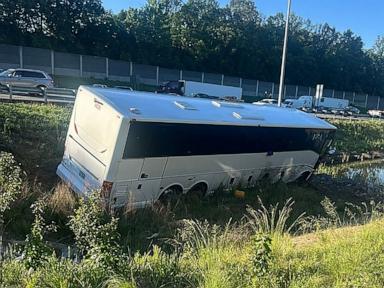
The asphalt of Interstate 95 does not care about Friday night plans. It doesn’t care about the playlist humming through the car speakers, the half-eaten bag of fast-food fries rolling around the floorboards, or the fact that a seven-year-old child just won a spelling medal that morning.
To the millions of drivers who blur across its lanes every year, I-95 is just a gray artery connecting point A to point B. It is infrastructure. But to those who have seen what happens when the artery ruptures, it is something else entirely. It is a place where lives are divided into a strict, merciless binary: the before, and the after.
On a warm evening, five people were traveling down this corridor, their minds likely fixed on the weekend ahead, or maybe just the comfort of their own beds. A thirteen-year-old with a lifetime of unwritten chapters. A seven-year-old whose world was still measured in playground games and bedtime stories. Three adults who held the invisible threads of a family together.
In a fraction of a second, the metal crumpled. The glass shattered. The music stopped.
Five people died in a single, devastating collision.
When you read the standard news reports, the tragedy is reduced to a bleak ledger of logistics. The headlines lead with the body count. They list the mile marker. They mention the traffic delays, as if the longest-lasting consequence of a catastrophic wreck is a twenty-minute detour for commuters listening to talk radio.
But a tragedy is not a statistic. It is a sudden, violent vacancy.
The Geography of a Sudden Silence
To understand the true weight of what happened on that stretch of highway, we have to look past the police tape and the flashing blue lights. Consider a hypothetical home—let us call it the house on Elm Street, though it could be any house in any suburb in America.
On Friday afternoon, the house is loud. There is the thud of a backpack hitting the floor. There is the specific, rhythmic creak of the floorboards as a teenager paces while staring at a phone. There is the laughter of a seven-year-old trying to coax the family dog into playing dress-up. The kitchen smells like toasted bread and coffee grounds.
Then, they leave. They pack the trunk. They buckle the seatbelts.
When the collision happens miles away, the house on Elm Street doesn't shake. The windows don’t rattle. The neighbors don’t hear a sound. Yet, in that exact microsecond, the entire environment inside those walls changes forever. The air grows heavy. The left-behind objects—a sneaker by the door, a half-finished drawing on the counter, a laptop plugged into the wall—suddenly lose their utility and become monuments.
The silence that follows a fatal car accident is not peaceful. It is aggressive. It presses against the eardrums of the relatives who eventually come to collect the mail, a suffocating reminder of what used to be.
We live in a culture that consumes tragedy at a breakneck pace. We scroll past a headline about a fatal crash on our feeds, give a brief sigh of pity, and keep scrolling to find a recipe or a meme. We have been conditioned to treat highway fatalities as an acceptable cost of doing business in a modern society. We look at the numbers—tens of thousands of people dying on American roads every year—and our brains glaze over. The numbers are too big. The grief is too abstract.
But it isn't abstract. It is highly specific.
It is the thirteen-year-old who will never walk across a high school graduation stage. It is the seven-year-old whose favorite toy is now sitting at the bottom of a bin, never to be played with again. It is the three adults whose accumulated wisdom, inside jokes, and daily sacrifices were wiped clean from the earth in the time it takes to blink.
The Physics of Failure and the Myth of Control
We like to believe we are safe inside our vehicles. We buy cars with top-tier safety ratings, lane-assist technology, and a dozen airbags tucked into the pillars like hidden cotton shields. We wrap ourselves in steel and leather, dial in the climate control, and feel completely insulated from the world rushing past at seventy miles per hour.
It is an illusion.
The physics of a high-speed collision are brutal and absolute. When two multi-ton objects collide, the kinetic energy must go somewhere. It tears through metal, snaps axles, and overrides every safety feature engineers have spent decades designing. In those moments, the human body is fragile. It is soft tissue and brittle bone operating in a world of unforgiving momentum.
The real terror of the highway isn't the machine; it is the variables.
Think about the last time you drove on the interstate. You are maintaining your lane, keeping your distance, doing everything right. But you are entirely at the mercy of the strangers surrounding you. You are trusting that the driver to your left isn’t text messaging. You are trusting that the semi-truck behind you has well-maintained brakes. You are trusting that the person ahead isn’t fighting a sudden wave of exhaustion.
Every journey on a major highway is an unspoken pact of mutual survival between thousands of strangers. Most of the time, the pact holds.
But when it breaks, it breaks completely.
The aftermath of a major crash is a surreal laboratory. Accident reconstruction teams arrive with lasers and tape measures. They analyze skid marks to calculate velocity. They look at the deformation of the metal to determine the angle of impact. They document the scene with cold, clinical precision.
Yet, no piece of investigative equipment can measure the weight of the invisible stakes. They cannot chart the trajectory of a shattered family tree. They cannot quantify the generational trauma that ripples outward from a single point of impact, infecting aunts, uncles, grandparents, and friends who must now learn to navigate a world that is permanently emptier.
The Ripple in the Local Circle
The damage of a fatal accident does not stop at the edge of the asphalt. It moves into the community like a slow-moving toxin.
Consider the first responders who arrived at the scene on I-95. These are men and women who have chosen a profession that requires them to run toward chaos. They are trained to be stoic, to prioritize triage over emotion, to do the hard work that needs to be done.
But nobody gets used to seeing a seven-year-old child in the wreckage.
The paramedics, the firefighters, the state troopers—they carry those images home with them. They look at their own children a little longer when they walk through the front door. They find themselves waking up in the middle of the night, staring at the ceiling, haunted by the specific smell of burnt rubber and spilled fluids. The trauma of the road creates secondary victims out of the very people who try to save us.
Then there are the classrooms. On Monday morning, a middle school teacher will look out at a room full of eighth-graders. One desk will be empty. The teacher will have to find the words to explain to a group of children—who still feel immortal—that their classmate is never coming back. The kids will look at the empty desk, and for the first time in their young lives, the concept of death will stop being a plot point in a movie. It will become a physical reality sitting right next to them.
A few miles away, an elementary school teacher will face a similar room. They will have to guide seven-year-olds through a grief they are not developmentally equipped to understand. How do you explain the finality of a highway accident to a child who still believes in magic?
These are the hidden costs of our transportation system. These are the narratives that never make it into the brief, three-paragraph blurbs on the local news station's website.
Moving Past the Metric of Inconvenience
If we want to honor the people who lose their lives on our roads, we have to stop treating these events as inevitable side effects of modern transit. We have to change the way we talk about them.
When a plane crashes, it is international news for weeks. Panels are formed. Investigators spend months searching for every scrap of fuselage. The entire aviation industry pauses to ensure the specific failure never happens again. We demand answers because we refuse to accept that flying in the sky should be inherently deadly.
Yet, when five people die on a highway, we check the traffic app to see if our route to work is clear.
This indifference is a cultural failure. We have normalized the slaughter on our streets because it is familiar. We have traded our capacity for outrage for the convenience of our daily commutes. We accept the risk because we assume it will always happen to someone else. It will always be a stranger's name in the headline. It will always be a family from another town, another state, another life.
Until it isn't.
Every single person who died on I-95 that night was someone’s everything. They were the center of a universe. They had arguments they hadn't resolved, projects they hadn't finished, and promises they intended to keep. They were not characters in a cautionary tale; they were real, breathing human beings who expected to wake up the next morning.
The next time you pull onto the highway, look at the cars around you. Don't see them as obstacles or traffic. See them as containers of human life. The minivan next to you is carrying someone’s children. The sedan in front of you is carrying someone’s parent. The truck behind you is driven by someone who is loved by a circle of people you will never meet.
The road demands more than just our mechanical attention. It demands our reverence. It demands that we remember how quickly a journey can end, and how long the silence lasts for those who are left waiting by the door.
The five empty chairs at that Sunday table will never be filled. The conversations will always have a missing chord. The holidays will always be shadowed by the memory of a Friday night when the world fractured on a stretch of interstate that didn't care. All that remains is the memory of their voices, and the duty of the living to drive with a little more care, a little more awareness, and a profound respect for the fragile lives traveling alongside us in the dark.