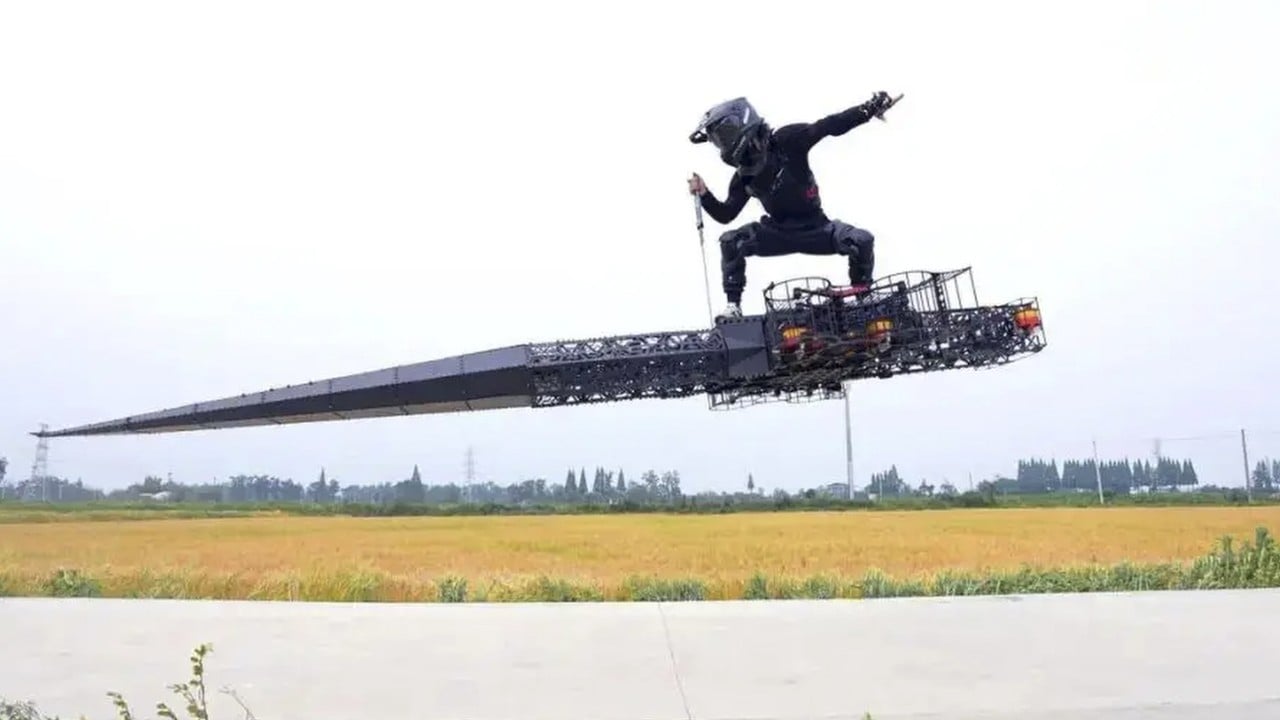
Tech media loves a good gimmick. When video surfaced of a Chinese inventor launching a massive, glowing "flying sword" drone into the night sky, the internet collectively lost its mind. Outlets rushed to declare that the mythical xianxia fantasy novels had officially become reality. They painted a picture of a breakthrough, a fusion of cultural heritage and mechanical engineering.
They are wrong. It is a party trick. Meanwhile, you can explore other developments here: The Microeconomics of Hyperscale Silicon: Deconstructing the Anthropic Maia 200 Architecture.
Worse, it is a masterclass in terrible aerodynamics masquerading as innovation. I have spent over a decade auditing commercial drone platforms and advising venture capital firms on unmanned aerial vehicle (UAV) logistics. I have seen companies torch tens of millions of dollars trying to make aesthetically "cool" shapes fly, only to learn the same brutal lesson that physics teaches every single time. Nature does not care about your favorite fantasy novel.
The media’s lazy consensus is that this "flying sword" represents a leap forward in creative drone design. The reality? It is an inefficient, unstable flying brick that exposes our current obsession with form over function in consumer tech. To explore the full picture, check out the recent analysis by Wired.
The Fatal Physics of the Flying Blade
To understand why this design is an engineering dead end, you have to look past the LED lights and examine the fluid dynamics.
A sword is inherently designed to cut through air linearly when swung by a human hand. It is optimized for a narrow, high-velocity slice. It is absolutely not optimized to generate lift or maintain stability as an independent aircraft.
When you turn a sword into a flying vehicle, you run into three immediate aerodynamic catastrophes.
1. The Surface Area Trap
For an aircraft to fly efficiently, its surface area needs to contribute to lift or stay out of the way to reduce drag. A sword-shaped chassis does neither. The long, flat blade creates a massive cross-section when subjected to crosswinds. Imagine a scenario where a standard quadcopter encounters a 15-knot gust. The air flows mostly through its open frame. Now imagine that same gust hitting a solid, six-foot-long vertical or horizontal blade surface. The sword turns into a sail. The onboard flight controller has to work overtime, dumping massive amounts of battery power into the motors just to keep the craft from flipping upside down.
2. Center of Gravity vs. Center of Pressure
In stable aircraft design, the relationship between the Center of Gravity (CoG) and the Center of Pressure (CoP) is everything. For a vehicle to be naturally stable, the CoP should sit slightly behind the CoG. A sword shape throws this balance into complete chaos. The long hilt and guard concentrate mass at one extreme end, while the long blade creates a massive surface area that shifts the CoP drastically depending on the angle of attack.
To keep this monstrosity stable, the inventor had to rely on aggressive, multi-axis electronic stabilization. You are not witnessing a triumph of aviation design; you are witnessing software desperately fighting against inherently broken hardware.
3. The Lift-to-Drag Disaster
Efficient flight relies on a high lift-to-drag ratio. The cross-section of a sword blade is usually a diamond or a flat hexagon. These are terrible airfoils. They generate massive amounts of parasitic drag and almost zero aerodynamic lift. Every ounce of lift this vehicle generates comes entirely from the raw, brute-force thrust of its rotors. It is essentially a standard multicopter hidden inside a heavy, drag-inducing plastic shell.
Dismantling the Pop-Culture Illusion
Go to any comment section discussing this vehicle and you will see variations of the same question. Let's look at the premise of these questions and dismantle them.
People Also Ask: Can we eventually scale up flying swords to allow human pilots to ride them like in fantasy movies?
No. Absolutely not. Stop asking.
To scale this platform up to support human weight—roughly 80 to 100 kilograms including the pilot and safety gear—you face the harsh reality of the square-cube law. As you double the size of the sword, its weight increases eightfold, while its surface area only increases fourfold.
To lift a human on a sword-shaped chassis, the rotors would need to be massive. At that point, the sword shape becomes entirely irrelevant because the vehicle is physically just a massive, highly inefficient helicopter with a dangerous piece of metal or carbon fiber sticking out of the front.
Furthermore, standing on a narrow, unstable beam with no safety cage while exposed to open rotors is a fast track to decapitation. The human body is a terrible aerodynamic weight distribution component. Shifting your weight even an inch on a narrow sword chassis would create a massive lever arm effect, overwhelming the flight controller and causing a catastrophic roll.
The Mirage of Creative Drone Design
The tech industry is currently suffering from a dangerous pivot toward novelty over utility. We see it in eVTOL (electric vertical takeoff and landing) startups building flashy prototypes designed for luxury marketing campaigns rather than real-world logistics.
The "flying sword" is the consumer-grade equivalent of this trend. It exploits cultural nostalgia to mask a total lack of functional utility.
Consider the trade-offs required to make this novelty vehicle fly:
- Battery Life Depletion: Carrying the dead weight of a non-functional sword shell cuts flight times by an estimated 40% to 60% compared to a clean, minimalist drone frame using the same battery capacity.
- Structural Vulnerability: Long, extended structures create massive bending moments during landings. One hard touchdown and the leverage exerted on the hilt will snap the internal frame.
- Zero Payload Capacity: Because the motors are spending all their energy fighting the drag and weight of the sword aesthetic, the vehicle has effectively zero remaining payload capacity for cameras, sensors, or delivery mechanisms.
If you are building a flying vehicle and your design choices make it heavier, less stable, shorter-ranged, and incapable of carrying a payload, you haven't invented the future. You've built an expensive toy that belongs on a shelf, not in the airspace.
How to Actually Innovate in UAV Development
If you want to disrupt the drone space, stop trying to make sci-fi or fantasy tropes happen. The real money and the real breakthroughs are happening in boring, unsexy optimizations.
Instead of chasing aesthetic gimmicks, engineers and developers should focus on three specific vectors that actually matter.
Optimize the Boundary Layer
Instead of building massive structures that fight the air, look at passive flow control. Companies like MicroFlite are experimenting with micro-textured surfaces that mimic shark skin to reduce skin friction drag on drone arms. That is real innovation. It increases flight time by up to 8% without adding a single gram of battery weight.
Biomimicry Over Fiction
If you want to look at non-traditional shapes, study biology, not comic books. Look at the wandering albatross. These birds can fly thousands of miles without flapping their wings by utilizing dynamic soaring, extracting energy from wind gradients. Designing fixed-wing UAVs that can autonomously map and exploit thermal updrafts will do more for the industry than a thousand glowing swords ever could.
True Structural Integration
The ultimate goal of modern UAV design is zero dead weight. Every component must serve multiple purposes. The frame shouldn't just hold the components; the frame should be the battery. Structural batteries—where the carbon fiber casing of the drone itself stores electrical energy—are the actual frontier.
Stop Applauding Bad Engineering
The "flying sword" is a symptom of a broader cultural problem in tech journalism: the celebration of the superficial. We treat a drone stuffed inside a plastic sword shell with the same awe we should reserve for genuine breakthroughs in solid-state batteries or autonomous collision-avoidance algorithms.
It is a neat video for social media. It gets clicks. It satisfies a niche fantasy demographic. But let’s call it what it is: an aerodynamic regression.
The next time an article tells you that a fantasy weapon has been brought to life by tech innovators, look past the flashing lights. Look at the rotors. Look at the drag profiles.
Stop buying into the gimmick. Demand real engineering.