The coffee in Nabatieh was supposed to taste different this morning. For over a year, the ritual of the morning brew in southern Lebanon had been seasoned with the metallic tang of adrenaline and the low-frequency hum of drones that never seemed to sleep. But Wednesday brought a ghost of a sound: silence. It was a silence so heavy it felt like a physical weight, the kind that follows a fever break.
On paper, the war was over. The ink on the ceasefire agreement was barely dry, yet the air carried the scent of hope and cedar. Families who had spent months huddled in cramped apartments in Beirut or sleeping in cars on the coastal highway began to look south. They didn't wait for official clearances or safety assessments. They followed an instinct older than borders—the pull of home.
They packed their lives into dusty SUVs. Matresses were strapped to roofs with frayed yellow rope. Children were wedged between bags of flour and canisters of cooking oil. They drove toward the Litani River, crossing a mental threshold from "displaced" back to "resident."
Then the sky broke again.
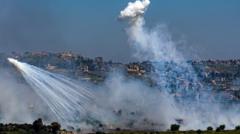
The strikes didn't come with the sustained roar of an all-out invasion, but they were no less final. In the village of Markaba, the ceasefire didn't stop the steel. Two people were killed. Their names might eventually appear in a scrolled list on a news ticker, but in the dirt of the village, they are a void that will never be filled. One moment, there is the rustle of a suitcase being unpacked; the next, there is only the settling of grey dust.
The tragedy of a broken truce isn't just the loss of life. It is the murder of trust.
When a missile hits a home during an active conflict, it is a statistic of war. When it hits during a ceasefire, it is a betrayal of the very idea of safety. For the people of southern Lebanon, the border is not a line on a map. It is a living, breathing entity that dictates when they can sleep, when they can plant, and when they must run. The Israeli military stated these strikes targeted "suspects" or "terrorist infrastructure" that violated the terms of the withdrawal. To a mother standing in the ruins of a kitchen she had just started to sweep, those technicalities are meaningless.
The geography of the south is a scarred beautiful thing. Olive groves that have stood for centuries now share space with the jagged craters of 2000-pound bombs. The tobacco fields, once the lifeblood of the local economy, are often littered with the unexploded remnants of yesterday's skirmishes.
Consider the logistical nightmare of a "phased withdrawal." The agreement dictates a sixty-day window. It is a slow-motion dance where one side retreats while the other advances, overseen by international monitors who often seem like spectators at a tragedy they have no power to stop. In those sixty days, the margin for error is microscopic. A single soldier misinterpreting a gesture, a drone operator seeing a shadow where there is only a civilian, or a militant firing a symbolic parting shot—any of these can reignite the furnace.
The strikes in Markaba and the shelling near the border villages of Wazzani and Khiam serve as a brutal reminder: peace is not a light switch. It is a fragile glass sculpture being moved across a tightrope in a high wind.
The Israeli perspective is framed by the haunting memory of October 7 and the relentless fire from the north that emptied their own Galilee panhandle. For the leadership in Jerusalem, the ceasefire is not a gesture of goodwill but a tactical pause conditioned on total compliance. They see any movement toward the border as a potential threat, a "breach" that justifies an immediate, kinetic response.
But for the Lebanese farmer, movement toward the border is simply movement toward his livelihood. If he cannot reach his trees, he cannot eat. If he cannot repair his roof before the winter rains turn the Mediterranean hills into mudslides, his family will suffer. These two realities—the military necessity of a buffer zone and the human necessity of a home—are currently colliding with lethal force.
The roads leading south remain choked. Even as the smoke rose from the latest strikes, the flow of traffic did not reverse. There is a stubborn, almost defiant quality to the Lebanese return. It is a refusal to be permanently uprooted. They drive past charred tanks and leveled apartment blocks with a grim determination. They know the risks. They have seen this cycle before—1978, 1982, 1996, 2006.
History in this part of the world doesn't move in a straight line. It moves in a circle.
Each time the circle completes a revolution, the cost of entry goes up. The infrastructure is more shattered. The trauma is deeper. The children have more nightmares to navigate. Yet, the pull of the land remains the strongest force in the region, stronger than the directives from Beirut or the warnings from Tel Aviv.
We often talk about "geopolitics" as if it were a game of chess played by giants. We analyze the influence of Iran, the diplomatic pressure from Washington, and the internal politics of the Israeli Knesset. But the real story is written in the smaller things. It is written in the way a man holds a set of keys to a house that no longer has a front door. It is written in the silence of a classroom in a village that is now a "closed military zone."
The international community watches through the lens of high-altitude satellites and thermal imaging. They see heat signatures and troop movements. They see "compliance" or "violations." They rarely see the face of the person who thought it was finally safe to take the tape off their windows.
The ceasefire was heralded as a diplomatic breakthrough, a rare moment of sanity in a year defined by its absence. And perhaps it still is. Perhaps these strikes are the violent aftershocks of a massive earthquake, the dying embers of a fire that is mostly out. But for the families in the south, there is no such thing as a "minor violation." A single shell is an entire world ending.
The sun sets over the Mediterranean, casting long, orange shadows across the wreckage of the coastal highway. In the villages, the people who made it back huddle in the dark. They don't turn on many lights. They listen. They listen for the sound of the wind, the sound of the sea, and the sound of the sky.
They are waiting to see if the promise made by men in suits thousands of miles away will hold through the night. They are waiting to see if tomorrow will bring the smell of coffee or the smell of cordite. In the silence between the waves and the wind, the weight of that uncertainty is the only thing that is certain.
A ceasefire is not peace. It is merely the absence of noise. And in southern Lebanon, the noise has a way of coming back just when you think you’ve finally forgotten the sound of it.



