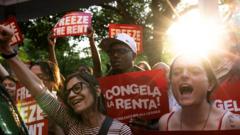
The New York Rent Guidelines Board just voted to freeze rents, and the progressive wing is throwing a victory parade. Zohran Mamdani and his coalition are celebrating this as a monumental win for the working class. They genuinely believe that capping the price of a commodity solves scarcity.
They are dead wrong.
What the media frames as a "victory for tenants" is actually a slow-motion demolition of New York’s housing supply. In the rush to score short-term political points, advocates are ignoring basic economic gravity. You cannot price-control your way out of a supply shortage. When you artificially depress rents in an inflationary environment, you don’t save affordable housing—you destroy it.
The Lazy Consensus: "Rent Freezes Protect Tenants"
The prevailing narrative in New York politics is simple, comforting, and fundamentally flawed: housing is a right, landlords are universally predatory, and government-mandated price caps are the only shield protecting vulnerable residents from displacement.
This argument treats the housing market like a fixed pie. It assumes that if the government forces the price of an apartment down, the apartment remains exactly the same, only cheaper.
But housing is not a static asset. It is a depreciating physical structure that requires constant capital reinvestment. When the Rent Guidelines Board votes to freeze rents while property taxes, insurance premiums, and utility costs are climbing at double-digit rates, they aren't squeezing profit margins. They are cutting the lifelines that keep buildings livable.
Consider the actual math that the Rent Guidelines Board's own staff highlighted before the vote. Operating costs for rent-stabilized buildings jumped by over 6% last year alone. Insurance costs in New York City have skyrocketed, driven by climate risks and a constricting regulatory environment. Fuel and utilities have not lowered their rates out of solidarity with tenants.
When income is frozen and expenses soar, something has to give. That something is maintenance.
The Mechanics of Decay: A Thought Experiment
Imagine a scenario where you own a 20-unit building in Queens. The roof starts leaking, a repair that will cost $40,000. At the same time, your property insurance premium increases by 25%, and the city hikes your water bill. Because your building is rent-stabilized, your revenue is legally locked.
You cannot raise rents to cover the capital expenditure. You cannot get a bank loan because your building's net operating income is plummeting, making you a default risk.
What do you do? You don't just absorb the loss out of the goodness of your heart. You delay the roof repair. You patch it cheaply. You cut down on hallway cleaning, defer boiler maintenance, and let the superintendent go. Over a decade, that building transforms from a safe, working-class home into a hazardous, deteriorating shell.
This is not a hypothetical. We have seen this movie before. In the 1970s and 1980s, strict rent controls across New York led to massive landlord abandonment. When owning a building becomes a guaranteed financial liability, owners walk away. They walk away from the properties, tax bills, and tenants. The result was thousands of vacant, decaying buildings across the Bronx and Brooklyn. The very policy meant to preserve housing ended up vaporizing it.
The Hidden Casualty: Invisible Warehousing
Proponents of the rent freeze argue that regulations prevent landlords from gouging tenants. What they miss is the phenomenon of "warehousing."
Under current New York law, specifically following the 2019 Housing Stability and Tenant Protection Act (HSTPA), landlords cannot significantly raise rents even after a long-term tenant vacates, regardless of how much money they spend renovating the unit. If an apartment becomes vacant after forty years of occupancy, it often requires $50,000 to $100,000 in plumbing, electrical, and structural upgrades to meet modern building codes.
If the legal rent for that unit is capped at $900 a month, a landlord will never recoup the cost of the renovation. The rational economic choice is to nail the door shut and leave the apartment empty.
Data from the New York City Department of Housing Preservation and Development has repeatedly shown tens of thousands of rent-stabilized units sitting vacant and off the market for this exact reason. A rent freeze exacerbates this crisis. It ensures that even more units become financially unviable to rent out. The progressive victory celebration is occurring in a room where the walls are actively closing in.
Dismantling the "People Also Ask" Delusion
Whenever this issue arises, the public consensus rallies around a few deeply flawed premises. Let's address them directly.
"Doesn't restricting rent increases stop gentrification?"
No. It accelerates it in the surrounding market. When you artificially restrict the supply of available housing by freezing rents and causing units to be warehoused, you don't stop the influx of people wanting to live in New York. You just redirect that demand.
The wealthy outsiders who can no longer find vacant rent-stabilized apartments pour into the market-rate sector. This drives market-rate rents to stratospheric levels, making neighboring non-stabilized units completely unaffordable. Rent regulation creates a privileged class of incumbent tenants who can never move, while punishing young professionals, immigrants, and anyone trying to enter the city's housing market.
"Why can’t landlords just accept lower profit margins?"
Because in many cases, there are no profit margins left. I have looked at the balance sheets of multi-family operators who bought properties under the old regulatory framework. They are facing a brutal reality: interest rates are hovering around 5-6%, refinancing costs have doubled, and net operating income is negative.
Many of these owners are not faceless private equity firms; they are immigrant families who put their life savings into a single rent-stabilized building. Forcing them into bankruptcy doesn't hurt Wall Street. It forces a foreclosure crisis that lands those buildings right into the hands of vulture funds who know exactly how to exploit regulatory loopholes.
The Flaw in My Own Argument
To be completely intellectually honest, there is a counter-argument to my position. If the city government simultaneously slashed property taxes for multi-family buildings and created a massive, billions-of-dollars subsidy fund to cover landlord maintenance costs, a rent freeze could theoretically work without destroying the housing stock.
But let’s look at reality. New York City is facing massive budget deficits. The city is cutting library hours and sanitation services. There is no multi-billion-dollar bailout coming for housing infrastructure. Relying on a rent freeze without fiscal support is like cutting off an engine's fuel supply and expecting the plane to keep flying because you voted that it should.
The Only Unconventional Solution That Works
If New York actually wants to protect tenants and lower housing costs, it needs to stop obsessing over price controls and start obsessing over abundance.
The fix isn't glamorous, and it doesn't make for good progressive rally speeches. It requires upzoning the wealthiest neighborhoods in Manhattan and Brooklyn to allow for massive, high-density residential development. It requires scrapping the archaic 1961 zoning resolution that treats New York like a suburban town instead of a global metropolis. It requires eliminating mandatory parking minimums that drive up construction costs by tens of thousands of dollars per unit.
When you flood the market with supply, landlords lose their leverage. They are forced to compete for tenants by lowering prices and offering better amenities.
Instead, the city chooses the coward's way out. They vote for a rent freeze, claim a victory for the working class, and watch as the city's housing infrastructure quietly rots from the inside out.
Stop celebrating a policy that sentences New York's housing stock to a slow, regulated death. Build more housing, or get out of the way.