You see the headlines every single morning. They all promise live updates, immediate breaking news, and direct tracking of the war in Ukraine. But behind the constant stream of alerts, the reality on the ground has hardened into a brutal, grinding formula. If you think either side is on the verge of a massive breakthrough, you are misreading the map.
Right now, the frontlines are moving by inches, but the human cost is skyrocketing. Data from independent tracking groups and intelligence reports shows that despite intense summer fighting, actual territorial control isn't shifting much. It is a war of attrition where tiny villages become meat grinders, and long-range tech determines who survives the day.
Let's cut through the noise and look at what is actually happening right now on the battlefields, why the maps look stuck, and what it means for the civilians caught in the middle.
The Reality Behind the Territorial Maps
If you look at the recent data from OSINT groups like DeepState, the net territorial gains are deceptively small. During the past month, Russian forces managed a net gain of roughly 15 square miles of Ukrainian territory. To put that in perspective, that is about two-thirds the size of Manhattan Island.
When an army pours thousands of troops and heavy artillery into an offensive only to walk away with a few fields and ruined hamlets, you aren't looking at lightning warfare. You're looking at World War I-style attrition.
The Eastern and Southern Fronts Broken Down
- The East: Russian forces have pushed heavily in sectors like Kostiantynivka. Meanwhile, Ukrainian troops have managed to claw back small pockets of ground further north in areas like Borova. It’s a constant, bloody back-and-forth where positions change hands multiple times a week.
- The South: Minor Russian advances continue around Houliaipole and Orikhiv. These aren't deep penetrations of the defensive lines; they are agonizingly slow frontal assaults against heavily fortified positions.
- The Cross-Border Footholds: In the Russian border regions of Kursk and Belgorod, the small Ukrainian foothold remains mostly static at around 4 square miles. The lines have stabilized, turning another potential breakthrough zone into a fixed trench line.
Why the Human Cost Just Hit a Grim Peak
Don't let the slow-moving maps fool you into thinking the fighting has cooled down. The intensity is actually worse than it has been in years. June 2026 was officially recorded as the deadliest month for Ukrainian civilians since April 2022.
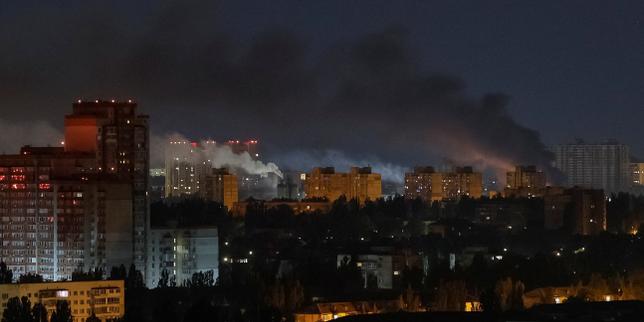
Long-range missile strikes and drone swarms continue to rain down far behind the frontlines. A massive missile barrage targeted Kyiv directly, destroying civilian infrastructure and killing over a dozen people in a single night.
For the people living near the contact lines, life is a nightmare. In the Russian-occupied areas of the Kherson region, particularly in towns like Oleshky along the Dnieper River, civilians are completely trapped. They face severe shortages of medicine, clean water, and food. Leaving is an immense gamble. The roads out are heavily mined by both sides, and crossing Russian checkpoints is completely unpredictable.
Drones and Logistics Define the Strategy
If you want to know where the real damage is being done, look at the logistics and the skies. The Ukrainian military has shifted its focus heavily toward hitting Russia’s ability to wage war deep behind the lines.
Recent strikes have targeted the Hvardiyske airfield and critical energy infrastructure in occupied Crimea, alongside supply depots across multiple occupied oblasts. By blowing up fuel networks and ammunition trains, Ukraine aims to starve the Russian artillery units at the front.
But the sheer volume of equipment being consumed is staggering. Ukrainian General Staff reports regularly show days where over 2,000 Russian unmanned aerial vehicles (UAVs) and dozens of artillery systems are destroyed or expended. This isn't a conflict dictated by grand tactical maneuvers. It is an industrial competition of who can manufacture drones, artillery shells, and air defense missiles faster.
The Aid Equation and What Happens Next
Western political leaders keep showing up in Kyiv to promise long-term support. European Commission President Ursula von der Leyen recently reiterated funding and military commitments during her visit. New initiatives are opening up, giving Ukrainian defense firms direct access to European Union defense programs and a 300 million euro support instrument. Even practical packages, like climate-controlled mobile shelters from Denmark to protect aviation gear, are trickling in.
But there is a massive gap between a funding announcement in Brussels and a shell arriving at a trench in Donetsk. The immediate future won't bring sudden peace talks or massive retreats. Expect the summer heat to bring more localized, intense assaults.
If you are tracking this conflict, stop looking for sweeping arrows on the map. Watch the logistics hubs, the drone production numbers, and the long-range strike reports. That is where the actual leverage is being won or lost. For the soldiers in the dirt and the civilians in towns like Oleshky, the reality remains a daily test of survival against heavy odds.