A Silence in Seoul
Power has a distinct sound in South Korea, and usually, it is loud.
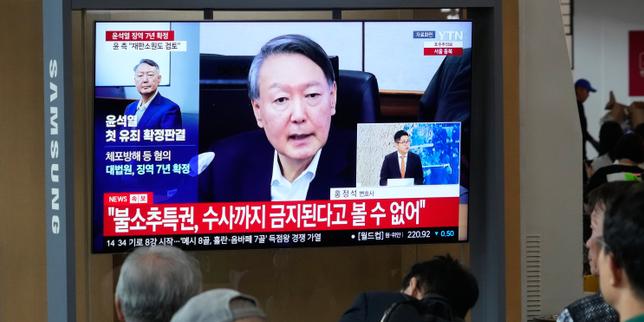
It sounds like convoy sirens echoing off the glass towers of Yeouido. It sounds like thousands of voices chanting through megaphones near Gwanghwamun Square, their breath fogging up the cold air. But when the Supreme Court finally sealed the fate of former President Yoon Suk Yeol, confirming his seven-year prison sentence, the moment belonged to silence.
The gavel struck. Wood met wood. A single, sharp crack that ended a political storm and left a nation holding its collective breath.
For a man who spent his life climbing the ranks of the public prosecutor’s office, prosecuting former presidents and dismantling political networks, the irony was almost unbearable. Yoon once embodied the relentless hand of Korean justice. Now, he was its target. Seven years. A number written on paper, signed by judges, and delivered to a nation that has grown weary of watching its leaders walk from the high halls of the Blue House straight into concrete cellblocks.
The Weight of a Promise Broken
To understand how South Korea arrived at this moment, you have to look beyond the legal jargon and the technical charges. You have to look at the contract between a leader and the people who hand over their trust.
A presidency is a fragile construct built on an unwritten pact: we give you power, and in return, you protect the rules of the game. When a leader breaches that trust, the fallout reaches far deeper than political party lines. It breaks something quiet and essential in the daily lives of citizens who just want to believe that the system works.
Think of a small business owner in Busan, turning on the morning news while opening the metal shutters of her shop. Or a university student in Sinchon, scrolling through headlines on a crowded subway car. They do not experience political scandals as abstract legal debates. They feel them as a heavy, dragging weight—a sudden realization that the people at the top were playing by a completely different set of rules all along.
Yoon’s presidency was born out of a promise to restore fairness and strict adherence to the law. He was the unyielding prosecutor, the man who feared no political faction. That was the pitch. That was the image projected on screen after screen across the country during a bitterly contested election.
Then came the unraveling.
The abuses of power, the backroom maneuvers, and the overreach that eventually led to his impeachment and trial were not just legal infractions; they were a betrayal of the very identity he had sold to the electorate. The court’s decision was not a sudden act of political vengeance. It was the slow, methodical grind of a judicial system holding a former chief executive accountable to the same standards he once enforced on others.
The Machinery of Accountability
Justice in a democracy rarely moves like a Hollywood thriller. It is slow. It is dry. It is buried under mountain ranges of case files, witness transcripts, and constitutional interpretations.
During the trial, observers sat in packed courtrooms, listening to hours of technical arguments regarding the boundaries of presidential authority and the illegal use of state power. The defense argued context, pressure, and political necessity. The prosecution presented paper trails, digital records, and sworn testimonies that painted a very different picture: an administration that believed its authority was absolute.
When the lower courts handed down the original seven-year sentence, allies expected a reprieve at the highest level. They hoped the Supreme Court would find procedural flaws, soften the blow, or kick the case back down the ladder.
Instead, the highest court in the land stood firm.
By confirming the seven-year term, the justices sent a message that resonated far beyond Yoon’s personal legal team. The court established a firm boundary line. It declared that no position, no matter how elevated, grants immunity from the law. The decision was a calculated, deliberate assertion of institutional strength over individual ambition.
It is easy to look at South Korea's history and see a tragic pattern. Yoon joins a long, troubling line of former South Korean leaders who ended their terms in prison, exile, or disgrace. Critics often point to this pattern as a sign of deep systemic weakness, arguing that the country's politics are stuck in a destructive cycle of retribution.
But there is another way to view this reality.
In many places around the globe, powerful leaders who cross the line simply rewrite the laws, dissolve the courts, or silence the critics. They walk away untouched. In Seoul, the sight of a former president facing a judge, hearing his sentence, and riding away in a dark vehicle toward a correctional facility is not a sign that democracy has failed. It is proof that the democratic guardrails are holding.
The Human Shadow Behind the Bench
Behind the legal briefs and political commentary sits a human reality that is impossible to ignore.
A man who held absolute power now measures his days in a confined space, away from the advisers, the state dinners, and the grand halls of power. The transition from the summit of national leadership to a prison cell is a sudden, brutal collapse.
Power is an intoxicating mask. It makes individuals feel invincible, surrounded by people who say yes, insulated from the friction of normal life. But when the state takes that mask off, what remains is just an ordinary person facing the consequences of their choices.
The nation, too, carries a burden. South Koreans are tired. They have spent years marching in the streets, debating at family dinner tables, and watching the leaders they chose tear down the credibility of the office they were entrusted to protect. There is no joy in watching a former president go to prison, even for those who opposed him fiercely. There is only a somber sense of closure.
The news cycles will move on. New candidates will step onto stages lit by flashbulbs, making grand promises about integrity, reform, and a fresh start. They will pledge that things will be different under their watch.
Yet, somewhere in the quiet corridors of power, the shadow of this ruling will remain. Every future president will know that the walls of the Blue House are not made of stone strong enough to block out the sound of a courtroom gavel.
On a cold evening in Seoul, as the neon signs flicker on across the city and the subways fill with commuters heading home, the noise of the political crisis begins to fade into history. The judgment stands. The law remains. And a nation continues the hard, necessary work of holding its masters accountable.