The courtroom is always quieter than the street. On the pavement outside, there is the raw, throat-tearing roar of megaphones, the rhythmic thud of boots, and the sharp hiss of aerosol cans painting slogans onto brick. Inside, there is only the rustle of heavy legal briefs, the soft clearing of throats, and the dispassionate murmur of judges.
This silence is where movements go to be measured.
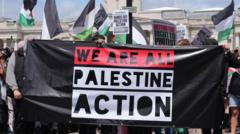
Recently, the Court of Appeal drew a sharp, indelible line through the British protest tradition. They ruled that the government’s ban on Palestine Action—a direct-action group known for targeting arms factories—was entirely lawful. To the lawyers in their wigs, it was a technical calibration of national security and public order legislation. But to the people on both sides of the police barricades, it feels like a tectonic shift in how far a citizen can go to force the world to look at suffering.
Consider a hypothetical activist. Let us call her Sarah. Sarah does not view herself as a criminal. When she chains herself to the gates of a defense factory or splatters red paint across its pristine glass facade, she sees herself as a human brake pad. In her mind, every hour the factory is forced to close is an hour that weapons components are not being shipped. She feels the weight of global conflict in her chest, a heavy, suffocating urgency that makes normal life feel like a betrayal.
Now consider another person, equally real but often invisible in the news commentary. Let us call him David. David is a security guard at that same factory. He has a mortgage, two kids, and a bad knee. When a crowd of masked activists rushes the gates at dawn, David does not see a geopolitical debate. He sees a threat to his physical safety. He sees chaos. When the factory is forced to lock down, he wonders if his shift will be cut, if his paycheck will land on time, and why his daily routine has become a battleground.
The law exists in the friction between Sarah and David.
For years, British protest law operated on a delicate, often frustrating balance. The state tolerated a massive amount of disruption—blocked roads, defaced statues, occupied buildings—because the right to voice dissent was viewed as a foundational pillar of a free society. If you cared deeply enough about an issue, you were allowed to make yourself a nuisance.
Then came the specialized, hyper-targeted groups. Palestine Action did not just march through central London on Saturdays. They went after the supply chains. They climbed onto roofs. They smashed windows. They targeted companies like Elbit Systems, an Israeli defense electronics firm, aiming to make it financially and logistically impossible for them to operate in the UK.
The government responded with a hammer, utilizing upgraded powers to proscribe the group entirely, effectively placing them in the same legal category as terrorist organizations.
The legal challenge that followed was inevitable. Activists argued the ban was a gross overreach, a draconian stifling of political expression that violates basic human rights. They argued that direct action is a time-honored British tradition, pointing to the Suffragettes who broke windows to win the vote.
But the Court of Appeal looked at the ledger of broken glass, disrupted businesses, and mounting policing costs, and they sided with the state. The ban stands. The state's right to maintain public order and protect commercial infrastructure overrode the activists' right to disruptive dissent.
This ruling changes the nature of activism in the UK. It sends a chilling message to any group believing that the righteousness of their cause exempts them from the consequences of criminality. The court essentially stated that when protest shifts from expression to economic warfare, it crosses a line that the law will no longer protect.
It is easy to get lost in the dry vocabulary of the ruling—terms like "proportionality," "statutory interpretation," and "public interest." But the emotional reality is far simpler and far more volatile.
For the defense workers and the communities surrounding these factories, the ruling brings a sense of relief. It restores a predictable boundary to their lives. It means the morning commute is less likely to involve a confrontation with riot police, and the workplace will no longer feel like a fortress under siege.
For the activists, the ruling feels like an admission that the system is entirely rigged against change. When the legal avenues for radical disruption are closed, the choices left to a movement become starker, darker, and infinitely more dangerous. History shows that when you outlaw a group, you do not erase the anger that created it. You merely drive it underground.
The paint on the factory walls can be scrubbed away with power washers. The broken windows can be replaced by specialized glazing crews. But the precedent set in that quiet courtroom cannot be easily undone. The state has claimed a wider perimeter for what it deems intolerable behavior, and the circle of permitted dissent has shrunk.
Outside the Royal Courts of Justice, the traffic flows smoothly down the Strand. The buses rumble past, commuters glance at their phones, and the city moves with its usual, indifferent momentum. The silence of the courtroom has won the day, but out in the rain, the pressure continues to build beneath the surface.