The air inside the Philippine Senate building is thick with the scent of floor wax and the hushed gravity of institutional power. It is a place of high ceilings and long shadows, designed to make the people inside feel permanent. But for Ronald “Bato” dela Rosa, the man with the polished scalp and the combat-hardened gaze, the marble walls have begun to feel less like a monument and more like a bunker.
He sits in a high-backed leather chair, a lawmaker by title, a policeman by soul. Outside these walls, across an ocean in a quiet courtroom in The Hague, prosecutors are leafing through dossiers that bear his name. They aren't interested in his legislative record. They are interested in the ghosts of a thousand dark alleys.
The Architect of the Night
To understand the man they call "Bato"—The Rock—you have to understand the smell of gunpowder in Davao City during the eighties and nineties. Before he was a Senator, he was the loyal shadow of Rodrigo Duterte. They were a pair forged in the chaos of a frontier town, where the line between the law and the lead was often thinner than a cigarette paper.
When Duterte rose to the presidency in 2016, he didn't just bring Dela Rosa to Manila; he handed him the keys to the nation’s arsenal. As the Chief of the Philippine National Police, Dela Rosa became the face of "Oplan Tokhang."
The word sounds innocuous, almost like a polite knock. Toktok (knock) and Hangyo (persuade). But for those living in the cramped, corrugated-iron shanties of Quezon City or Tondo, it was the sound of a death sentence.
The strategy was deceptively simple: police would visit the homes of suspected drug users and "persuade" them to stop. In practice, the narrative shifted. The sun would set, the streetlights would flicker, and the "nanlaban" stories would begin. Nanlaban—he fought back. It became the rhythmic pulse of the evening news. A plastic sachet of shabu, a rusty .38 caliber revolver, and a body sprawled on the pavement, leaking life into the gutter.
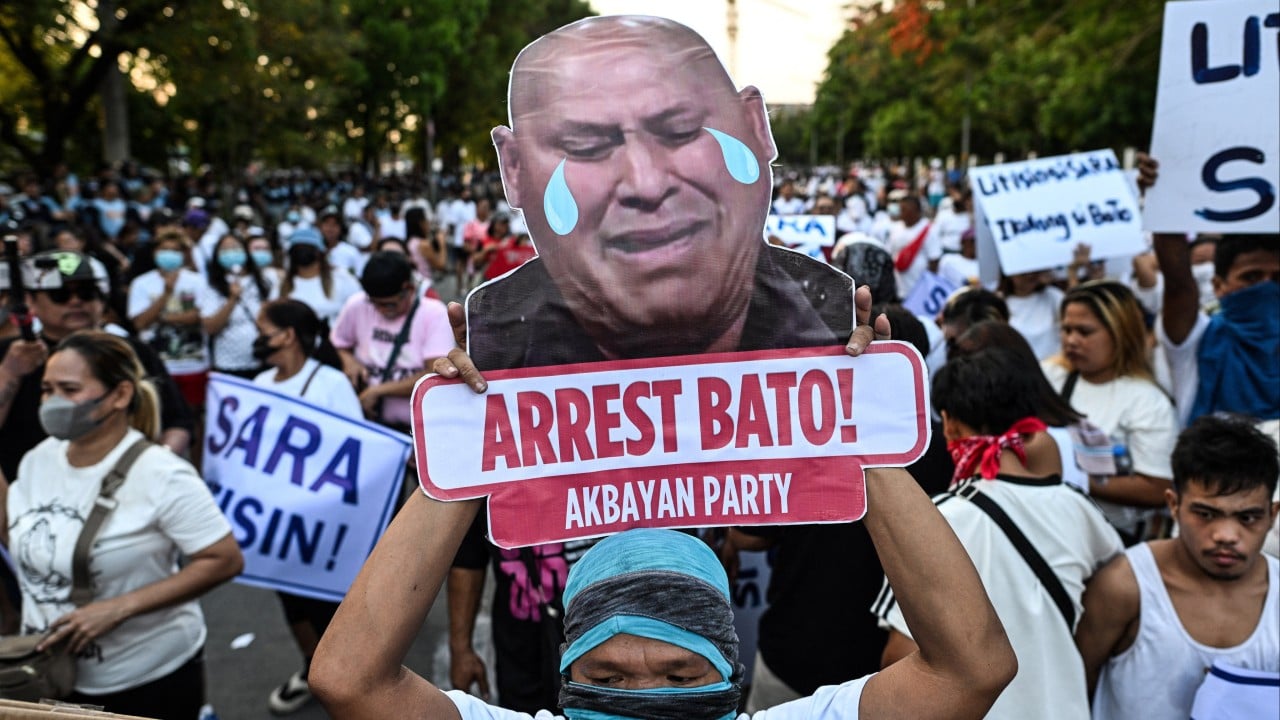
Dela Rosa was the conductor of this grim symphony. He cried on television when his integrity was questioned, and he flexed his muscles when the "enemies of the state" were mentioned. He was the quintessential "tough guy" in a culture that, at the time, was starving for a strongman. He wasn't just enforcing a policy; he was leading a crusade.
The Weight of the Dossier
The International Criminal Court (ICC) does not care about political crusades. It cares about patterns.
The investigators in The Hague see a different story than the one told in the Senate halls. They see a systematic campaign that resulted in thousands of deaths—estimates vary wildly from the official 6,000 to rights groups' claims of 30,000. For the ICC, Dela Rosa isn't a hero who cleaned up the streets. He is a primary "person of interest" in a probe into crimes against humanity.
The stakes are invisible but absolute. If an arrest warrant is ever issued, Dela Rosa’s world shrinks to the borders of the Philippines. The moment he steps onto international soil, the machinery of global justice could grind him into its gears.
Consider the hypothetical life of a mother in a Manila slum—let’s call her Maria. Maria doesn't know where The Hague is. She doesn't understand the nuances of the Rome Statute. All she knows is that one night in 2017, men in masks took her son from a sari-sari store. She heard three pops. The next day, the police report said her son "fought back." Maria is the silent participant in this legal drama. Her grief is the fuel for the ICC’s slow-moving engine.
Dela Rosa knows this. He dismisses the ICC with a wave of his hand, calling them "white people" who don't understand the Filipino struggle. He wraps himself in the flag and the sovereignty of the nation. But even the thickest flag can feel thin when the world starts knocking on the door.
The Sanctuary of the Senate
Why is he "holed up" in the Senate?
It is a question of optics and protection. In the Philippines, the Senate is a bastion of privilege. As long as he is a sitting Senator, and as long as the current administration maintains a complicated, shifting relationship with the idea of international intervention, Dela Rosa is safe. He uses his seat to launch inquiries, to defend his former boss, and to remind the public that he is a servant of the people.
But the political winds in Manila are notoriously fickle. The alliance between the houses of Duterte and Marcos—once a juggernaut of convenience—has begun to fray. Cracks are appearing in the facade.
If the government ever decides that Dela Rosa is a more valuable bargaining chip than a political ally, the sanctuary of the Senate could evaporate overnight.
He lives in a state of high-stakes suspense. Every headline about the ICC is a tremor in the ground beneath his feet. He blusters, he laughs, he cracks jokes with the media, but the laughter has a hollow ring to it. He is a man who spent his life hunting, and now, for the first time, he knows what it feels like to be the quarry.
The Human Cost of Certainty
Dela Rosa’s tragedy—and perhaps the nation’s—is the absolute certainty that he was right.
He believed that the only way to save the country was to bleed it. He viewed the drug war as a necessary surgery, performed without anesthesia. To him, the "collateral damage" was a price worth paying for the feeling of safety in the suburbs.
But justice has a long memory and a very slow gait.
The "Rock" is finding that even the hardest stone can be weathered by the persistent drip of accountability. He is a man caught between two worlds: the Davao of his youth, where a gun and a loyal friend were all you needed, and a modern world that demands receipts for every life taken in the dark.
He remains in his office, surrounded by the trappings of a statesman. He studies bills, he attends hearings, and he speaks into microphones. But when the cameras turn off and the aides leave for the night, the silence in the Senate must be deafening.
In that silence, the faces of the "nanlaban" don't stay in the dossiers. They don't stay in The Hague. They wait in the corners of the room, reminders that while power can build a fortress, it can never quite bridge the gap between a "tough" past and an uncertain future.
The lawmaker waits. The prosecutors wait. And the families of the fallen wait. The marble walls remain cold, indifferent to the heat of the man inside who is learning, day by day, that some shadows are too long to outrun.