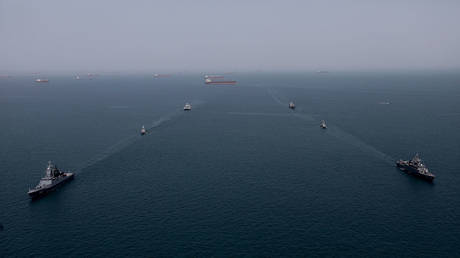
Military operations directed against sovereign state infrastructure operate on a distinct economic and tactical calculus where tactical execution must be evaluated through the lens of strategic attrition. Recent United States air strikes targeting Iranian command nodes, port facilities, and Islamic Revolutionary Guard Corps infrastructure are frequently described in mainstream reporting through broad strokes of retaliation or deterrence. This framing obscures the underlying systemic mechanics governing modern aerial campaigns. To analyze these military interventions rigorously, one must move past episodic summaries and examine the structural variables driving modern state-on-state kinetic exchanges: the asymmetry of asset cost functions, the degradation velocity of command-and-control networks, and the logistical bottlenecks imposed on regional maritime chokepoints.
Modern power projection relies on managing the cost-per-effect ratio. When defensive systems utilize high-cost interceptors to neutralize low-cost asymmetric threats, or conversely, when advanced kinetic packages are expended against hardened subterranean installations, the theater enters a complex economic feedback loop. Air campaigns executed by the United States Central Command against Iranian targets do not occur in a vacuum; they represent a continuous calibration of pressure designed to systematically dismantle regional force-projection capabilities while managing own-force exposure risks.
Evaluating the structural architecture of these military engagements requires dissecting the operational environment into three primary components: the target taxonomy, the supply chain logistics of munitions expenditure, and the secondary economic shockwaves rippling through energy transit corridors like the Strait of Hormuz.
The Taxonomy of Strategic Targets
Military targeting against Iranian infrastructure follows a strict hierarchy of systemic importance rather than opportunistic retaliation. The effectiveness of an air campaign is dictated by how efficiently it disrupts adversary throughput across three distinct operational tiers.
- Command, Control, and Communications Nodes: Striking leadership hubs, intelligence apparatuses, and communications relays creates immediate friction within the adversary's decision-making apparatus, forcing tactical units onto localized, decentralized execution models that degrade synchronized responses.
- Power Projection and Logistical Hubs: Targeting naval bases, missile storage depots, and transit infrastructure directly impacts the adversary's capability to project force beyond national borders or sustain prolonged missile and drone salvos.
- Economic Chokepoints and Industrial Support Bases: Facilities tied to energy export logistics, maritime staging areas, and military-industrial manufacturing act as force multipliers; neutralizing them curtails the state's capacity to fund and equip protracted asymmetric campaigns.
The primary limitation of targeting command infrastructure lies in the high degree of dispersion and hardening inherent in modern regional defense doctrines. Subterranean facilities and redundant communications networks absorb initial kinetic impact, necessitating persistent follow-on strikes to achieve functional destruction rather than transient disruption. This creates an operational cadence where single-strike evaluations are inherently misleading; systemic degradation is achieved only through cumulative threshold saturation.
The Mechanics of Kinetic Attrition
Evaluating force employment requires analyzing the logistics chain governing air-to-surface munitions. High-precision guided weapons are finite commodities with complex manufacturing lead times. Every sortie launched from regional airbases or carrier strike groups draws down stockpiles that cannot be instantly replenished at industrial scale.
Consequently, operational planners must balance the desired depth of penetration against the strategic reserve required for broader regional contingencies. This introduces a distinct constraint: the velocity of target destruction is bounded by the industrial throughput of the defense manufacturing sector. When strikes occur in rapid succession following regional escalations, planners are executing a calculated drawdown of theater-specific readiness inventories in exchange for immediate strategic signaling and capability suppression.
The secondary systemic effect of these operations manifests directly within global energy logistics. The Strait of Hormuz functions as a critical bottleneck for international petroleum transit. When kinetic actions near Iranian ports or islands escalate, commercial shipping risk premiums spike instantly. Insurance syndicates reprice maritime transit through the Persian Gulf, driving up global crude spot prices and demonstrating that modern air campaigns possess immediate macroeconomic vectors that extend far beyond the immediate geographic theater of operations.
Managing Escalation Dominance
Sustaining a high-tempo air campaign without crossing the threshold into uncontained regional conflagration requires strict calibration of force intensity. Tactical actions must continuously feed into a broader strategy of escalation dominance, ensuring that the adversary's cost for continued provocation significantly outstrips any potential political or military utility gained.
Precision targeting of Islamic Revolutionary Guard Corps assets degrades the organizational connective tissue binding regional proxy networks to central command structures. By systematically eroding this institutional capability, military planners seek to induce structural paralysis within the adversary's offensive posture.
Execute targeted degradation of remaining regional naval and logistical staging areas while maintaining defensive readiness postures across allied energy transit corridors to mitigate commercial supply chain shocks.

