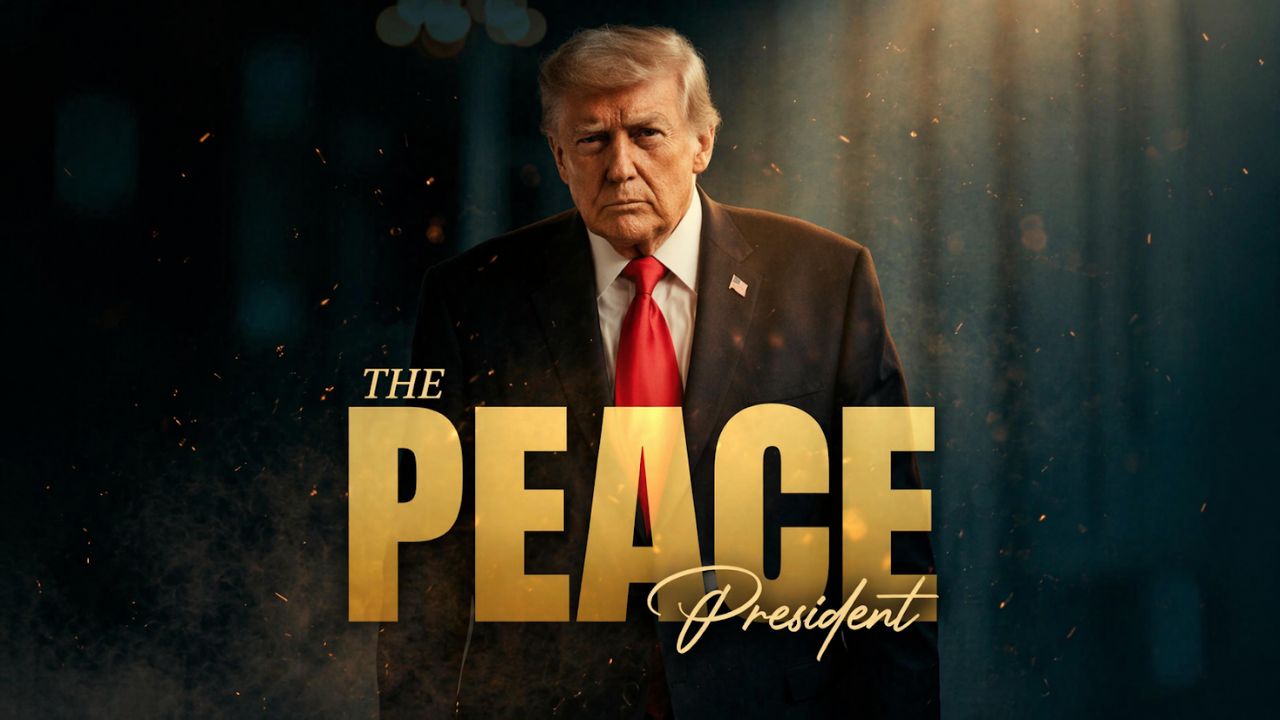
The "reopening" of the Strait of Hormuz functions as a high-stakes pivot in political branding, transforming a standard de-escalation into a cornerstone of the Peace President doctrine. By framing the cessation of maritime hostilities as a personal diplomatic victory, Donald Trump utilizes a specific form of geopolitical arbitrage: he absorbs the risk of high-tension rhetoric and then liquidates that risk to produce a "stability dividend" for domestic consumption. This maneuver relies on the systematic neutralization of internal critics—labeled "panicans"—to consolidate authority over the narrative of American interventionism.
The Mechanics of Crisis De-escalation as a Political Asset
The transition from a closed or contested Strait of Hormuz to an open waterway provides a quantifiable metric of success that bypasses traditional diplomatic nuances. The strategic utility of this event is categorized through three distinct structural layers.
1. The Volatility-Stability Cycle
The administration’s strategy hinges on a deliberate expansion of the threat envelope. By allowing or encouraging the perception of imminent conflict, the subsequent return to the status quo is perceived by the electorate not as a reversion to the mean, but as an active achievement of peace. The "Peace President" image is thus constructed through the resolution of crises that the administration’s own maximum pressure campaigns helped catalyze. This creates a closed-loop logic where the president is both the source of the pressure and the only agent capable of relieving it.
2. Information Asymmetry and the Panican Archetype
The term "panican" serves a functional purpose in rhetorical strategy. It categorizes any individual or entity that prioritizes traditional risk-assessment frameworks—such as intelligence briefings or historical precedent—as being emotionally compromised or intellectually weak. By discrediting the "panicans," the administration creates an environment where the President’s intuition is positioned as the only reliable North Star. This devalues expert consensus and elevates executive instinct to a primary strategic tool.
3. The Economic Signaling of Maritime Security
The Strait of Hormuz is a critical chokepoint for global energy markets. The physical reopening of the strait acts as a real-time validation of American hegemony. When tankers move without incident, the administration can map that physical movement directly to the efficacy of its "Trust Trump" directive. This creates a tangible link between a psychological state (trust) and a global economic reality (unhindered oil flow).
The Three Pillars of the Peace President Doctrine
To understand the shift in branding, one must analyze the component parts of the "Peace President" persona as it is currently being deployed. This is not a pacifist stance, but a transactional approach to global security.
Pillar I: Tactical Unpredictability
The doctrine rejects the "rules-based international order" in favor of a "person-based negotiation order." Unpredictability is used as a lever to force concessions from adversaries like Iran. The logic holds that if an adversary cannot predict the American response, they will default to a more cautious posture to avoid catastrophic miscalculation. The reopening of Hormuz is presented as the successful outcome of this tactical "madman" approach.
Pillar II: Burden Shifting
A core element of the "Peace President" image is the refusal to commit American "blood and treasure" to perpetual conflicts. By resolving the Hormuz crisis through brinkmanship and subsequent negotiation rather than a sustained naval campaign, the administration satisfies the isolationist wing of its base while maintaining the appearance of global strength. The strategic goal is the achievement of American objectives with zero kinetic engagement.
Pillar III: Domestic Validation via Foreign Policy
Foreign policy is treated as an extension of domestic campaigning. Every diplomatic engagement is filtered through its ability to be distilled into a slogan. The Hormuz situation is particularly effective because it involves clear imagery: ships, oceans, and military hardware. These are easily translatable into a narrative of American dominance that requires no nuance to be understood by a domestic audience.
The Cost Function of Maximum Pressure
While the "reopening" is framed as a victory, a rigorous analysis must account for the systemic costs associated with this strategy. The "Peace President" image is not maintained without significant geopolitical overhead.
- Erosion of Alliance Predictability: Partners in the region (e.g., UAE, Saudi Arabia) face increased insurance premiums and security costs during the "volatility" phase of the cycle. This creates a trust deficit that may lead these actors to seek security guarantees from alternative powers like Russia or China.
- The Elasticity of Iranian Retaliation: Each time the "maximum pressure" lever is pulled, the Iranian response becomes more sophisticated. The "Peace President" image relies on the assumption that Iran will always choose de-escalation over total conflict. This assumption has a diminishing return as the Iranian regime’s internal political costs for backing down increase.
- Decoupling of Perception and Reality: The insistence on "Trust Trump" creates a divergence between the actual security situation in the Gulf and the public’s perception of it. If a low-level kinetic event occurs during a period of "declared peace," the administration’s credibility suffers a more significant blow than if it had maintained a more cautious, transparent stance.
Causality and the Bottleneck of Personal Diplomacy
The competitor's narrative suggests that the reopening of Hormuz is a direct, linear result of presidential strength. A structured analysis reveals a more complex causal chain. The "reopening" is likely a result of a temporary alignment of interests: the U.S. needed a "win" for domestic branding, and Iran needed a reprieve from sanctions or a pause in naval attrition to regroup.
This creates a bottleneck in American strategy: the entire apparatus of U.S. foreign policy is now dependent on the personal whims and communications of a single individual. The professional diplomatic corps is sidelined, which removes the "fail-safe" mechanisms that traditionally prevent minor incidents from escalating into regional wars.
The Strategic Shift in Conflict Management
The administration has effectively moved from "Conflict Resolution" to "Conflict Management and Monetization." By treating the Strait of Hormuz as a stage for a grand performance of peace-making, the administration has changed the metrics of success. Success is no longer defined by long-term regional stability, but by the absence of a headline-grabbing crisis on any given day.
This shift has three immediate consequences:
- Short-Termism: Policy is dictated by the 24-hour news cycle rather than 10-year strategic plans.
- Increased Leverage for Adversaries: Knowing the President’s desire for the "Peace President" label, adversaries can manufacture crises specifically to offer the President a "victory" in exchange for concessions.
- The Marginalization of Institutional Knowledge: The "panican" label forces career officials into silence, ensuring that the only information reaching the top is that which confirms the existing "Peace President" narrative.
Strategic Recommendation: The Liquidity of Strength
The current branding effort is a masterclass in psychological operations. To maintain this "Peace President" image, the administration must ensure a constant supply of "resolved" crises. The strategic play for the next quarter is the identification of a new flashpoint—likely in the South China Sea or Eastern Europe—where the same cycle of manufactured tension followed by "personal" resolution can be replicated.
The objective is to make the "Peace President" label synonymous with the avoidance of large-scale ground wars, regardless of how many smaller, more volatile proxy or maritime conflicts occur. Investors and global actors must look past the "Trust Trump" rhetoric and focus on the underlying fundamentals: the U.S. is not withdrawing from the world, but is instead re-pricing its presence. It is moving from a provider of "global public goods" (like free navigation) to a "transactional security provider." The reopening of Hormuz is the first successful invoice of this new era.