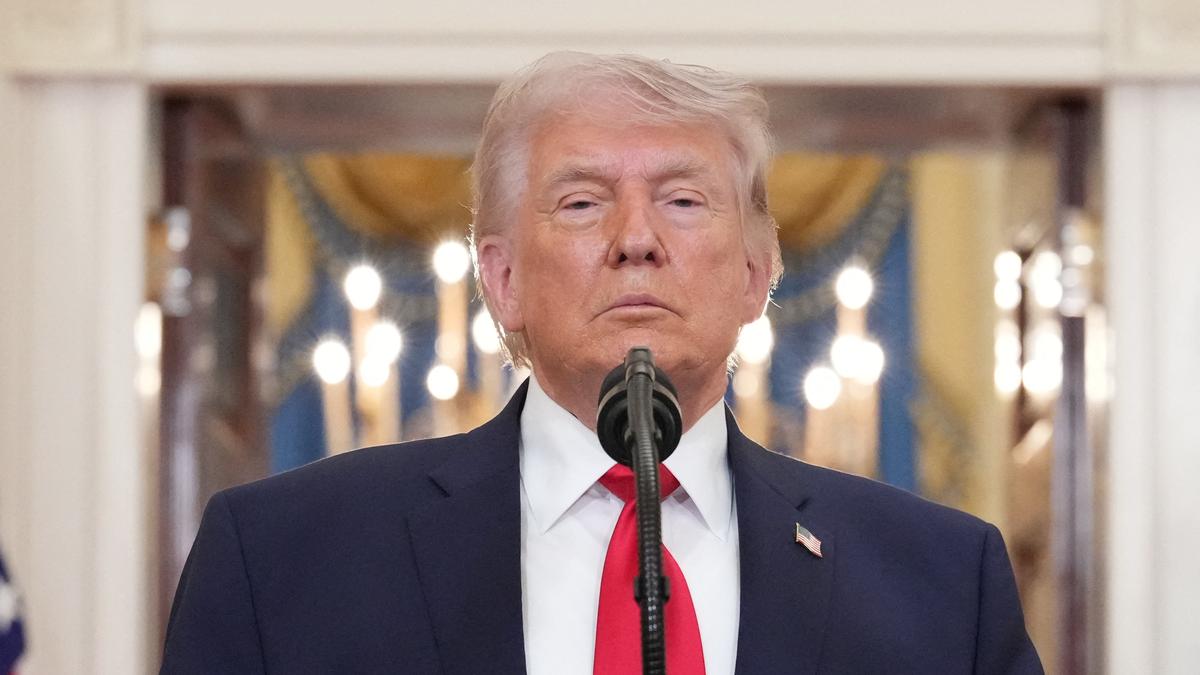
The shift in executive communication regarding Iranian nuclear compliance signals a transition from "maximum pressure" to a calibrated psychological operation designed to exploit the domestic and economic vulnerabilities of the Iranian regime. When a definitive deadline is seemingly blurred by a high-profile executive statement, it is rarely a sign of softening; rather, it is an expansion of the "uncertainty tax" levied against foreign markets and Iranian internal planning. By moving the goalposts, the administration resets the clock on Iranian defensive maneuvers while maintaining the credible threat of kinetic or economic escalation.
The Triad of Strategic Ambiguity
Strategic ambiguity serves three distinct functions in high-stakes nuclear diplomacy. First, it disrupts the adversary’s internal decision-making cycle. The Iranian Revolutionary Guard Corps (IRGC) and the clerical leadership rely on fixed timelines to coordinate their brinkmanship—specifically their progress toward "breakout capacity," the time required to produce enough weapons-grade uranium for a single nuclear device. Also making headlines in this space: Monarchy and Manifold Pressure The Mechanics of Anglo American Nuclear Nonproliferation Strategy.
Second, it preserves diplomatic optionality. A hard deadline forces a binary outcome: compliance or conflict. By introducing "cryptic" variables into the public discourse, the executive branch retains the ability to pivot between intensified sanctions, back-channel negotiations, or military posturing without the political cost of retreating from a self-imposed ultimatum.
Third, it manages global market volatility. Energy markets react violently to fixed dates of potential conflict. Stretching the timeline allows for a slow-bleed of the Iranian economy through existing sanctions while preventing a sudden spike in Brent Crude prices that would damage domestic economic interests. More information on this are explored by Associated Press.
The Breakout Capacity Equation
To understand why a deadline might be extended, one must quantify the technical reality of Iran's nuclear program. The timeline is governed by the $SWU$ (Separative Work Unit), which measures the effort required to enrich uranium.
The relationship between centrifuge efficiency and breakout time is non-linear. If Iran increases its inventory of IR-6 centrifuges, the time to acquire $SQ$ (Significant Quantity) of highly enriched uranium (HEU) drops precipitously. The executive strategy assumes that by signaling a potential extension, they can incentivize Iran to pause enrichment at a "sub-critical" threshold to avoid immediate repercussions, effectively lengthening the breakout clock without signing a formal treaty.
The Cost Function of Sanctions Overreach
The decision to extend a deadline often stems from a calculation of the diminishing returns of economic warfare. The "Maximum Pressure" framework operates on a curve:
- Initial Shock Phase: High-impact asset freezes and oil embargoes cause immediate currency devaluation.
- Adaptation Phase: The target regime develops "resistance economy" tactics, such as dark-fleet oil shipments and barter systems with non-aligned powers.
- Overreach Phase: Sanctions begin to alienate allies and incentivize the creation of parallel financial systems (e.g., BRICS+ initiatives), which reduces the long-term efficacy of the US dollar as a tool of statecraft.
By appearing to extend the deadline, the administration mitigates the risk of hitting the Overreach Phase. It signals to international partners that the US is still willing to engage in the "diplomatic process," thereby maintaining the multilateral buy-in necessary to keep current sanctions effective.
Internal Iranian Power Dynamics
The timing of this extension likely targets the friction between the Iranian presidency and the Supreme Leader’s office. The Iranian political structure is not a monolith. The pragmatic elements of the bureaucracy require a "pathway to relief" to justify to the hardliners why they should not immediately sprint toward a nuclear test.
When the US provides a cryptic extension, it empowers the Iranian negotiators to argue for continued restraint. This creates a feedback loop where the US controls the internal temperature of Tehran's debating chambers. If the US appears too rigid, it validates the hardline stance that "the Great Satan" will never negotiate in good faith, leading to an inevitable escalation. If the US appears too weak, it encourages further enrichment. The cryptic nature of the post is the specific tool used to maintain this equilibrium.
Tactical Deception and Kinetic Readiness
An extension in rhetoric does not always correlate with an extension in military readiness. Historically, tactical pauses in diplomatic language have preceded "Operation Opera" style strikes or sophisticated cyber interventions like Stuxnet.
The mechanism at play is the distraction of the adversary’s intelligence apparatus. If the Iranian leadership believes they have an additional three to six months of breathing room, their defensive posture may relax. This window provides the US and its regional allies the opportunity to:
- Position carrier strike groups under the guise of routine rotations.
- Finalize the integration of regional missile defense systems with partners in the Gulf Cooperation Council (GCC).
- Update target packages for hardening facilities like Fordow and Natanz.
The "cryptic" post is a layer of electronic and psychological noise designed to mask these operational movements.
The Regional Security Architecture
The deadline extension also serves as a stabilizing signal to Israel and Saudi Arabia. For Israel, a hard deadline that passes without action signals American retreat, potentially triggering a unilateral Israeli strike. For Saudi Arabia, it provides time to continue the delicate process of regional normalization and internal economic diversification (Vision 2030) without the immediate threat of a regional war.
The administration is essentially managing a "security multiplex." It must balance:
- The Israeli Red Line: The point at which Israel feels it must act to prevent an existential threat.
- The Gulf Stability Requirement: The need for a stable Persian Gulf to ensure the flow of hydrocarbons.
- The Non-Proliferation Global Standard: The necessity of maintaining the integrity of the NPT (Non-Proliferation Treaty).
Each of these variables has a different "tolerance for delay." The cryptic extension is the only way to satisfy all three simultaneously.
Risk Assessment of the Extended Timeline
The primary risk of this strategy is the "Sunk Cost of Time." Every day the deadline is extended, Iran’s scientists gain more experience in handling IR-9 centrifuges and advanced metallurgy. Knowledge cannot be sanctioned.
A secondary risk is the degradation of American credibility. If a deadline is extended too many times, it becomes a "red line" that is perceived as a "pink line." This perception encourages other actors—such as North Korea or Russia—to view US ultimatums as negotiable or performative.
The Final Strategic Play
The administration's move should be viewed as a "Gamma Hedge" in geopolitical terms. They are protecting themselves against the "volatility" of a sudden war while keeping the "upside" of a potential diplomatic breakthrough or a more opportune moment for intervention.
The immediate tactical move for the Iranian regime will be to interpret this as a sign of American weakness to appease their domestic base, while privately scrambling to understand the true "red lines" hidden within the cryptic language. The US response must be to follow this post with a series of quiet, high-impact sanctions on Iranian shipping networks and "front companies" in the UAE and Turkey. This "Speak Softly and Carry a Big Stick" approach ensures that while the rhetoric is ambiguous, the economic reality remains suffocating.
The extension is not a reprieve; it is a tactical widening of the kill zone. By giving Iran enough rope to think they can escape, the US ensures that any future "snap-back" of sanctions or kinetic action will be met with less international resistance, as the administration can point to this "extension" as the final, failed attempt at a peaceful resolution. The clock has not stopped; the increments of the second hand have simply become more difficult for the adversary to read.



