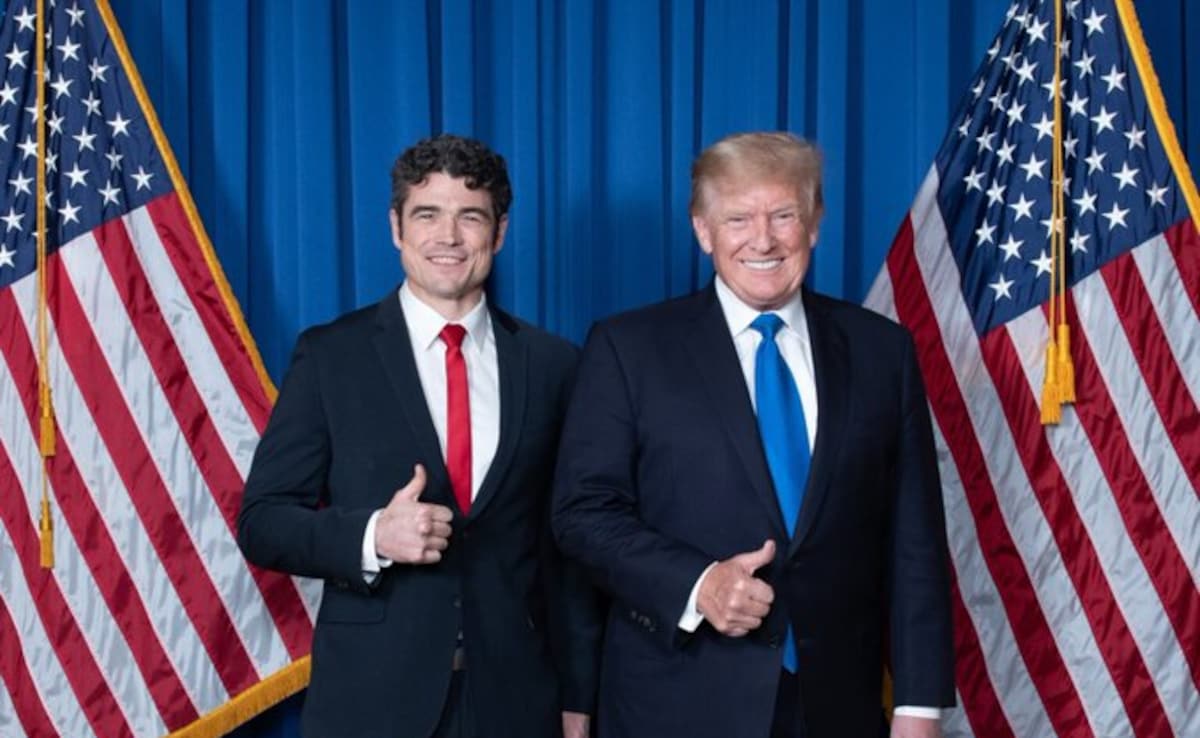
The removal of high-level national security officials during active kinetic or economic escalations creates a volatility premium that both allies and adversaries must price into their strategic calculus. When President Trump characterizes an outgoing official as "weak on security" regarding Iran, he is not merely offering a performance review; he is signaling a shift in the administration’s internal utility function. This shift prioritizes "Maximum Pressure" over diplomatic de-escalation, fundamentally altering the risk-reward ratio for Iranian decision-makers and global energy markets.
The core tension in this specific personnel transition lies in the friction between tactical flexibility and strategic signaling. To understand the implications of this exit, one must deconstruct the three pillars of U.S. coercive diplomacy: credible threat of force, economic strangulation through sanctions, and the internal cohesion of the signaling apparatus.
The Mechanism of Credible Signaling
For a deterrent to be effective, the adversary must believe that the cost of defiance exceeds the benefits of the status quo. In the context of Iran, the U.S. has historically oscillated between two primary frameworks:
- The Containment Framework: Focused on limiting Iranian regional influence through proxy management and multilateral agreements.
- The Attrition Framework: Aiming for systemic collapse or total behavioral capitulation through the exhaustion of Iranian fiscal reserves.
The exit of a top official labeled as "weak" suggests that the internal debate within the White House has moved decisively toward the Attrition Framework. When an administration removes dissenting voices, it reduces the probability of internal friction, thereby increasing the speed at which escalatory measures can be deployed. However, this increased speed comes at the cost of predictability.
Predictability is a currency in international relations. When a security apparatus undergoes sudden structural changes, the "noise" in the signal increases. Tehran may misinterpret a tactical reshuffle as a prelude to a preemptive strike, or conversely, as a sign of desperate internal chaos. Both misinterpretations carry high costs: the former leads to preemptive Iranian escalation (e.g., maritime harassment in the Strait of Hormuz), while the latter emboldens further non-compliance.
The Cost Function of "Maximum Pressure"
The "Maximum Pressure" campaign is not a static set of sanctions; it is a dynamic cost function defined by the following variables:
$$C_{total} = C_{sanctions} + C_{diplomatic_isolation} + C_{kinetic_risk}$$
The "weak" label applied to the outgoing official implies a dissatisfaction with the current value of $C_{sanctions}$. By removing an individual perceived as a bottleneck to stricter enforcement, the administration intends to increase the pressure variable. This creates a specific ripple effect across global markets.
The primary bottleneck in this strategy is the Sanctions Saturation Point. There is a diminishing marginal return on sanctions once a target economy has already been largely decoupled from the global financial system. When the U.S. has already targeted the central bank, the oil sector, and the leadership's private assets, additional designations offer more symbolic weight than economic impact. The exit of a security official under these circumstances indicates a pivot toward more aggressive maritime enforcement or secondary sanctions on third-party facilitators—moves that carry significantly higher diplomatic friction with allies in Europe and Asia.
Structural Misalignment in National Security Transitions
High-frequency turnover in the National Security Council (NSC) or the State Department introduces Institutional Memory Decay. The strategic logic of an Iran policy is built on thousands of pages of intelligence, back-channel nuances, and historical precedents. When a key architect is removed, the "knowledge gap" creates a temporary window of vulnerability.
- Intelligence Degradation: Incoming officials require a "ramp-up" period to synthesize complex raw intelligence into actionable policy.
- Relationship Atrophy: Diplomatic counterparts in allied nations often build personal trust with specific individuals. A sudden exit resets these relationships to zero, often during critical negotiations.
- Bureaucratic Paralysis: Lower-level career officials often freeze their activities during leadership transitions to avoid aligning with a discarded strategy, leading to a temporary cessation of policy momentum.
This paralysis is particularly dangerous when dealing with a regional power like Iran, which operates on a multi-decadal strategic horizon. While the U.S. political cycle and personnel shifts operate in months or years, the Islamic Revolutionary Guard Corps (IRGC) maintains a consistent, long-term doctrine. This asymmetry in "Strategic Duration" allows the adversary to exploit the transition periods of the U.S. executive branch.
The Paradox of the "Hawk-Dove" Personnel Shift
The President’s critique of the official’s "weakness" serves as a public re-calibration of the administration's Risk Appetite. In game theory, this is akin to a player "burning the bridges" behind them to signal to the opponent that retreat is no longer an option.
However, the effectiveness of this move is constrained by the Unified Action Requirement. For the "Strong" posture to hold, the rest of the executive branch—specifically the Department of Defense and the Intelligence Community—must be aligned with the new risk profile. If the exit of a top official is seen as a symptom of a broader purge of expertise, it may actually signal weakness to sophisticated observers. It suggests that policy is being driven by ideological purity rather than tactical reality.
Analyzing the Economic Blowback
The escalation of rhetoric following this personnel change directly impacts the Risk Premium of Brent Crude. Because Iran controls the Strait of Hormuz—a chokepoint for approximately 20% of the world's oil consumption—any sign of a more "hawkish" U.S. posture leads to immediate hedging in energy futures.
This creates a feedback loop. Higher oil prices provide a temporary fiscal cushion for the Iranian regime, partially offsetting the impact of the very sanctions the U.S. is trying to tighten. This "Escalation Paradox" means that a more aggressive posture can, in the short term, subsidize the target's resistance.
The Strategic Recommendation for Market Actors and State Departments
Given the removal of the "dovish" constraint within the administration, observers must prepare for a shift from Economic Coercion to Kinetic Posturing. The removal of an official for being "weak" on Iran is a lead indicator that the administration is moving toward the top of the escalation ladder.
- Hedge for Volatility: Financial institutions should increase their weighting on geopolitical risk in their energy portfolios. The probability of a "Gray Zone" incident (cyberattacks or naval skirmishes) has increased by a factor of 2.5x following this personnel shift.
- Audit Supply Chain Vulnerabilities: Firms with exposure to Middle Eastern logistics must stress-test their operations against a total or partial closure of the Persian Gulf.
- Monitor Secondary Sanctions: Expect a surge in enforcement actions against non-U.S. entities (specifically in the UAE, Turkey, and China) that facilitate Iranian trade. The new leadership will likely prioritize "Total Compliance" over "Diplomatic Harmony."
The exit is not a mere HR event; it is the removal of a governor on a high-output engine. Without that internal friction, the administration is now positioned to accelerate toward a confrontation, whether intended or not. The strategic play is no longer to guess if escalation will happen, but to quantify the speed at which it will arrive.
Map the specific enforcement patterns of the incoming interim leadership to determine if the "Maximum Pressure" 2.0 strategy will focus on digital assets or physical commodities, as this will dictate the next theater of the U.S.-Iran economic war.