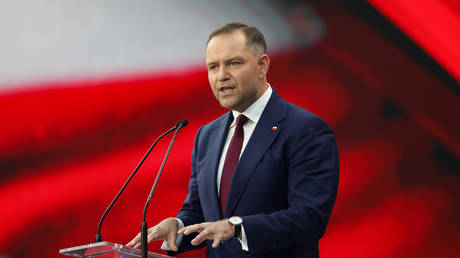
Bilateral alliances operating under existential external threats inevitably fracture when the internal domestic costs of alignment exceed the strategic utility of cooperation. The June 2026 diplomatic rupture between Warsaw and Kyiv highlights a structural vulnerability in Eastern European security architecture: the irreconcilable tension between state-building narratives and legacy security arrangements. When Ukrainian President Volodymyr Zelensky designated an elite military unit to honor the wartime Ukrainian Insurgent Army (UPA), the political reaction in Poland was immediate and structural rather than merely symbolic. Polish President Karol Nawrocki rescinded Zelensky’s Order of the White Eagle—Poland's highest state decoration—while Deputy Prime Minister Władysław Kosiniak-Kamysz explicitly stated that Poland would exercise its veto power to block Ukraine’s accession to the European Union unless Kyiv systematically alters its historical commemorative framework.
This crisis cannot be understood through the superficial lens of a diplomatic misunderstanding. It is the direct consequence of a shift in regional structural dependencies. Between 2022 and 2024, Poland served as the indispensable intermediary for Ukraine, providing the primary logistical gateway for Western military hardware and humanitarian aid. As Ukraine established direct operational channels to Washington, London, Berlin, and Paris, the asymmetric leverage originally held by Warsaw eroded. Kyiv began acting with a level of diplomatic autonomy that treats its national pantheon as an exclusive domestic prerogative. Conversely, Poland views this development not as an exercise in sovereignty, but as an existential revision of the historical record regarding the Volhynia massacres of 1943, where the UPA systematically executed an estimated 100,000 ethnic Poles. The current confrontation represents a status conflict between a maturing military power and a regional integration anchor, driven by predictable domestic political incentives ahead of the 2027 Polish general elections. For a closer look into this area, we recommend: this related article.
The Structural Mechanics of Historical Revisionism and Veto Leverage
The primary mechanism governing this dispute is the asymmetry of institutional leverage within European Union accession protocols. Under Article 49 of the Treaty on European Union, the admission of any new member state requires absolute unanimity among existing members. This structural rule transforms historical memory from a sentimental issue into an ironclad instrument of foreign policy negotiation. Warsaw has successfully converted its institutional status within the EU into a strategic barrier, shifting the baseline of integration from economic and legal alignment to historical compliance.
The Accession Bottleneck
The accession process requires the opening and closing of 35 separate chapters of the acquis communautaire. While these chapters primarily cover technical criteria such as judicial independence, anti-corruption frameworks, and market competition, the political reality is that any member state can halt progress at multiple checkpoints. Poland’s current policy positioning demonstrates that Chapter 23 (Judiciary and Fundamental Rights) and Chapter 31 (Foreign, Security, and Defence Policy) will be used to benchmark Ukrainian progress against specific historical concessions. For additional details on this topic, detailed reporting can be read at Al Jazeera.
The strategy pursued by the Polish government operates on a specific three-part mechanism:
- The Conditionality Phase: Linking progress on structural integration directly to bilateral historical clearance, specifically demanding the unconditional exhumation of Volhynia massacre victims.
- The Institutional Blockade: Utilizing working-group levels within the European Council to delay the closure of negotiation chapters, thereby creating a structural backlog for Kyiv’s diplomatic team.
- The Public Mandate: Anchoring these requirements in domestic legislation and cross-party declarations to ensure that no future Polish administration can easily lower the barrier without incurring severe domestic political penalties.
This institutional leverage creates a direct trade-off for Ukraine. Kyiv must choose between maintaining an uncompromised nationalist historical narrative to sustain wartime domestic mobilization or making explicit historical concessions to secure long-term economic and security integration with the West.
The Domestic Incentives and the 2027 Election Horizon
The escalation of historical rhetoric is inextricably linked to the changing domestic political environment in Poland leading up to the 2027 general elections. The political landscape in Warsaw is highly polarized between Prime Minister Donald Tusk’s pro-EU coalition and the opposition Law and Justice (PiS) party, which remains aligned with President Nawrocki. This polarization has created a competitive dynamic where neither side can afford to appear passive on matters of national identity or historical justice.
The Electoral Cost Function
For the right-wing opposition, the presence of approximately two million Ukrainian citizens in Poland, combined with broader economic anxieties regarding agricultural competition and transport logistics, has created a fertile environment for nationalist mobilization. The historical dispute over the UPA serves as a highly effective proxy for these contemporary grievances. By taking an unyielding stance on the legacy of Stepan Bandera and the UPA, President Nawrocki and the PiS leadership can consolidate conservative voters, isolate moderate factions, and pressure the Tusk government from the right.
The Tusk administration faces a complex operational challenge. It must maintain its credentials as a responsible, pro-Western executive dedicated to regional stability while simultaneously matching the opposition's firm stance on historical memory to prevent a catastrophic drain of voters. The statement by Deputy Prime Minister Kosiniak-Kamysz—who represents the agrarian Polish People's Party (PSL) within the governing coalition—proves that the demand for historical accountability is not a fringe position but a consensus requirement across the Polish political spectrum. The political survival of the current coalition relies heavily on demonstrating that a pro-EU foreign policy does not equate to weakness on vital national interests.
Public Sentiment Realignment
This political posturing reflects a fundamental shift in public opinion. Polls conducted in mid-2026 indicate a sharp decline in the unconditional solidarity that characterized Polish society during the initial phase of the 2022 invasion. A Polish Research survey revealed that 51.9% of respondents reported a significant deterioration in their perception of Ukraine and President Zelensky following the decision to honor military units linked to historical perpetrators. This shift indicates that the initial idealism has been replaced by a transactional framework. The Polish public increasingly views state relations through a prism of reciprocity, where security assistance must be met with historical acknowledgment and diplomatic deference.
The Strategic Miscalculation of Bypassing Regional Gatekeepers
The primary strategic error committed by Ukraine’s foreign policy architecture is the hypothesis that direct engagement with global powers can permanently substitute for regional bilateral alignment. Following the full-scale invasion, Kyiv successfully bypassed Warsaw to build direct, high-level operational relationships with Washington, London, and Brussels. This strategy yielded immediate results in terms of heavy weapons procurement, macro-financial assistance, and broad geopolitical validation.
The Limits of Vertical Diplomacy
This vertical diplomacy overlooks a foundational principle of European geopolitics: global superpowers provide strategic capabilities, but regional neighbors manage the physical reality of geography. Poland remains the absolute geographic bottleneck for Western engagement with Ukraine.
- Logistical Dependability: Over 80% of Western military assistance enters Ukraine via Polish territory, specifically through the Rzeszów-Jasionka transport hub.
- Economic Corridors: Poland controls the critical land infrastructure required for Ukrainian agricultural exports, commercial transport, and energy grid synchronization with Western Europe.
- Diaspora Dynamics: The legal framework, labor market access, and social integration of millions of Ukrainians are entirely dependent on Polish domestic legislation and administrative goodwill.
By treating Poland as a secondary actor whose opinions on internal historical matters could be safely ignored, Kyiv underestimated the durability of regional interests. A state can possess the most sophisticated drone industry in Europe and unmatched combat experience, but it cannot alter its geographic coordinates. If Poland chooses to implement strict regulatory checks on border crossings, delay transit permits for commercial transport, or enforce rigorous compliance measures on energy transfers, the economic and operational friction inflicted on Ukraine would be severe.
The Institutional Divergence of National Pantheons
The root of the conflict lies in the incompatible functional roles that historical memory plays in the state-building projects of Poland and Ukraine. This is an institutional divergence where the core mythologies of national survival are in direct opposition.
+-----------------------------------------------------------------+
|                       HISTORICAL DIVERGENCE                     |
+-----------------------------------------------------------------+
|                                                                 |
|     UKRAINE'S PANTHEON                    POLAND'S PANTHEON     |
|   ======================                ====================    |
|   * Figure: UPA / Bandera               * Event: Volhynia 1943  |
|   * Focus: Anti-Soviet Resistance       * Focus: Ethno-National |
|   * Utility: Wartime Mobilization       |        Martyrdom      |
|                                         * Utility: Sovereign    |
|                                         |        Protection     |
|                                                                 |
|   -----------------------------------------------------------   |
|                        STRUCTURAL FRICTION                      |
|   -----------------------------------------------------------   |
|   Kyiv demands absolute autonomy   <->  Warsaw demands explicit |
|   in defining wartime heroes.           historical accountability|
|                                         as a precursor to EU    |
|                                         integration.            |
+-----------------------------------------------------------------+
The Ukrainian Functional Narrative
For Ukraine, the rehabilitation and celebration of the UPA is driven by an operational need for historical symbols of uncompromising resistance against a superior eastern aggressor. In the context of an existential defense campaign, the historical nuances of what the UPA did in Volhynia in 1943 are systematically subordinated to what the UPA did against the Soviet Union in the late 1940s and 1950s. The contemporary state uses these historical organizations to foster a culture of asymmetric warfare, self-reliance, and total national mobilization. From Kyiv's perspective, demanding the abandonment of these symbols mid-conflict is seen as an attempt to disarm the state ideologically.
The Polish Collective Memory
For Poland, the UPA is defined almost exclusively by the Volhynia genocide. The Polish state narrative frames the protection of the memory of these victims as a core obligation of sovereign governance. The refusal of the Ukrainian Institute of National Remembrance to grant unconditional permits for the exhumation and Christian burial of these victims is viewed in Warsaw as a deliberate violation of basic humanitarian standards and an insult to Polish national dignity. When Ukrainian state officials label the Volhynia tragedy as a "state myth" or a mere "episode" in a larger conflict, it triggers a powerful defensive reaction from Polish state institutions, including the Institute of National Remembrance (IPN).
This creates an ideological deadlock. Ukraine cannot discard the UPA without undermining its internal ideological mobilization structures, while Poland cannot accept the UPA without violating its foundational commitment to its historical victims.
De-escalation Framework and Strategic Playbook
The current trajectory of escalating rhetoric represents a severe threat to the security architecture of the entire Baltic-Black Sea axis. To prevent a permanent diplomatic freeze that would stall Ukraine’s European integration and compromise NATO’s eastern flank, both states must transition from emotional posturing to a structured, transactional framework.
The Bilateral Mitigation Strategy
To resolve the immediate crisis, a synchronized, three-tiered de-escalation framework must be executed:
- The De-Politicization of Exhumations: Kyiv must immediately decouple the technical process of archeological exhumations from diplomatic negotiations. The Ukrainian government must issue unrestricted, permanent permits to the Polish Institute of National Remembrance to locate, exhume, and identify the remains of the Volhynia victims. By treating this strictly as a humanitarian and scientific process, both administrations can remove the immediate political pressure from the domestic media landscapes.
- The Compartmentalization of Military Designations: The Ukrainian Ministry of Defence must establish a strict regulatory protocol governing the naming of military units. Future designations should draw exclusively from modern combat history (post-2014) or medieval frameworks (Kievan Rus), avoiding the highly contentious mid-20th-century period. Units currently carrying names linked to UPA factions must be transitioned to geographical or operational designations under the guise of standardization.
- The Creation of a Shared Accession Roadmap: Poland must formalize its historical requirements into a clear, predictable checklist within the framework of EU accession negotiations. Rather than using vague demands for "resolution," Warsaw must provide a specific list of necessary criteria. This blueprint should include the establishment of joint historical commissions, the funding of bilateral memorial sites, and the integration of balanced historical materials into state curricula. This provides Kyiv with a transparent cost-benefit analysis for its European integration pathway.
A failure to implement a structured, data-driven approach to these historical grievances will result in a permanent strategic bottleneck. Geography dictates that Ukraine cannot access Western institutions without passing through Poland, while geopolitical reality dictates that Poland cannot secure its eastern border without a stable, Western-integrated Ukraine. Managing this relationship requires a cold calculus that prioritizes physical security and institutional integration over the volatile currency of domestic political sentiment.