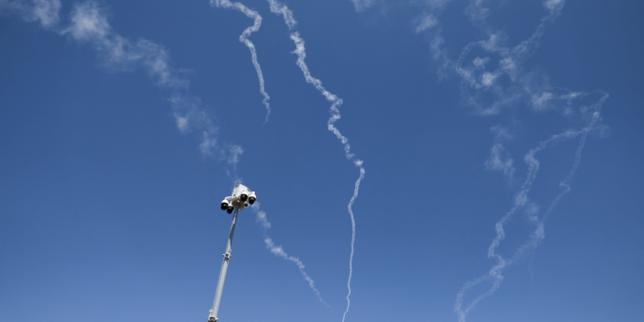
The convergence of kinetic military engagement in the Middle East and the formalization of multi-year border security financing in Washington reveals a structural realignment of American power. Statecraft operates across distinct domains, yet both events demonstrate a transition from reactive, short-term policing to permanent, highly capitalized operational postures.
While conventional media reports these events as distinct snapshots—an exchange of fire near the Strait of Hormuz and a narrow legislative vote in the House of Representatives—a rigorous strategic analysis treats them as parallel indicators of a broader systemic shift. This shift prioritizes long-range resource allocation and definitive deterrence models over transient diplomatic compromises.
The Kinetic Exchange Mechanism in the Strait of Hormuz
The recent exchange of strikes between U.S. Central Command (CENTCOM) forces and the Islamic Revolutionary Guard Corps (IRGC) represents a calculated calibration of asymmetric deterrence. Following the downing of a U.S. Apache helicopter, the retaliatory architecture deployed by the U.S. military targeted structural assets: Iranian air defense infrastructure, ground control stations, and surveillance radar installations directly bordering the Strait of Hormuz.
This target selection operates on a precise strategic logic. Rather than engaging in broad economic degradation or symbolic political strikes, the kinetic response systematically degrades Iran’s situational awareness and anti-access/area-denial (A2/AD) capabilities along a global maritime chokepoint. By neutralizing radar and command nodes, the U.S. forces reduce the operational efficiency of Iranian anti-ship missile batteries and drone launch facilities, directly shifting the tactical risk calculation in the Gulf of Oman.
Conversely, the IRGC’s counter-strikes—utilizing unmanned aerial vehicles and ballistic missiles directed at regional hubs including the U.S. Navy’s 5th Fleet in Bahrain, airfield infrastructure in Al-Azraq, Jordan, and the Ali Al-Salem base in Kuwait—reveal the parameters of their defensive doctrine.
This doctrine relies heavily on distributed regional proxy networks and asymmetric saturation tactics designed to exploit gaps in theater missile defense systems. The geographical distribution of these counter-strikes confirms that Iran views its security through a theater-wide lens, seeking to demonstrate that any localized friction near the Strait of Hormuz will immediately generate operational costs across multiple sovereign borders in the Middle East.
The underlying limitation of this kinetic cycle is the fragile equilibrium of tit-for-tat deterrence. The primary vulnerability of a calibrated strike model is the high probability of systemic miscalculation. When tactical actions depend on compressed command-and-control timelines, the distinction between a defensive response and an escalatory trigger becomes highly fluid. Each iteration of strikes increases the data variance for intelligence analysts, rendering future behavioral modeling less predictable.
Deconstructing the Secure America Act: Institutionalizing the Domestic Front
Simultaneously, the domestic political apparatus has finalized a long-term capital allocation strategy that removes critical migration enforcement agencies from the cyclical volatility of federal budget disputes. The passage of the Secure America Act via a 214–212 budget reconciliation vote represents a highly calculated legislative maneuver. By dedicating $69.5 billion specifically through September 2029, the bill establishes a multi-year fiscal firewall for the primary apparatus of domestic immigration enforcement.
The capital allocation structure breaks down into three distinct operational vectors:
- Immigration and Customs Enforcement (ICE): Allocated $38 billion to sustain interior enforcement, tracking operations, and high-volume deportation logistics.
- Customs and Border Protection (CBP): Allocated $26 billion to secure physical points of entry, expand technological surveillance grids, and increase Border Patrol manpower.
- Department of Homeland Security (DHS) Core: Allocated $5 billion to manage overarching departmental logistics, inter-agency data integration, and infrastructure support.
This statutory funding mechanism addresses a structural vulnerability that crippled departmental operations earlier in the fiscal cycle. Following a intense political blockade triggered by an operational incident in Minneapolis, the subsequent 75-day partial shutdown of DHS exposed the friction points of using critical law enforcement funding as political leverage.
The compromise architecture enacted in late April temporarily resolved the impasse by funding non-enforcement components of DHS while leaving ICE and CBP in fiscal limbo. The passage of the Secure America Act permanently corrects this operational asymmetry by guaranteeing funding through the duration of the current presidential term.
The strategic consequence of this multi-year allocation is the decoupling of law enforcement execution from short-term legislative oversight. Historically, the threat of government shutdowns served as an iterative review mechanism for congressional minorities to demand operational guardrails and policy concessions.
By utilizing the budget reconciliation procedure—which bypasses the traditional legislative filibuster—the current majority has insulated the executive branch’s immigration enforcement agenda from legislative interference for the next three fiscal years.
The Macro Intersection of Sovereign Power
When viewed in isolation, foreign kinetic engagements and domestic border appropriations appear to serve entirely separate national objectives. However, an integrated analytical framework reveals that both operations are governed by a unified strategic imperative: the optimization of sovereign control over critical frontiers.
[Geopolitical Cost Function]
       │
       ├─► External Vector: Maritime Interdiction & A2/AD Degradation (Hormuz)
       │
       └─► Internal Vector: Structural Decoupling of Enforcement Capital (Secure America Act)
The external vector seeks to stabilize global logistics and trade routes by enforcing maritime norms through targeted attrition. The internal vector seeks to stabilize domestic political and administrative jurisdiction by hardening territorial borders through multi-year capital injections.
Both strategies operate on an identical cost function. The state calculates that the long-term expenditure of capital—whether measured in precision-guided munitions deployed in the Persian Gulf or billions of dollars appropriated for detention infrastructure—is fundamentally lower than the systemic cost of allowing its geographical or maritime boundaries to be continuously contested.
The structural vulnerability of this dual-front approach lies in its immense consumption of political and fiscal capital. On the international stage, maintaining a permanent naval blockade and an active retaliatory posture strains logistics pipelines and complicates diplomatic negotiations with Persian Gulf allies, who remain sensitive to the disposition of frozen sovereign assets and regional escalation.
On the domestic front, the complete absence of bipartisan consensus on the Secure America Act guarantees that the institutionalization of immigration enforcement remains highly polarized, setting the stage for severe administrative reversals should the legislative majority shift in future cycles.
The optimal strategic play requires an immediate transition from reactive enforcement to systemic optimization. To maximize the return on the $69.5 billion domestic appropriation, operational commanders must prioritize the deployment of autonomous surveillance grids and predictive data modeling over simple headcount expansion, thereby reducing the long-term marginal cost of border monitoring.
Concurrently, in the theater of operations overseen by CENTCOM, tactical actions must shift away from predictable tit-for-tat kinetic responses. Instead, the focus must center on non-kinetic cyber disruption and rapid, deniable electronic warfare capabilities designed to permanently blind IRGC command nodes without triggering the overt political costs of kinetic escalation.