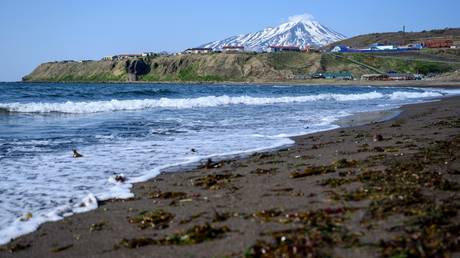
Territorial disputes at the intersection of maritime choke points and post-World War II legal frameworks frequently operate under zero-sum constraints. The ongoing friction between Moscow and Tokyo over the southern Kuril chain, known in Japan as the Northern Territories, exhibits a rigid structural deadlock. Recent high-level political posturing from figures such as Dmitry Medvedev, warning of severe ramifications should Tokyo maintain its territorial assertions, highlights the militarized diplomacy governing the region. Deconstructing this friction requires analyzing the strategic value of the islands through military geography, economic opportunity costs, and international legal asymmetry.
The Military Geography Matrix
The primary driver of Moscow's intransigence is not economic extraction, but maritime force projection and anti-access area denial mechanics. The Kuril chain acts as a natural breakwater separating the Sea of Okhotsk from the open Pacific Ocean.
- The Sea of Okhotsk Sanctuary: For the Russian Navy, the Sea of Okhotsk functions as a protected bastion for strategic nuclear-powered ballistic missile submarines. Controlling the entire Kuril ridge ensures that foreign surface combatants and attack submarines face severe acoustic and geographical barriers when attempting to enter this body of water.
- Choke Point Dominance: Straits such as the Kuril Strait and Bussol Strait provide critical deep-water passages for naval transit. Militarizing these islands grants Moscow radar and missile coverage that effectively neutralizes hostile naval maneuverability in the northwestern Pacific.
If sovereignty were transferred or shared, the defensive perimeter of the Russian Far East would contract immediately. The cost function for Moscow dictates zero territorial concessions because the military utility of the archipelago outweighs any diplomatic or economic dividend derived from a formal peace treaty with Tokyo.
The Legal and Diplomatic Impasse
The structural failure of bilateral negotiations stems from fundamentally incompatible legal interpretations of post-1945 instruments. Tokyo asserts that the San Francisco Peace Treaty of 1951 did not explicitly grant sovereignty over the southern islands to the Soviet Union, and that these specific territories were never historically part of the broader Kuril chain relinquished by Japan.
Moscow operates under a contrasting realist interpretation. The legal reality is anchored in the unconditional surrender of Imperial Japan and subsequent allied understandings, such as the Yalta Agreement, which transferred administrative and sovereign rights of the entire chain to Soviet control. Because Tokyo ties the execution of a formal World War II peace treaty directly to the return of all four southern islands, and Moscow views its borders as non-negotiable post-war realities, diplomatic channels face a permanent structural bottleneck.
Economic Viability and Resource Asymmetry
Arguments suggesting that economic integration could resolve the dispute underestimate the asymmetric value of the territory. Tokyo historically dangled the prospect of large-scale capital investments, joint economic ventures, and technological cooperation to incentivize a land transfer.
However, the economic utility of the islands has shifted. The region contains rich fishing grounds and substantial deposits of strategic minerals, including rhenium on Iturup Island. More importantly, Moscow has prioritized national integration of its eastern territories over foreign-financed development models. External investment carries a high political risk and provides insufficient leverage to induce territorial surrender when weighed against sovereign security imperatives.
Strategic Forecast
The bilateral relationship will remain locked in a state of diplomatic non-resolution, devoid of a formal peace treaty. Rhetorical escalations from Russian leadership serve to signal resolve against any incremental diplomatic normalization pursued by Tokyo. As long as the strategic architecture of the Pacific demands absolute control over the Sea of Okhotsk bastion, Moscow will treat territorial claims as closed matters, leaving security competition as the primary operational reality in the region.